



 13.58°C Kathmandu

Thu, Oct 22, 2026
Money
Pradeep Adhikari’s flight to power—and the turbulent fall
He became most powerful, most controversial official in Nepal’s aviation sector, exposing a system where policy corruption, patronage and regulatory failure trump public safety.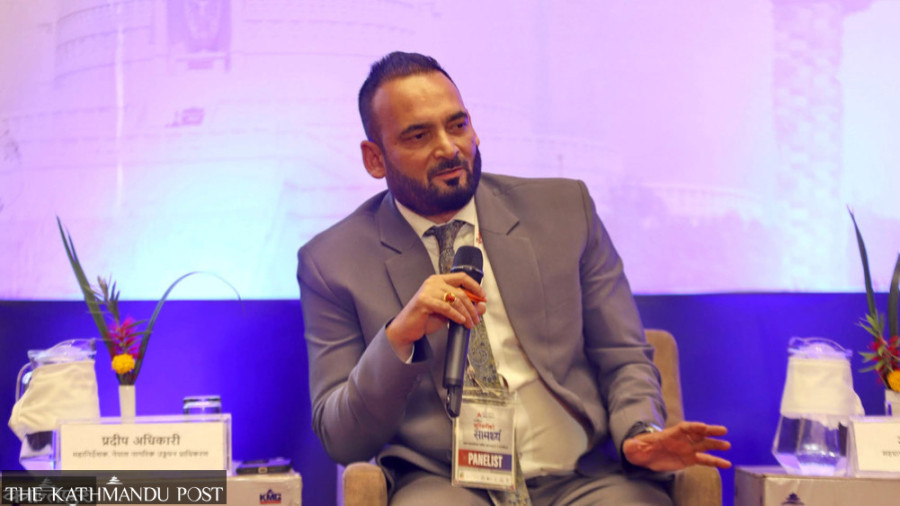
bookmark![]()
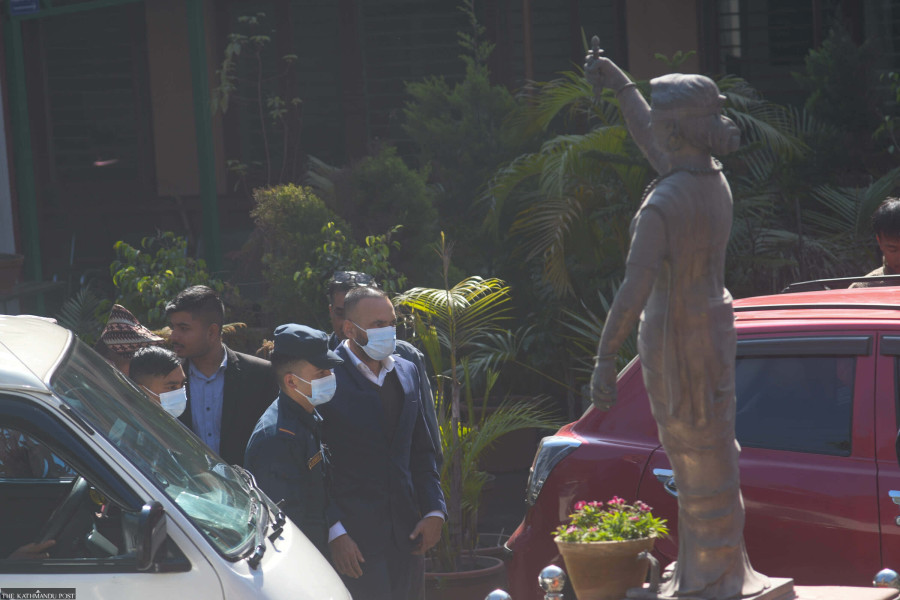
Pradeep Adhikari (right) being presented to the Special Court in Kathmandu to record his statement earlier this month. Post file photo
Sangam Prasain
Published at : December 21, 2025
Updated at : December 21, 2025 06:38
Kathmandu
Does anyone voluntarily demote themselves? In a bureaucracy built on hierarchy, power, and survival, such an act is almost unheard of. Yet a few months ago, something extraordinary unfolded inside the boardroom of the Civil Aviation Authority of Nepal (CAAN).
Pradeep Adhikari, then director general of the powerful aviation regulator, himself forwarded an agenda, proposing his own demotion—from director general to deputy director general.
The proposal stunned those present. Adhikari had been appointed director general in February 2022 for a four-year term, picked directly from the 11th to serve in the 13th level.
Now, as his tenure was nearing its end, he formally asked the board to downgrade his own position. This was widely seen as a calculated manoeuvre—an attempt to reset the process by reverting to the 11th level and then securing promotion to the 12th level, which would have allowed him to reappoint himself to the top post again.
The agenda was quietly put on hold, as board members grasped what was unfolding.
A board member present at the meeting told the Post that Tourism Joint Secretary Indu Ghimire strongly objected, saying that such an act amounted to the height of unprofessionalism.
That gambit failed.
Two weeks ago, the noose finally tightened around one of the most powerful officials Nepal’s aviation sector has ever produced.
The Commission for Investigation of Abuse of Authority (CIAA), the constitutional anti-graft body, arrested Adhikari, accusing him of financial irregularities related to the construction of a heliport in Nalinchok, Bhaktapur.
A few days later, the constitutional anti-graft agency also filed another case against him on the irregularities in the construction of the $215.96 million international airport in Pokhara and stated that multiple other cases of financial irregularities, in which Adhikari is allegedly the kingpin, are still under investigation.
The corruption case related to the Chinese-funded Pokhara International Airport is Nepal’s largest in terms of the amount of money involved in construction under the public procurement process.
The political nexus of Adhikari—who once headed three multi-million-dollar national pride projects, including Pokhara airport project—reflects the extent of the power he amassed in a relatively short time.
The KP Sharma Oli Cabinet in 2018 had extended him the privilege.
Adhikari entered the Civil Aviation Authority of Nepal on January 8, 2008 in the engineering department as a seventh-level officer. Four years later, on January 12, 2012, he was promoted to the eighth level, followed by the ninth level on May 18, 2016. Subsequently, he reached the 11th level on February 22, 2017 through open competition.
On February 3, 2022, he was appointed to lead the country’s civil aviation body, for the first time breaking the hierarchy by bypassing six deputy director generals—a move that itself sparked controversy.
At least three of his colleagues, who spoke to the Post on condition of anonymity, describe his career trajectory as a textbook example of everything that is wrong with Nepal’s public enterprises and bureaucracy: nepotism, brokerage politics, policy corruption, and an arrogance fuelled by proximity to power and money.
Once appointed director general, Adhikari wasted no time asserting his dominance.
In June 2022, he ordered a Buddha Air captain grounded for failing to greet him with a “namaskar” at Kathmandu’s domestic terminal. “He was a character,” one colleague recalled. “He had great political backing. His performance, however, was almost zero.”
Under his leadership, Nepal failed to operationalise two newly built international airports. Talks with India to open new air entry routes went nowhere. Relations with international and domestic airlines deteriorated.
Professional integrity within the regulator collapsed.
Nepal’s aviation safety record during his tenure tells a grim story.
Over four years, the country witnessed eight plane crashes, five of them fatal, killing more than 100 people. All occurred while Adhikari was at the helm.
Officials say to save his chair, he made several presentations to former prime ministers, assuring them he would get Nepal off the European Commission’s safety blacklist, but he failed every time.
One official familiar with the matter said, “He even went so far as to try to counter the European Union by scrapping all bilateral support to Nepal’s civil aviation system—simply because Nepal was asked to improve its air safety, given the large number of foreign travelers flying here.”
A highly controversial episode under his watch took place in January 2025, when the Civil Aviation Authority of Nepal decided to impose a ban on the import of Airbus helicopters, citing safety concerns and a lack of technical assistance from the European aerospace corporation.
The news was “orchestrated” by Adhikari.
Gyanendra Bhul, the authority’s information officer, on Adhikari’s behalf, swiftly circulated the information to the media. The announcement triggered controversy, and then tourism minister Badri Prasad Pandey instantly called the director general.
Adhikari’s response in the same meeting—where Bhul was also present—was that “no such circular has been issued and no decision has been made to that effect.”
Later tourism secretary Binod Prakash Singh summoned him at the ministry and asked for clarification. Singh even scolded him, saying that “not even a leaf stirs in your organisation without your permission,” and warned him not to lie.
When the ministry demanded written clarification, CAAN simply ignored the request. “It was a naked display of power,” a ministry official said.
“After the request was made again, a one line clarification came — “No such decision has been made”.
Adhikari also sought to shape media coverage.
In past years, the Post received multiple complaints from top airline executives who said Adhikari would contact or text them saying, “I am sending a reporter” and “please give him the interview in my favour”—meaning to speak against the proposed split of the civil aviation body.
He also made multiple phone calls to the Post’s current and former editors, urging them not to publish news about Nepal’s civil aviation body or the individuals the Post quoted.
Several employees of the civil aviation authority filed complaints with the Prime Minister’s Office and anti-graft agencies, alleging corruption, suspicious accumulation of wealth, misuse of office, arbitrary transfers, and administrative abuse under his leadership. A dedicated biometric attendance system was installed in his office, but he never used it to mark his attendance.
He remained unfazed.
On one occasion, he publicly said on a social media platform that members of Parliament were “donkeys.”
At a public event in Pokhara, while delivering a speech, he even claimed that he was the “state” and that his decisions were final.
“Political actors produce officials like Adhikari,” says Khem Raj Regmi, a retired government secretary and former president of Transparency International Nepal. “Politicians plant them, groom them, exploit them, and eventually discard them.”
“People like Adhikari are products of a corrupt system. They act as intermediaries for politicians who have been looting the country for decades,” Regmi says.
Corruption in Nepal manifests in various forms, including bribery, commissions, favouritism, nepotism, embezzlement, and diversion of resources.
The most pervasive form is policy corruption, where laws, regulations, and Cabinet decisions are deliberately shaped to serve political, bureaucratic, and corporate interests rather than the public good.
Nepal ranks 107th in the 2024 Corruption Perceptions Index and continues to struggle with systemic manipulation of policy loopholes.
The construction of Pokhara airport under Chinese funding is a textbook example of such manipulation.
Perhaps the most dangerous plan attributed to him emerged in 2023.
Adhikari attempted to push for an Airbus A320 to fly under visual flight rules from Kathmandu to Pokhara—a risky manoeuvre unsuitable for large jets. He planned to carry the President, the prime minister and other VVIPs on what was essentially a test flight during Pokhara airport’s inauguration.
Himalaya Airlines refused at the last moment. Aviation experts say had the flight happened, it would have been “criminal negligence”.
The regulator had earlier flown journalists and officials on a test flight in a Nepal Airlines plane during Bhairahawa airport’s opening in May 2022. When controversy erupted, the regulator defended the flight as a so-called “demo flight”.
Fear of retaliation kept many silent.
“Pokhara airport is a case study of how corruption kills,” says advocate Amrit Kharel, who filed cases on the regulator and the operator after the Yeti Airlines crash that killed 72 people. “When unqualified people run safety-critical institutions, people die.”
The regulator’s negligence became glaringly evident in the Saurya Airlines crash at Kathmandu Airport, exposing the absence of any effective oversight in Nepal’s civil aviation sector.
“Yes, in Nepal, politics runs such projects, and it is a successful business,” says Regmi. “Politicians become rich, live luxurious lives, and no one dares complain.”
Inside CAAN, fear prevailed. Staff say Adhikari neutralised threats either by offering promotions or by transferring dissenters. Trade unions were his first target upon assuming office. “No one dares speak against him,” employees said. “If you do, you’re transferred overnight.”
A few days before he was arrested, he dispersed his core team.
Adhikari is only the pawn, though.
Madhav Kumar Nepal, then chair of the CPN (Unified Socialist), had once emerged as a rare political voice advocating for the separation of the Civil Aviation Authority of Nepal’s dual role as both regulator and service provider—an international best practice repeatedly demanded by the European Commission. Yet he too would soon change his tunes.
In October 2021, Nepal sent Prem Ale to head the Ministry of Culture, Tourism and Civil Aviation. Ale’s mandate, at least on paper, was to move forward with long-pending reforms, including tabling bills to split the civil aviation authority into two separate entities.
But Ale did the opposite.
He stopped the bills—already passed by the National Assembly in August 2021—from being tabled in the House of Representatives.
“Yes, I did it. I withdrew the bills,” Ale later told the Post. “I acted on behalf of Madhav Kumar Nepal. Nepal called Agni Prasad Sapkota, the then Speaker of the House of Representatives, in front of me and instructed him to stop the civil aviation bills from being discussed in Parliament.”
What followed was an unprecedented surge in infrastructure spending but investment in air safety was below par. Between 2015 and 2025, more than Rs100 billion was poured into civil aviation infrastructure, even as safety oversight remained weak and plane crashes continued with alarming regularity.
He was also overseeing several multi-billion-rupee projects, including plans to develop a double-runway airport in Dang, build a large terminal at Bhairahawa airport, and construct new domestic airports. And politicians were happy with his aggressive infrastructure drive which however lacked proper planning.
Even behind the decision to stop parliamentary discussions on the civil aviation bill, multiple officials say, was Pradeep Adhikari.
The separation of the civil aviation authority would have diluted the immense power concentrated in the director general. At the time, the authority’s annual budget was nearing Rs50 billion, making the position one of the most lucrative and influential in Nepal’s bureaucracy.
Apart from haphazardly building airports and runways—many of which remain underutilised or abandoned—Adhikari also launched a sweeping campaign to renovate domestic airports, backed by massive budget allocations.
“To stay in power, he promises benefits to all political leaders,” Ale says.
Ale initially backed Adhikari, but the alliance did not last.
In a rare moment of public contrition, Ale later admitted in Parliament that appointing Adhikari was a political mistake. “It was our party’s decision to pick an unqualified person for the post,” he told lawmakers. “I regret that.”
Ale also claimed on multiple social media platforms that corruption at Pokhara International Airport was merely “the casting,” while the “entire film” was the Gautam Buddha International Airport project—particularly the land acquisition part.
The relationship between Ale and Adhikari finally soured after Adhikari allegedly committed the minister to upgrading Dhangadhi airport into an international airport and securing budget allocations for the project without due process.
Under the plan, around Rs1 billion was allocated to acquire 40 bighas of land for expansion, even though the project would require more than 200 bighas.
“It is beyond belief that a minister would lobby for the aviation authority’s budget to build yet another international airport,” then finance secretary Rameshore Khanal, now finance minister, told the Post in December 2021. “Half the fiscal year had already passed, yet the budget remained blocked. This is against all principles of good governance.”
Khanal questioned the very rationale of the project. “Upgrading Dhangadhi airport into an international airport is not part of the government’s stated policy. Who will be accountable for the delayed expenditure and policy deviation?”
Political instability compounded the rot.
Over 15 years, there were 16 tourism ministers. Meanwhile, KP Sharma Oli, Pushpa Kamal Dahal, and Sher Bahadur Deuba were busy breaking records as prime ministers, in what was a game of musical chairs. Adhikari skillfully maintained good relations with all three and wielded enough influence to install ministers of his choosing.
After Ale, Jeevan Ram Shrestha briefly took charge of the tourism ministry, declaring on his first day that he was “not interested” in waiting for the European Commission’s demands to separate the aviation regulator.
That stance changed again when Sudan Kirati was appointed minister by the then Maoist Centre. Kirati revived the civil aviation bills and formally accused Adhikari of persistent failure to ensure aviation safety amid repeated accidents under his watch.
Kirati recalls repeatedly seeking explanations from Adhikari, only to be ignored. When tensions peaked, then prime minister Pushpa Kamal Dahal summoned the minister.
“I went to Dahal’s residence, but Adhikari was already seated in the prime minister’s chamber,” Kirati, who recently quit the Maoist Centre to join a new party, told the Post.
“The prime minister told Adhikari to submit the clarification and to honour the minister’s post. And I was instructed to never make his clarification public. I was told to work in tandem with Adhikari.”
“That’s how governance works,” Kirati says. “Bhagbanda—power sharing—produces people like Adhikari.”
The issue reached Parliament’s International Relations and Tourism Committee, which directed then prime minister Pushpa Kamal Dahal to table the bills immediately.
But months later, the committee’s chairman Raj Kishore Yadav quietly reversed the course, saying the split was “not necessary.”
Behind the scenes, aviation policy was manipulated to preserve CAAN’s enormous budget and authority. Bills to split the regulator were stalled. Former minister Prem Ale admitted to personally withdrawing the legislation at the behest of party leaders. The director general’s post, overseeing a budget of nearly Rs50 billion annually, was simply too lucrative.
Every time the government changed, so did the minister, creating a potential headache for Adhikari, who had to constantly court new leaders to maintain his influence.
Minister Badri Prasad Pandey, however, took a different approach even as outrage over Adhikari’s performance mounted in Parliament. Lawmakers were demanding the resignation of both Pandey and Adhikari for persistently failing to make Nepali skies safer.
“There was pressure from all sides. But even if I had sacked him, he would have returned with a court stay order,” Pandey told the Post. “That’s why I decided not to dismiss him, despite his poor performance, and instead focus on getting him to work.”
“There are no performance contract provisions in CAAN for the director general,” Pandey says.
For many within the system, the reversal only reinforced one conclusion: Adhikari’s real strength lay not in competence, but in his ability to align with whoever held power at any given time.
Adhikari’s reign saw erratic regulatory decisions—night flight mandates rolled back within days, weather-based flight bans reversed under pressure, airlines grounded to promote empty airports, foreign carriers threatened for refusing to operate unviable routes.
In Bhaktapur, a heliport was forced into operation despite safety concerns, with companies coerced through punitive measures.
Human rights violations followed.
A writ petition filed at Patan High Court links Adhikari’s ad-hoc flight ban to the death of a six-month-old child in Humla. Only after public outrage and intervention by the National Human Rights Commission did the authority reverse its decision.
International watchdogs repeatedly questioned Nepal’s aviation oversight. More than 100 lives lost in crashes in just a short period of time under his tenure, underscoring systemic failure.
Even then, Adhikari was shielded—until now.
His arrest does not mark the end of the story. Those who understand the system insist he is merely one visible pawn in a deeply entrenched network.
But amid the decay, there are signs of change.
Public anger, Gen Z activism, and renewed scrutiny have begun to shift the landscape. Whether that momentum will dismantle the structures that created—and protected—figures like Pradeep Adhikari will be the country’s defining test.
“Don’t be surprised,” Regmi says. “In Nepal, corruption happens through consensus. It is open. Who comes to rule is really irrelevant.”
Sangam Prasain
Sangam Prasain is Business Editor at The Kathmandu Post, covering tourism, agriculture, mountaineering, aviation, infrastructure and other economic affairs. He joined The Kathmandu Post in October 2009.


Most Read from Money
Nepal travel agents threaten to stop selling Thailand trips over visa rules

Why does an hour long flight to Dhangadhi cost more than a flight to New Delhi?
Malaysia rejects Nepal’s demand to open recruitment to all manpower agencies

No school, but a graduation cap for women dairy farmers
Nepal arrests four medical service providers as Malaysia recruitment row deepens
Editor's Picks




E-PAPER | October 22, 2026

×