



 14.81°C Kathmandu
Sat, Oct 24, 2026
Money
Nepal Rastra Bank’s gold assets surge 71 percent in a year as bullion prices soar
Skyrocketing gold prices have sharply boosted the central bank’s gold valuation despite unchanged reserves,prompting the bank to consider further investment in paper gold amid global central bank buying.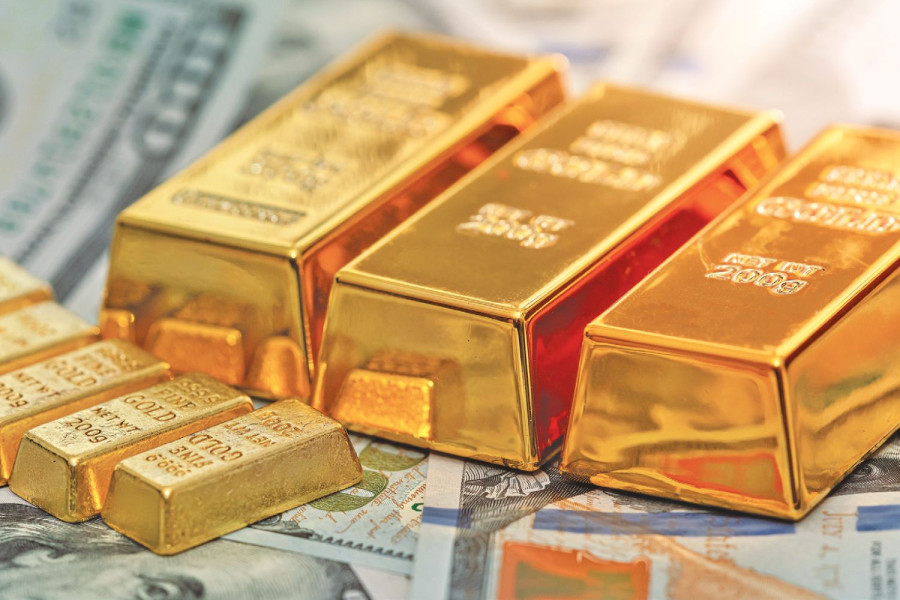
bookmark
Krishana Prasain
Published at : December 20, 2025
Updated at : December 20, 2025 07:23
Kathmandu
With gold prices climbing almost every day, the value of Nepal Rastra Bank’s gold holdings has jumped by a massive 71.25 percent within a year, even though the quantity of gold in its vaults remains unchanged.
According to the central bank’s monthly balance sheet, Nepal Rastra Bank held gold deposits worth Rs210 billion as of mid-November, up from Rs122.79 billion in the same period last fiscal year. The sharp rise reflects price appreciation rather than an increase in physical reserves.
Nepal’s gold reserves stood at 7.99 tonnes in the second quarter of 2024, unchanged from the first quarter, according to reports. Gold reserves in the country averaged 4.38 tonnes between 2000 and 2024, reaching an all-time high of 7.99 tonnes in recent years.
The central bank invests in bullion through three channels: gold certificates, physical gold and silver assets, and trading inventories of gold and silver managed by its Mint Division.
Investment in gold certificates—paper instruments that represent ownership of physical gold stored in vaults—stood at Rs152.97 billion during the review period, up from Rs87.31 billion a year earlier. These certificates allow the bank to benefit from rising gold prices without holding additional physical bullion.
Similarly, the value of physical gold and silver assets rose to Rs55.41 billion from Rs34.02 billion over the same period, while inventories used for minting and selling coins increased to Rs1.90 billion from Rs1.45 billion last year.
Officials at Nepal Rastra Bank say the increase in bullion holdings is primarily the result of soaring prices rather than any change in quantity.
“Looking at the global trend of central banks increasing their gold holdings and prices hitting record highs, we have also reached a point where we need to increase our gold and silver investment,” said Guru Prasad Paudel, spokesperson for Nepal Rastra Bank. “However, the quantity has not been decided yet.”
Paudel said the central bank is inclined to increase exposure through paper gold rather than expanding physical holdings. “We are thinking of additional investment in gold certificates instead of physical gold,” he said.
In the domestic market, gold prices have surged by Rs109,400 per tola (11.6 grams) over the past year. On Friday, gold traded at Rs258,400 a tola, reflecting strong safe-haven demand driven by geopolitical tensions and economic uncertainty.
Gold traditionally attracts investors during periods of political instability, military conflict, and financial stress, as risk-averse sentiment weakens equities and boosts demand for assets perceived as reliable stores of value.
Globally, central banks are accumulating gold at a record pace. According to the Central Bank Gold Reserves Survey 2025 published by the World Gold Council in June, central banks have added more than 1,000 tonnes of gold in each of the past three years—more than double the annual average of 400 to 500 tonnes seen over the previous decade.
The survey found that 95 percent of respondent central banks expect global gold reserves to increase over the next 12 months. Gold’s performance during crises, its role in portfolio diversification, and its effectiveness as an inflation hedge were cited as key drivers behind continued accumulation.
The World Gold Council noted that gold’s unique characteristics—as a store of value, a crisis hedge, and a strategic reserve asset—continue to make it attractive for central banks amid geopolitical and economic uncertainty.
Rising global demand has also been reflected in Nepal’s import data. Gold imports in the first four months of the current fiscal year surged more than fivefold compared to the same period last year. Between mid-July and mid-November, Nepal imported 935 kg of gold worth Rs16.23 billion, according to the Department of Customs. Silver imports during the same period jumped 537.48 percent.
In response to the surge in demand, the central bank increased the daily gold import quota in October to 25 kg from 20 kg.
Globally, the United States continues to hold the world’s largest gold reserves at 8,133.46 tonnes, accounting for more than 80 percent of its total reserves, according to the World Gold Council. China holds 2,303.51 tonnes, while India’s gold reserves stand at 880.18 tonnes.
Krishana Prasain
Krishana Prasain is a business reporter for The Kathmandu Post covering markets. Before joining The Kathmandu Post in 2018, she spent 3 years in New Business Age magazine covering business.




Most Read from Money

Why does an hour long flight to Dhangadhi cost more than a flight to New Delhi?

Nepal travel agents threaten to stop selling Thailand trips over visa rules

Malaysia rejects Nepal’s demand to open recruitment to all manpower agencies

No school, but a graduation cap for women dairy farmers
Nepal arrests four medical service providers as Malaysia recruitment row deepens
Editor's Picks




E-PAPER | October 24, 2026

×