SIA project springs back to life after Turkish jet mishap
The Ministry of Culture, Tourism and Civil Aviation has asked the Cabinet for permission to demarcate the boundary of the long-planned second international airport (SIA) in Nijgadh
The Ministry of Culture, Tourism and Civil Aviation has asked the Cabinet for permission to demarcate the boundary of the long-planned second international airport (SIA) in Nijgadh, Bara in a move to speed up the project.
It has proposed to delineate an area of 80 sq km for the modern airport which is expected to have two runways.
Ministry officials said that the Cabinet would also declare the name of the proposed airport and publish it in the Nepal Gazette.
“The construction work at the airport site has formally begun. Once the Cabinet gives the go-ahead, the modality, financing and other technical aspects will be discussed,” said Buddhi Sagar Lamichhane, joint secretary at the ministry.
On Monday, the National Planning Commission briefed representatives from the Tourism Ministry, Investment Board Nepal and Finance Ministry and other stakeholders on the current status of the proposed project.
“We have decided to conduct an extensive discussion next week,” said Lamichhane, adding that the next meeting would also propose to form a high-level committee to expedite the project.
The SIA scheme envisions building a modern airport in the southern plains 175 km from Kathmandu as an alternative to congestion and winter fog at Tribhuvan International Airport (TIA), the country’s sole aerial gateway.
The planned airport at Nijgadh is also being publicized as a successful example of decentralization.
A budget of Rs 500 million has been earmarked for this fiscal year to carry out initial preparations for the multi-million dollar project. More than 90 percent of the land proposed to be taken over for the project is forest land. Likewise, there are an estimated 1,450 squatters, including landless squatters, occupying the project site.
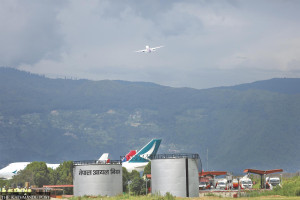
The proposed airport reappeared on the government’s radar after Wednesday’s incident at TIA when a Turkish Airlines Airbus landed without its nose landing gear deployed and veered off the runway onto the grassy shoulder.
The airport was paralysed for four days as technicians worked frantically to lift the jet’s nose off the grass and tow it away to clear the runway. Thousands of travellers were stranded exposing the vulnerability of Nepal’s aviation sector with only one international airport.
Meanwhile, a number of rounds of meetings have been conducted on the SIA project’s modality and financial viability. A detailed and design feasibility study conducted by Korea’s Landmark Worldwide (LMW) in April 2012 has shown that the SIA would be financial viable if Kathmandu’s airport is transformed into a domestic airport.
Discussions have been held to combine the SIA and TIA in a single package. If the two airports are awarded to a single investor, it will be the investor’s responsibility to distribute air traffic between the two to make both of them financially viable, government officials said.
The report has shown that the internal rate of return (IRR) of the airport will be 1.4 percent which is unviable for a multi-million dollar project. The estimated cost for the first phase, according to the feasibility study, is $650 million.
If the government were to provide a 100 percent tax exemption, revise the per passenger revenue to $40 and make the SIA an exclusive international airport, the IRR would increase to 16 percent making the project viable, the study report shows. The airport had been proposed to be developed under the build own operate and transfer (BOOT) model.
On March 8, 2010, the government had awarded the contract to carry out a detailed feasibility study to LMW. The company has spent $3.55 million on the detailed and design feasibility study.
As per Landmark’s feasibility study, the proposed airport would be able to handle 15 million passengers annually and even accommodate the super jumbo Airbus 380 after the first phase of construction.
In the second phase, the airport would be expanded to accommodate 30 million passengers annually. By the end of the third phase of construction, the airport would have a parallel runway enabling it to handle 60 million passengers annually.
The airport would have a three-storied terminal building with the latest systems and highly intelligent security equipment. The study has stated that a Kathmandu-Tarai fast track highway should be completed at least six months before the airport goes into commercial operation.
The project had been assigned to Investment Board Nepal with instructions to fast-track it under a single window.
Sangam Prasain is Business Editor at The Kathmandu Post, covering tourism, agriculture, mountaineering, aviation, infrastructure and other economic affairs. He joined The Kathmandu Post in October 2009.




 20.12°C Kathmandu