The burden of coping with the fuel hike will largely fall on the middle and lower-middle classes
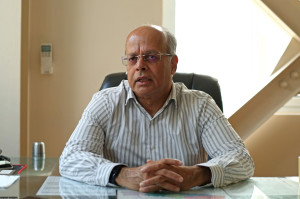
When you consider that nearly 25 percent of our GDP is under direct threat from sectoral disruptions, the scale of the crisis becomes clear.Gunakar Bhatta, economist Post Photo: Deepak KC
As the fires of conflict in the Middle East continue to rage, the tremors are being felt far beyond the immediate geography of the Levant and the Persian Gulf. For Nepal, a nation inextricably tied to the global energy market and dependent on the labour corridors of the West Asian region, the economic stakes have seldom been higher.
The Post’s Biken K Dawadi sat down with former Executive Director of the Nepal Rastra Bank, economist Gunakar Bhatta, to explore the effects of the conflict on the national economy, dissect the intricate web of fuel volatility, inflationary pressures, and the structural shifts required to safeguard the Nepali economy. Excerpts.
How does this specific regional turbulence mechanistically drive the surge in global fuel prices, and in what ways is the Nepali state beginning to manifest these external shocks domestically?
The relationship between fuel prices and the broader economy is characterised by a complex array of indicators that are both directly and indirectly interconnected. When we observe a spike in fuel prices, the most immediate and visceral impact is witnessed in inflation. This singular rise in the cost of a commodity has a cascading effect. Primarily, the surge in fuel costs directly inflates transportation expenses. Once the cost of moving goods increases, a multiplier effect is triggered across multiple sectors, most notably impacting the wholesale and retail markets, and eventually permeating the entire food supply chain.
In the context of Nepal, the transmission of these price increases is particularly severe because fuel acts as a foundational input for our three primary economic pillars: agriculture, industry and the service sector. Currently, the crisis in West Asia is threatening the very backbone of our economy—the agricultural sector—which engages approximately 62 percent of our population and contributes nearly 25 percent to our Gross Domestic Product (GDP). The volatility leads to a two-pronged crisis: The unavailability of fertilisers due to supply chain obstructions and the prohibitive costs of those fertilisers when they are available. This uncertainty regarding timely supply, coupled with high prices, creates a precarious environment for our agrarian base.
You mentioned the industrial and service sectors as well. Given that our industrial growth has historically been sluggish, how does this energy crisis further complicate the path towards a robust manufacturing base?
The industrial sector faces a daunting challenge characterised by the acute shortage of raw materials, which significantly hinders production. If we look back 30 years, the industrial sector’s contribution to our GDP was approximately 22 percent; today, that figure has dwindled to a mere 12 percent. This fuel price hike is set to adversely affect this already struggling sector even further.
Simultaneously, the service sector, specifically tourism, is poised for a significant downturn. We rely heavily on tourists from the Middle East, Europe and the Americas, as well as our immediate neighbour, India. However, with global agencies like Moody’s slashing India’s growth projections to around 6 percent, the pool of potential tourists from our primary market is also likely to shrink. When you consider that wholesale and retail contribute 14 percent to our GDP, transportation 7 percent, and the hotel and restaurant industry about 2 percent, it becomes clear that nearly 25 percent of our GDP is under direct threat from these sectoral disruptions.
For the layperson trying to grasp the magnitude of this crisis, how do international projections regarding ‘dollars per barrel’ translate into the inflation they see at the marketplace?
To understand this, we must look at the projections provided by international financial institutions. The Asian Development Bank (ADB) has suggested a scenario where, if fuel prices reach approximately $155 per barrel in the second quarter of 2026, it could lead to a 3.2 percentage point increase in inflation. To put that in perspective, if our current inflation is hovering around 3.6 percent, an international price of $150 to $155 per barrel could push our domestic inflation toward the 6 percent mark.
Furthermore, research by the International Monetary Fund (IMF) indicates that for every 10 percent increase in petroleum products per barrel, inflation rises by approximately 0.4 percentage points. Given our government’s target to keep inflation within a 5 percent ceiling this year, there is a very real risk that we will exceed this limit on a point-to-point basis, even if the annual average remains somewhat stable. This is a significant risk that the public must be prepared for, as it is largely driven by factors beyond our domestic control.
This sense of external inevitability can be disheartening. How should the government and the citizenry prepare for a shock that is essentially beyond their control? Are there immediate, tactical measures that can mitigate the severity for the most vulnerable?
Because this shock is international and beyond our control, we must adopt a multi-pronged approach. First, we must focus on consumption reduction. The government’s recent decision to implement a two-day public holiday per week to curb fuel use is a step in the right direction for economising resources, regardless of its debated impact on productivity.
At the individual and household levels, we need to aggressively substitute Liquefied Petroleum Gas (LPG) with electric stoves and other renewable alternatives. We should also see a shift towards mass transportation and vehicle pooling in urban centres. Promoting electric vehicles (EVs) for both private and public transport, such as the initiatives seen with Sajha Yatayat, is crucial.
However, we must be honest about our fiscal space. The government’s revenue growth is currently stagnant at around 4 percent, meaning the state does not have the luxury of providing widespread subsidies or grants. The burden of coping will largely fall on the individuals and institutions, particularly the middle and lower-middle classes, who are disproportionately affected. In the medium term, we must revisit the lessons of the 2015 economic blockade, where we first truly felt the sting of energy dependence. Our absolute priority moving forward must be food and energy security.
You speak of long-term priorities, yet we continue to see high import bills for basic goods. How do we reconcile our theoretical potential in energy with the reality of our current dependence?
It is staggering that in just eight months, we have imported Rs28 billion worth of rice, alongside massive amounts of fruits and vegetables. These are items we can, to a large extent, substitute through internal production if we promote domestic agriculture. Regarding energy, even though we have 4,000 megawatts of production, we remain dependent on Indian electricity during the dry season. We must mitigate this reliance as a matter of national priority.
Another avenue for resilience is digitalisation. We saw during the Covid-19 pandemic how the banking industry underwent a sea change as people transitioned to digital banking. We should leverage this current crisis to further digitise government service delivery and university education to reduce the need for physical commuting and fuel consumption. By encouraging people to access services digitally within our existing infrastructure, we can create a permanent behavioural shift that benefits the economy in the long run.
Some analysts suggest the current crisis is less about global supply and more about domestic panic—specifically, demand-side hoarding. Is the difficulty in finding cooking gas today a result of international obstructions or a failure in domestic surveillance against artificial shortages?
It appears to be a combination of both. Initially, there were reports of hoarding creating an artificial shortage, though precise estimates are difficult to pin down. However, we have now transitioned into a genuine supply-side problem. When the international source is obstructed, the message filters down to the common man, who responds with natural anxiety.
This is where the state’s regulatory bodies must step up. We need increased surveillance to prevent artificial shortages and provide a disincentive for those seeking to profit from the crisis. While this crisis is a hardship, it is also an opportunity for the government and the organised private sector to reimagine and reform consumer habits while building the medium-term infrastructure necessary to withstand future shocks.
Regarding that infrastructure, it has been a year since significant natural gas reserves were identified in Dailekh. While this might not produce petrol, it could yield CNG and LNG. Is it high time we pivoted our industrial policy to aggressively exploit these internal resources?
You raise a vital point. Since the 2008 financial crisis, and especially post-Covid, the world has entered an era of protectionism. In this context, we are seeing a global revival and reorientation of industrial policy. For Nepal, industrial policy should not mean the government running shoe or sugar factories; the private sector is already there.
Instead, the government and private sector should collaborate on Clean Energy production and the development of the entire supply chain, including battery manufacturing and the extraction of our internal mineral and energy reserves. We must rethink our industrial strategy to produce clean energy—be it hydropower, solar, or wind—where we have a distinct competitive advantage. This is the right time to align our governance, social justice and prosperity goals with a high-growth economy driven by increased productivity.
You’ve touched on productivity and the ‘marginal’ gains of education. How does our human capital formation factor into our ability to withstand these recurring global crises?
Productivity is enhanced when we invest in schooling and vocational training that meet the demands of the future. Unfortunately, we are seeing a trend where fewer youngsters are opting for science-based paths. Given that global market volatility and geopolitics are so unpredictable, we can almost guarantee that another crisis will emerge in the next decade.
We must prepare our human capital to be resilient. For a small economy like Nepal, these shocks are incredibly costly, and we cannot afford to bear the brunt without a buffer. By integrating sustainable development with our energy and tourism sectors, we gain the capacity to withstand the shock. We should also look toward international climate financing and the International Energy Agency’s trends, where trillions are being invested in clean energy, to support our transition.
Returning to immediate policy, the government’s move towards a two-day weekend and odd-even vehicle rotation has met with mixed reactions. Are these sustainable measures, or are they merely extraordinary bandages for a deep wound?
We are living in extraordinary times, and such times demand stern, non-ordinary measures. Countries like the Philippines, Thailand and Pakistan have introduced similar restrictions. Given that 20 percent of our imports consist of energy and petroleum products, these measures are both timely and necessary in the short term.
In the long run, however, the two-day holiday could actually become a permanent positive. It is a global standard that can promote domestic tourism and improve the labour-leisure choice for workers, providing psychological benefits and supporting the economy in different ways. Beyond this, we must maintain a minimum three-month fuel stock, similar to the practices in China, Japan and South Korea. We need to activate local governments to promote large-scale commercial farming and utilise Artificial Intelligence to monitor credit usage in the agricultural sector, ensuring that production actually reaches the market.
As a final projection, where do you see the ceiling for fuel prices? Is there a point where the market simply cannot sustain further hikes?
It depends entirely on how long the crisis is prolonged. It is not just an issue for the Middle East; it adversely affects advanced, emerging and developing economies alike. Based on international projections, if the conflict continues, we could see prices reaching $155 per barrel. However, I am cautious about highlighting this figure because it can create unnecessary panic. These prices are determined by market forces and, presently, are being driven almost entirely by the war situation.
In any crisis, the labour sector often suffers in silence. While the prices of goods rise overnight, wages do not. What specific mechanisms can the state employ to ensure the working class isn’t left behind as their ‘real wages’ evaporate?
You are correct; real wages are set to decline, which directly impacts living standards, poverty levels and income inequality. This is a failure of ‘just development’. In an ideal world, the government would provide subsidies or increase social security, but as I mentioned, the Exchequer is under immense pressure, and we are already relying heavily on internal and external borrowing.
Rather than direct cash transfers, which we cannot afford, the government should act as a guarantor for production. We must activate institutions like the Food Management and Trading Company Limited to guarantee the purchase of farmers’ produce and ensure it reaches urban markets. We must induce people towards production through subsidy loans and coordinated efforts between the public and private sectors. We cannot simply distribute money like advanced economies; we must be extremely careful with fiscal and monetary stimulus to avoid further economic instability.
Finally, let’s talk about the human face of this crisis: Our migrant workers. With the Middle East in turmoil, many face layoffs. How does this double-edged sword of declining real wages abroad and job loss impact our remittance-dependent nation?
It is difficult to predict how long this will last, but a prolonged crisis in the Middle East—which usually benefits from high oil prices—is now being offset by damaged infrastructure and a halt in tourism and international transit. This uncertainty will inevitably hit our remittance flows.
We face two major problems: the existing labour stock abroad may lose their jobs and return to Nepal in a state of confusion, and the potential labour stock currently in Nepal will be unable to leave, adding immense pressure to our domestic labour market. If remittance declines, our foreign exchange reserves will face a dual assault: We will receive less foreign currency while having to pay significantly more for the same quantity of petroleum imports.
At the household level, this means education and health will suffer. The government, particularly at the local level, must coordinate with schools to ensure the children of migrant workers aren’t expelled for being unable to pay monthly fees. We need constructive dialogue between all layers of government and the private sector to ensure that the lives of ordinary people do not become unbearably harsh. Coordination is not just a policy choice; it is our only path to ensuring that the most vulnerable can survive this period of global volatility.




 17.49°C Kathmandu