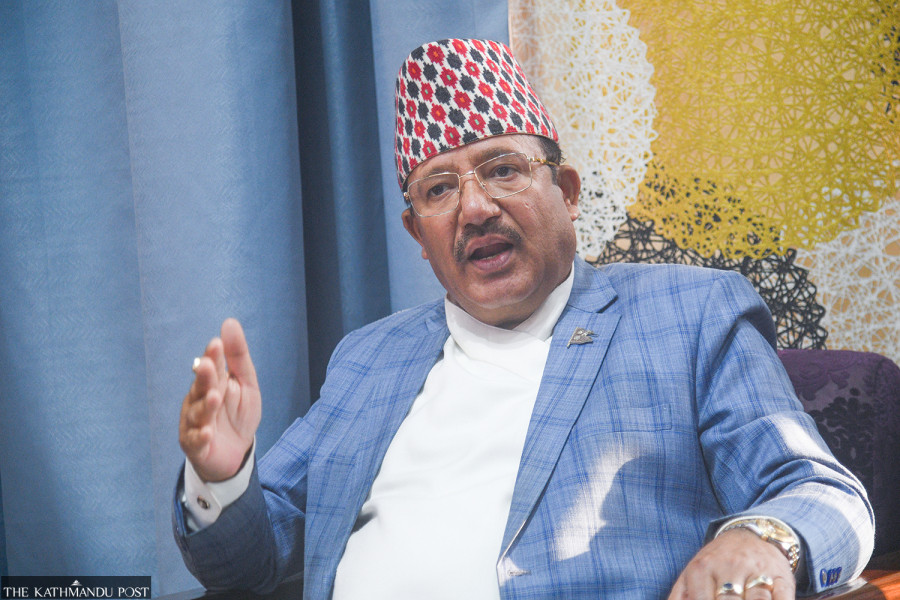
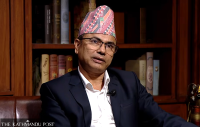
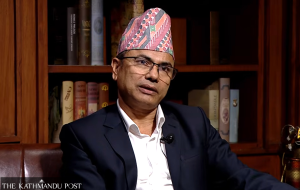
If the Election Commission becomes punitive in order to impose the code of conduct, the situation will not be pleasant for the parties or candidates. Ram Prasad Bhandari, acting chief election commissioner Deepak KC/TKP
There are now 24 days remaining until the snap polls scheduled for March 5 in the aftermath of the Gen Z protests. As Nepal approaches the critical date, the Election Commission remains busy with final-minute preparations for an election that has the potential to flip the political landscape of the country. However, the Commission continues to court controversy. The political parties and candidates have largely ignored the election code of conduct and guidelines of the commission regarding women's representation. There have also been reports of changes in the closed lists of candidates. A big roadblock to the elections also seems to be the weather, as doubts have been raised over the feasibility of holding the election in multiple phases.
The Post’s Biken K Dawadi and Rajesh Mishra sat down for an interview with the acting chief election commissioner Ram Prasad Bhandari. Excerpts.
In what state do you currently find yourself—are you overwhelmed with an influx of work, or in a more relaxed state?
We are continuing with our standard daily operations. Regarding the context of election preparations, that work is largely complete. If you look at the Election Commission (EC) grounds now, the tents have already been pitched, and materials are being dispatched from the centres. We have finalised all preparations for the 14 types of materials distributed from the centre. Our District Election Officers and Provincial Election Officers have already procured 37 types of items locally, which are now stored in their respective warehouses. These items are currently being packaged and dispatched to the storage sites near the polling stations.
Regarding ballots, the printing for the Proportional Representation (PR) system is complete. For the first-past-the-post system, over 8 million ballots have been printed so far, with approximately 11 million remaining to be printed. Once the printing is finalised, we will transport these ballots.
What is the timeline for the delivery of these materials to the districts?
We will have dispatched all election materials to the relevant election offices by February 19. Once the polling officers are appointed, they will take custody of these materials and begin their journey to the designated polling stations and centres. The election staff, security personnel and representatives involved in the electoral process will reach their respective stations early to complete all necessary arrangements so that we are prepared and at ease for March 5.
As of today, tasks have been decentralised and moved to the local levels. The chief election officers, election officers, and polling officers are now in charge. The chief election officers are judges, while the election officers are Under-Secretaries from the legal sector. Manpower management is being handled at the district level, and these officers will be deployed to their respective locations immediately.
Does this imply that the EC is currently in a more relaxed position?
One cannot be truly relaxed until the election is successfully concluded. However, the workload is significantly less now because we have cleared many of the major hurdles and established a rhythm. Therefore, regarding election materials and general preparations, we are on track.
Recently, there has been a sudden resurgence of discussion on whether the election will be held in one phase or two. How does the commission view it?
The EC has never believed in phases from the very beginning. In the context of elections, various questions arise at every critical juncture. These questions remain alive until the election is completed, after which they burst and vanish like water bubbles. The commission has never uttered the words ‘one phase’, ‘two phases’, or ‘three phases’. I have maintained from the start that the election will be held on the scheduled date of March 5, from 7:00 AM to 5:00 PM.
What do you see as the major challenges for the remaining 24 days and the counting period?
I don’t see any major challenges now. Some wondered if the weather in the Himalayan regions would prevent the election. We wrote to the Department of Hydrology and Meteorology, and they provided a report today based on 30 years of analysis. They predict no natural disasters, snow or heavy rain on March 5. The weather will support the election.
Many hoped that out-of-constituency voting would be possible this time around. Why did it not happen?
Once an election date is announced, it is not permissible to change the laws or the technology related to the election. With the dissolution of the House of Representatives (HoR) after the Gen Z protests, we do not even have a functioning legislature at the moment. President Ramchandra Paudel stated that this action was taken to save the constitution. Whether it was the revolution of 1951, the movement of 1990, or the people’s movement of 2006, those movements discarded and tore up the old constitutions. However, even after weathering the Gen Z uprising, the constitution has remained alive; it has not been torn or discarded. We must conduct the election within its boundaries. Therefore, after the election date is declared, election-related acts, rules and laws cannot be amended. Without such amendments, the current law cannot accommodate voters abroad or out-of-constituency voting.
Is this also why the ‘None of the Above’ (NOTA) option could not be implemented?
Yes, the situation is the same for NOTA. Many suggest that we simply need to add one more box to the ballot paper, but adding that box requires constitutional backing. It is not like simply adding a room at an airport; it requires a formal amendment. At this stage, it is not possible.
We have seen a blatant disregard for the election code of conduct by parties and candidates. Recently, former chief election commissioner Bhojraj Pokharel slammed the EC for the lack of political will to book the offenders. Why is no action being taken?
The Code of Conduct is always issued during elections, and parties often find it difficult to follow. When violations occur, the leadership tries to escape responsibility by blaming others. However, we will now have zero tolerance for such violations.
A Central Monitoring Committee has been formed under the coordination of an election commissioner. Below that, there are district-level monitoring committees, as well as committees at the provincial and municipal levels. Furthermore, we have a process for subtle monitoring at various checkpoints. The EC will also appoint various other monitoring officers to ensure compliance.
If a violation is proven, the nomination of the candidate can be cancelled even after the election is completed. As we have been clear about this from the start, I believe parties and leaders are being more cautious this time. The ‘dos’ and ‘don’ts’ are explicitly stated for everyone to read. If the EC is forced to be punitive to ensure compliance, the situation will not be pleasant for the parties or candidates.
Regarding the PR component, were the closed lists illegally changed?
No, that is not the case. If there was a disciplinary action within a party, a breach of their internal order, or if the submitted schedule was not legally sound—meaning there was a legal error—the party has a chance to correct it. However, a change to the submitted list is not permitted under any circumstances.
Recent reports suggest that some areas remain highly sensitive. What strategy is being used to ensure a peaceful, free and fair election?
You must look at it this way: the commission’s job is to conduct the election, while the government’s job is to guarantee peace and security. The EC has independently categorised areas as high-risk, sensitive, or normal. Security agencies have also performed their assessments. We summoned the heads of security agencies here and asked if they could provide security, and they assured us of their capability.
Further, the Nepali people are very resilient. After September 8 and 9, people were frightened, wondering if another plume of smoke would appear in the sky. On October 16, even when the government and other agencies were unable to act, the EC called 40-45 parties for a discussion. We sat for eight hours, which allowed for the venting of pent-up frustrations. After that, the EC and the government initiated multiple efforts to bring stakeholders and civil society together. Each of these efforts has helped build a peaceful climate for elections.
Where did the ultimate assurance for this process come from?
It came from a comprehensive discussion held at the Office of the Prime Minister in Singha Durbar, involving the EC, political parties, civil society leaders and Gen Z representatives. Before that discussion, the atmosphere was murky regarding who would participate in the election. Spending three or four hours in that discussion cleared the atmosphere. Honestly, we had to struggle to create that environment, but we are now in this stable position because of it.
The EC had provided a guideline to the parties to achieve 33 percent women’s representation even in direct election nominations, but it seems this was largely ignored. Are firmer steps needed?
Please understand the nuance here. Often, women leaders within parties do not speak up against it in their parties. Most of the older leaders have a specific mindset. The commission issued directives multiple times asking parties to field at least 33 percent women for direct seats. Instead, the parties fulfil the requirement through the PR and do not field women candidates. The commission’s role is to issue directives; we do not have the authority to invalidate their nominations if parties don’t follow through. It ultimately depends on the role of the top leadership of the political parties to follow these directives.
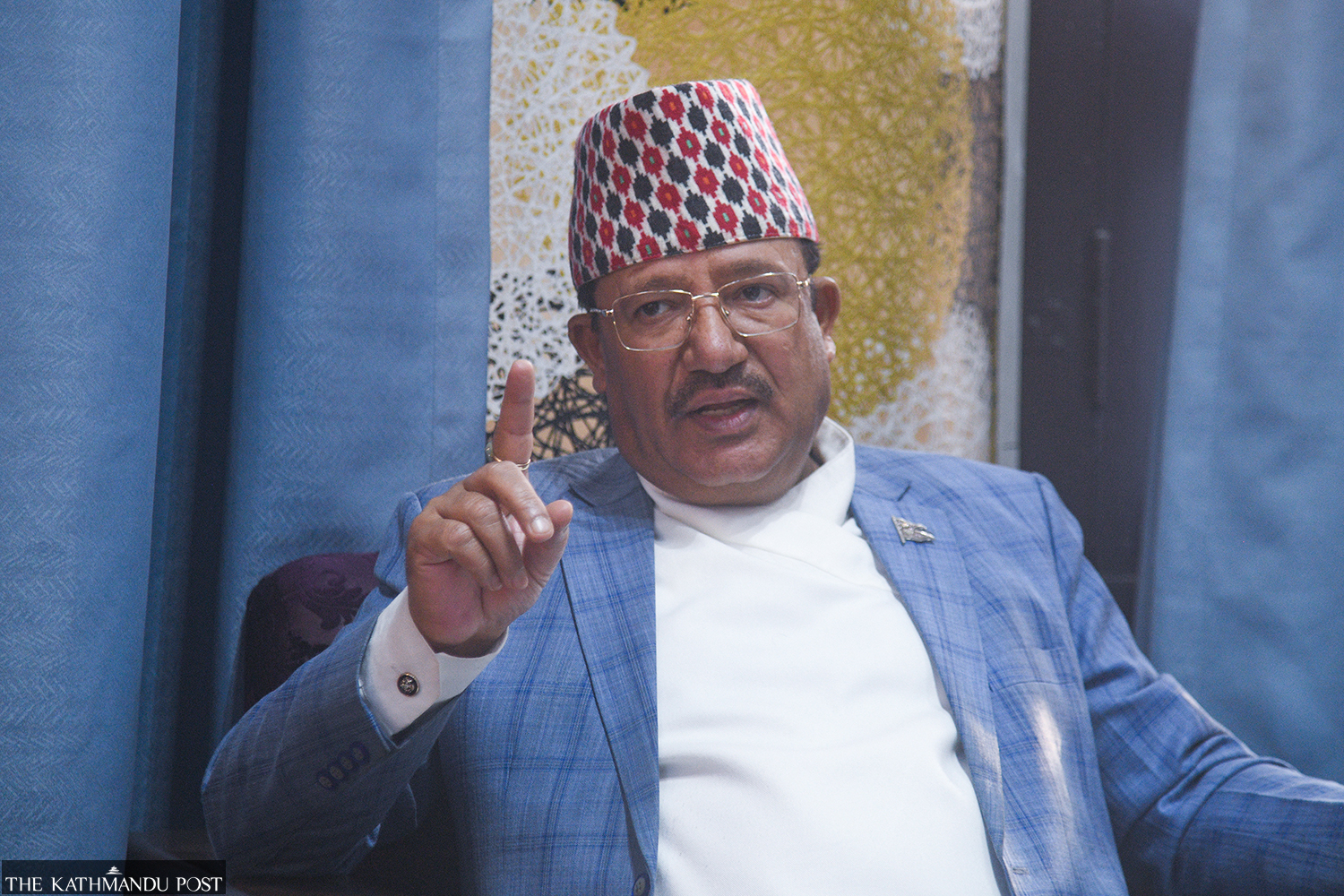
Deepak KC/TKP
This election has seen the emergence of a significant alternative force. How does this differ from a normal election, and does it require different preparations?
The upcoming elections are snap ones, not a periodic one. Everyone, including myself as a referee, is a voter. Previously, even periodic elections didn’t create much enthusiasm, but now nearly 900,000 new voters have been added for the snap election. The commission believes the new generation will be vigilant and ensure a clean, free and fair election.
Will the upcoming elections be the most ‘informed’ election to date?
Absolutely. We forecast that voter turnout will increase, and the percentage of invalid votes will decrease. People are more interested now. Between the EC's efforts and the parties' campaigns, voters have educated themselves at home on how to vote correctly so their ballots aren't invalidated.
Regarding social media usage, there are concerns about buying followers and fake interactions from bots to manipulate voters. How is the commission handling this?
I have repeatedly said that people must distinguish between right and wrong information on social media. If it is wrong, discard it. The EC is alert and has discussed with authorised agencies how to keep the election free from the misuse of social media. We are aware that platforms like TikTok can be misused. We have formed various committees and sub-committees to monitor and control this.
How are foreigners helping with this election?
The entire world is watching. Everyone who cares about Nepal wants to see a successful election, new representatives and the establishment of good governance and peace. The world wants to see Nepal develop peacefully. India has provided over 600 vehicles, and various governments have provided billions in aid, though the specific data sits with the government. Japan's prime minister also expressed readiness to support Nepal's election and governance during our President's recent visit. Even the UNDP provided 8-10 machines and hundreds of computers when we were struggling with where to print voter lists. This allowed us to print everything internally without needing external tenders. While the government coordinates with China, the Election Commission hasn't received direct aid from them yet.
Is there any room for doubt left?
None at all. Even the Prime Minister, after visiting the Janak Education Materials Centre and seeing the mountains of printed ballots, remarked that only the people's stamps are left to be applied.
Let’s change track. Could the EC have played any role in promoting good governance in parties before the Gen Z movement?
After four years of study with stakeholder groups, we were prepared to issue a directive about seven months ago. We wanted every political party to conduct a self-evaluation and submit a report to the EC. This would involve parties assessing their own status, their work, public trust and the performance of their representatives. We wanted them to seek public opinion and maintain their own integrity. However, when we called the parties to discuss this, their response was to ask who the Election Commission was to audit or perform a financial inspection of political parties. If the parties had accepted this self-evaluation and presented their findings to the voters and the Nepali people, the Gen Z movement would never have occurred. We simply asked the parties to identify their own standing, but they refused. Today's situation is a result of that.
Can this election reflect the spirit of the Gen Z movement?
Yes. Elected representatives will capture that spirit and provide good governance. Only elected representatives can establish peace and order by representing the spirit of the GenZ movement. Regarding minor issues, like the police spokesperson mentioning a gap of 1600 four-wheel vehicles, these are small problems that will be addressed during the election.




 14.81°C Kathmandu