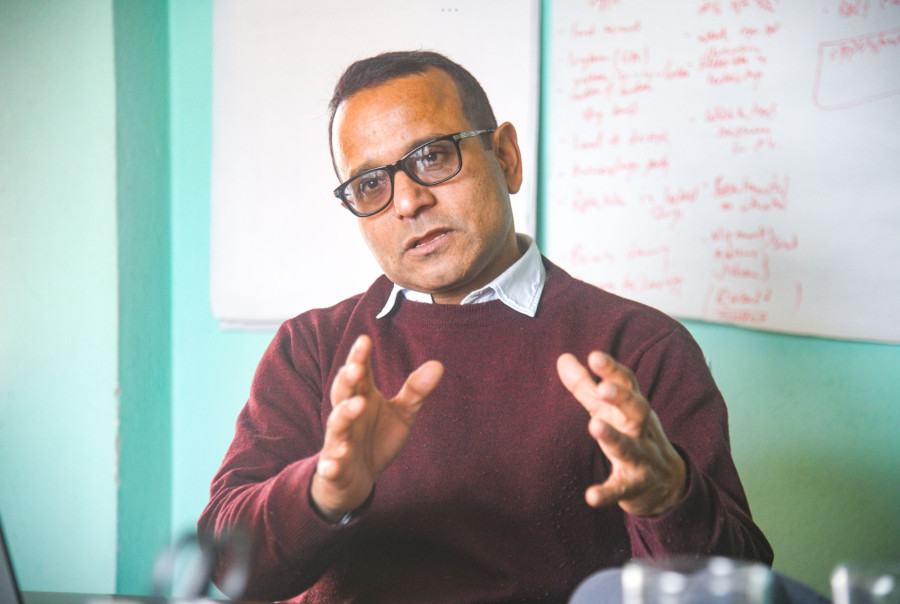
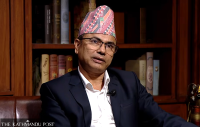
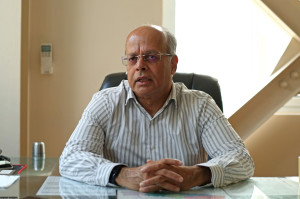
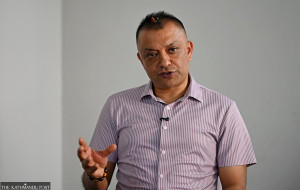
In Nepal, two-thirds of the population is below the age of 35, yet the state and politics were controlled by those above 60. This massive imbalance makes rebellion inevitable. Tula Narayan Shah, Executive Director (NEMAF) Post Photo: Deepak KC
Tula Narayan Shah, Executive Director of the Nepal Madhesh Foundation (NEMAF), is a prominent political analyst known for his deep expertise in Madheshi politics, federalism and inclusion. The Post’s Biken K Dawadi sat down with Shah to break down why the general elections on March 5 represent a ‘fifth shift’ in the country’s modern political history, driven by the Gen Z movement that demands functional governance over structural promises. He argues that while traditional parties scramble for damage control, the electorate has moved toward performance-based politics, leaving those who ignore the spirit of the movement at a significant disadvantage.
As we approach the March 5 elections, there is a palpable sense of political shift in the air. How does the current electoral environment differ from previous electoral cycles?
Context is everything. Context determines the psychology of the voter and the polarisation of society, which ultimately determines the result. If we look at the history of our parliamentary elections, we have seen four distinct phases or contexts before this.
The first was in 1959 after the fall of the Rana regime; it was a struggle between the monarchy and democratic forces, and the Nepali Congress, having led the revolution, secured a two-thirds majority. The second was in 1991, after the restoration of democracy; the Congress and the Leftists, who had jointly ousted the Panchayat, dominated. The third shift came around 2006-2008, when the Maoists disrupted the unitary state through war, and the Madhesh movement rose immediately after. This created a context where the ‘winners’ of those movements—the Maoists and Madheshi forces—gained massive mandates because they were seen as the agents of change. The fourth phase was in 2017, following the promulgation of a new constitution and the Indian blockade. KP Oli emerged as a nationalist leader against the backdrop of the Madhesh protests, and the resulting alliance won big.
Now, we are entering the fifth phase. This is a completely new era set by the Gen Z uprising. In the past, elections followed movements that sought structural changes—moving from monarchy to republic, or unitary to federalism. But this Gen Z movement is different; it isn’t about structural change.
People feel the constitution is fine, but the way the state works is the problem. They are rebelling against corruption, ‘nepo-babies’, and a leadership that has created a syndicate of power. This is about functional problems, and that is why this election is a special, unprecedented event in our history.
The Gen Z movement was largely unorganised and leaderless. How can such a movement translate into a tangible electoral result if it doesn’t have a singular representative party?
While the movement was unorganised, its legacy is being claimed. In Nepal’s context, whoever is seen as the driver of the movement that forced the election tends to benefit most. Even if Gen Z didn’t form a formal party, the public has handed that legacy to Balen Shah.
People don’t see him just as a mayor; they see a ‘star’ who has functioned for three years without being tainted by financial scandals. He established an image of someone who follows the rules and doesn’t fear the powerful. When he tweeted that Gen Z should be ready to talk to the Army Chief or called for the dissolution of Parliament, he was tapping into that rebellious spirit. Intellectuals might analyse his tweets point-by-point, but for the common man, all those dots connect to form a logic: Balen is the carrier of the Gen Z spirit. Because of this, he has become the central figure of this election.
You’ve previously mentioned that the CPN-UML faces significant ‘damage’ in this cycle. Why the UML and not the Congress?
The Gen Z protests were primarily directed against the UML-led government, where the Congress was in a supporting role. Therefore, the UML is facing the brunt of the backlash. I estimate that the UML could face a big time damage [in terms of loss of seats] as they failed to engage with the movement’s core demands for leadership change.
The Nepali Congress, however, was smarter with its ‘damage control’. It allowed the debate of generational shift to enter party structure. By transitioning leadership to younger, more vision-oriented faces like Gagan Thapa, it revived hope among its base. Had the Congress stayed under the old guard—the Deuba-style leadership—it would have faced the same fate as Oli’s UML. Because of this internal shift and the way they are conveying their message on social media and in mass meetings, I estimate their damage will be limited to less than half of the damage dealt to the UML. To put it simply: If the UML loses seven seats, the Congress might only lose three.
What about the Maoists and the traditional Madhesh-based parties? Will they be swept away by this wave, or will they manage to stay afloat?
The Maoists, who have now merged with Madhav Nepal’s party, are managing the elections strategically. First, they’ve publicly owned the Gen Z agenda, at least rhetorically. Second, they’ve brought in influential leaders who left the UML. Third, and most importantly, they are being very quiet in areas where the new parties have a massive wave. They aren’t wasting energy there; instead, they are focusing on the West—Sudurpaschim and Karnali—where they can win seats with less effort.
In Madhesh, the situation is complex. Upendra Yadav and Mahanta Thakur merged to protect their seats in specific pocket areas. Upendra Yadav has been critical of Balen, but his merger with Thakur could come to his advantage. The Janamat Party, which was the ‘new force’ last time, is now facing damage because it is no longer the only alternative. As for the Rastriya Prajatantra Party (RPP), their anti-federalism stance is an ‘anti-current’ line that hasn’t created a significant nationwide wave this time.
We are seeing high-profile candidates like Gagan Thapa and Balen Shah heading to the Tarai belt to contest. What is it about this region that makes it the ultimate battleground for those with prime ministerial ambitions?
This is not actually new, but it is more noticeable now because the election has become a managed event. Historically, the Tarai has always been the cradle of Nepali politics and revolutions. When party politics were banned, leaders lived in exile near the border; the Madhesh was accessible for organisation.
Look at our history: Almost all our prime ministers have roots or bases in Tarai: BP Koirala, Girija Prasad Koirala, and Krishna Prasad Bhattarai (who won from Parsa after losing in Kathmandu) all looked south. Even Pushpa Kamal Dahal won from Siraha. Over 50 percent of Nepal’s population now resides in the Tarai-Madhesh. You cannot ignore where the people are.
For someone like Balen, launching his campaign in Janakpur on the legacy day of the Madhesh movement was a brilliant strategic move to ignite the region. Gagan Thapa followed suit immediately. Madhesh is, and has always been, the most fertile land for national leadership.
There is a perception that Madhesh voting is still heavily dictated by caste and ethnicity. Or is this style of politics a country-wide phenomenon?
It is a mistake to blame only the Madhesh for caste-based voting; it is a national reality. If you look at Nepal’s electoral history, before the proportional representation (PR) system was introduced in 2008, Brahmins and Chhetris held 60 percent of the legislative representation. The 2008 shift dropped that to 30-35 percent, finally allowing Dalits, Janajatis, and Madheshis a foot in the door.
Sociologically, people everywhere vote based on five factors: caste, wealth, media presence, social connection (attending weddings, funerals, or birthdays), and gender. Globally, as political scientists like Robert Putnam have noted, winnability is tied to social structure, class and connection to power, such as the police and courts.
In rural areas, if a leader like Sharat Singh Bhandari can get the police to listen to a constituent or spend four hours at a local birthday party, he wins. He is ‘one of them’ across class lines. He even built a community building for the Mushar community, securing their 4,000 votes for life. This isn’t ‘primitive’; it’s how social capital works in politics.
The rise of leaders like Balen Shah, Harka Sampang and Kulman Ghising suggests a shift toward performance-based politics. Does it mean that identity politics is taking a backseat in Nepal?
Identity politics never truly dies, but its dominance as a wave fluctuates. In 2007-2008, the wave was about representation and identity. Today, the wave is about service delivery. When I visit my village in Saptari, people aren’t talking about Harka Sampang because of his ethnicity; they talk about him because they see his performance on their phones.
They see Balen not just as a Madheshi but as a mayor who provides scholarships and puts school results on a mobile app. That feeling of fairness is what is driving the current polarisation. Kulman Ghising’s party isn’t campaigning on social justice or identity; they are talking about hydropower and economic growth. Performance is the new identity.
Despite this shift, major parties are said to be ignoring the most pressing, existential issues in the Madhesh. What are they missing?
This is the tragedy of our current discourse. We talk about the Gen Z movement, but we ignore the daily survival crises. In Madhesh, the 2025 water crisis was devastating; deep boring has lowered the water table, and irrigation is failing. Then there is the human-wildlife conflict—people in the Tarai spend sleepless nights fearing elephant attacks.
None of the major parties has adequately addressed these in their manifestos. My concern is that while we’ve won the battle against discrimination (bibhed)—getting representation and identity—we are losing the battle against maladministration (byathiti).
The Madheshi youth faces a double burden. Like a youth from the hills, they suffer from the state’s failure to provide jobs. But when they reach the passport counter, they still face the additional burden of being looked at with suspicion because of their surname or skin colour. Politics in Madhesh must shift from just ‘Madheshi unity’ slogans to improving schools, health and the lives of the migrant community who are exploited from the village level all the way to the Gulf.
In Madhesh specifically, how do you expect the seat distribution to look like given that there are no major pre-poll alliances this time?
The lack of pre-poll alliances actually benefits the larger parties with strong organisational roots. In 2017, there were two major blocs, and the Congress, fighting alone, still came second in 14 out of 32 seats. Now, the vote is divided, at least five ways: the Congress, the UML, the NCP, the RSP and the Madhesh parties.
In this fragmented field, the party with the most solid vote base wins. Therefore, I see the Nepali Congress and the RSP emerging as the largest parties in Madhesh. The UML will be on the defensive because of the Gen Z wave. The NCP might regain their 2017 position of four or five seats because it has managed the movement strategically. The Madhesh-based parties are struggling for existence, but they won’t disappear because of their deep-rooted identity politics and recent mergers.
There were doubts about whether these elections would happen on time. How significant is it that we are proceeding as scheduled?
It is absolutely vital. Technically, PM Oli was powerful with a massive majority, but politically, he had become weak because the dynamics of the country had shifted. When a movement occurs, it means the citizens no longer accept the state’s current power equation.
In Nepal, two-thirds of the population is below the age of 35, yet the state and its politics are controlled by those above 60. This massive imbalance between the state and society makes rebellion inevitable. Holding elections on time is the only way to reset that balance. It allows for a new power relationship to emerge—one where new faces, new parties, and a new age group can take the lead in governing. This election is the necessary settlement for the country’s future, and there is no reason to be unhappy about it.




 20.4°C Kathmandu