



 20.11°C Kathmandu
Wed, Sep 30, 2026
Health
Three in four maternal deaths in Nepal occur in health facilities or in transit
Experts blame referral delays and poor quality care in birthing centres and district hospitals for high maternal death.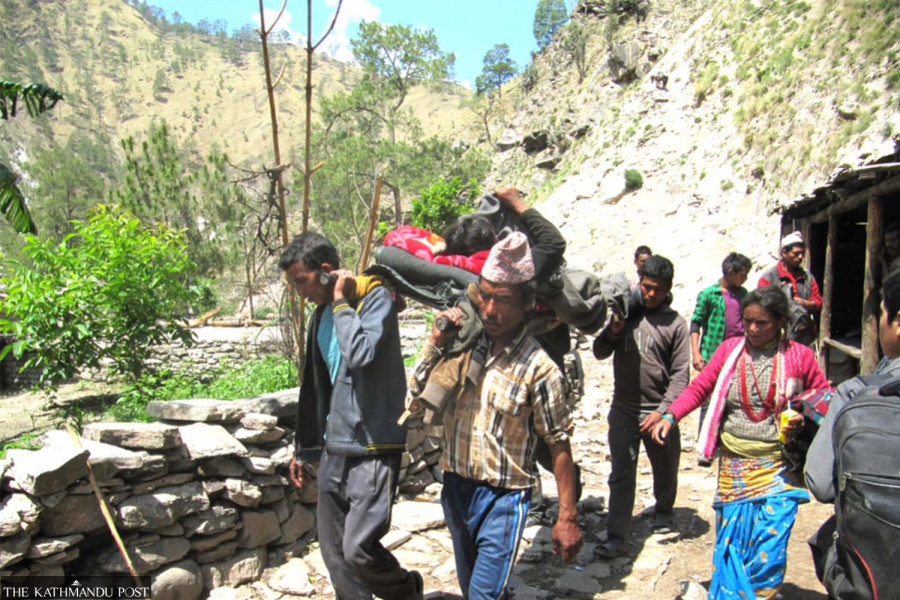
bookmark
Arjun Poudel
Published at : June 24, 2026
Updated at : June 24, 2026 21:10
Kathmandu
A 37-year-old woman carrying twins delivered her first child through normal delivery at the Karnali Provincial Hospital in Surkhet on Tuesday night. Moments later, her condition deteriorated rapidly, as her blood pressure, along with other vital signs, worsened. Doctors rushed her to the operating theatre for an emergency caesarean section.
The woman, who had been admitted to the hospital for two weeks, was suffering from polyhydramnios, a condition in which excessive amniotic fluid accumulates around the baby during pregnancy.
“We immediately performed a C-section, but couldn’t save the second baby,” Dr Amit Singh, head of the Department of Obstetrics and Gynaecology at the hospital, told the Post over the phone from Birendranagar, Surkhet. “It was a 34-week pregnancy. If we were only 10 minutes late, the outcome could have been very different. The bleeding was so severe. We were able to save the mother only because we acted immediately.”
Doctors say similar emergencies occur across the country, where mothers and newborns continue to face life-threatening complications even after reaching health facilities.
A recent study by the Ministry of Health and Food Safety in all seven provinces found that nearly three out of four maternal deaths in Nepal occur in health facilities or while patients are being transported to health facilities.
The report attributes the deaths to weak referral mechanisms, limited functionality of health facilities, and delays in receiving timely and quality care.
In Karnali province, nearly 73 percent of referrals require more than two hours of travel, followed by Sudurpaschim province at over 50 percent and Koshi at around 50 percent.
Madhesh and Lumbini provinces performed comparatively better in terms of comprehensive obstetric and newborn care services, with more than three-quarters of facilities meeting functionality standards. However, even in those provinces, most basic facilities failed to meet the required criteria.
The report shows that none of the basic emergency obstetric and newborn care facilities in Koshi, Bagmati, Gandaki, Lumbini, Karnali, and Sudurpaschim provinces meets the emergency obstetric and newborn care functionality criteria. Only four such facilities of Madhesh Province meet the criteria.
Experts say the functional criteria for emergency obstetric and newborn care are standards used to determine whether health facilities are capable of providing these services when needed. The criteria include the availability of trained health workers, essential medicines and supplies, required equipment and infrastructure, and the ability to perform critical emergency procedures on a regular basis.
They warn that the absence of even one of the requirements can put the lives of both mother and newborns at risk.
“In one case, doctors at a district hospital attempted a C-section but after they failed to control the bleeding, they temporarily closed the surgical incision and referred the woman to us," said Singh. "We managed to save both the mother and the baby. But even minor lapses can become fatal."
The report shows that small pockets of the population in every province remain beyond the recommended two-hour accessibility threshold for emergency and newborn care. Referral travel time exceeding two hours remains a major challenge, as it significantly increases the risk of maternal mortality during transit, according to the report.
Most provinces have designated far more emergency obstetric and newborn care facilities than the international standards recommend. Many of these health facilities are underutilised and lack the capacity to provide the required services.
“These days, more women and newborns are dying in health facilities or on the way to health facilities than at home,” said Dr Ganesh Dangal, a maternal and child health expert. “That is deeply concerning. It shows gaps in our efforts to prevent maternal and newborn deaths. Authorities must ensure basic standards, including the availability of trained personnel, equipment, lifesaving medicines, as well as timely access to care.”
Of late, Nepal has made a good improvement in the institutional delivery rate. According to the Nepal Multiple Indicator Survey 2024-25, the institutional delivery rate increased to 90.5 percent in 2025 from around 80 percent in 2022 and around 18 percent in 2009.
Institutional delivery and delivery by skilled birth attendants or skilled health professionals has long been a national priority programme, which is credited with reducing maternal and child mortality.
Yet maternal deaths remain high despite the rise in institutional deliveries.
Experts cite delayed diagnosis of complications, delays in treatment and inadequate access to expert care as major reasons.
Nepal reduced the maternal mortality rate from 539 deaths per 100,000 live births in 1996 to 239 in 2016. For this the ww2wwa2wwa222w2wwa, even received a Millennium Development Goals award.
According to the WHO, Nepal has reduced maternal deaths by over 70 percent since 2000. The UN health body, in its latest report, stated that 2aa2waww2w2ww 142 Nepali women diemat2222222382ernity-related 2aelated complications per 100,000 live births.
Nepal’s original target under the UN’s Sustainable Development Goals is to reduce the maternal mortality to 75 per 100,000 births by 2030.
The SDGs, a follow-up on the Millennium Development Goals (MDGs), aim to end poverty, hunger and all forms of inequality in the world by 2030. Nepal has committed to meeting them.
Arjun Poudel
Arjun Poudel is a health reporter for The Kathmandu Post. Before joining the Post, he worked for Sagarmatha Television, Naya Patrika, Republica and The Himalayan Times.
Most Read from Health
JE is killing more adults in Nepal as vaccination only covers children
24 days after flood, hunger grips three Rasuwa wards
Four die in three weeks as scrub typhus spreads in Salyan
Seven die of scrub typhus in one month in Salyan
A four-year-old died of rabies at home last week, but his death does not appear in government records
Editor's Picks

What triggered the Rasuwa flood? Scientists piece together a complex chain of events

The floods keep coming. Nepal keeps starting over

In a settlement destroyed by the Bhotekoshi flood, a disabled couple offer strangers the little they have

Nepal working on detailed assessment as Bhotekoshi flood reconstruction could cost up to $5 billion

Rabindra Dhant gave Nepal a reason to smile. Now his camp wants real action behind the praise
E-PAPER | September 30, 2026

×