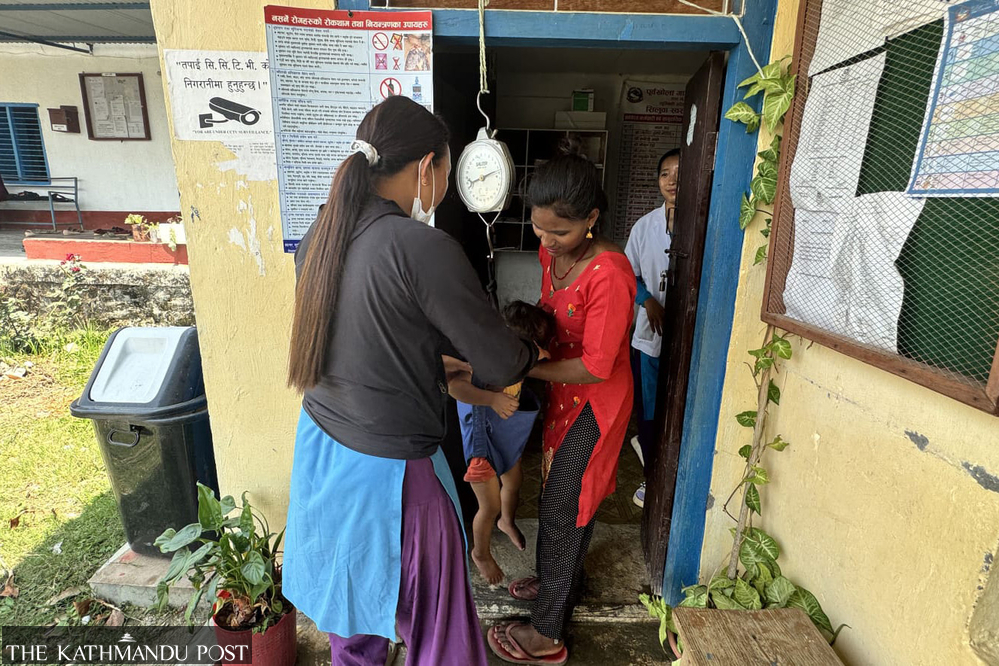
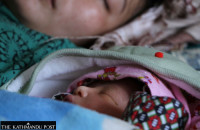
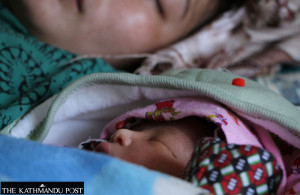
Over 200,000 children under five years of age suffer from acute malnutrition, a nationwide survey conducted last month shows.Measurements being taken of a malnourished child in Palpa. Post file photo
In Kusumkhola of Ribdikot Rural Municipality in Palpa, 39-month-old Shivam, the son of Narayani Tharu, weighs just 7.8 kilograms. After a local health post diagnosed him with severe acute malnutrition, he was referred to a nutrition centre in Khasyauli and later to Lumbini Provincial Hospital. But Narayani could not take him there. Health workers say financial hardship and family responsibilities prevented her from seeking further treatment.
In another case, a 23-month-old girl from Bhagwanpur in Krishnanagar Municipality of Kapilvastu, suffering from low weight and stunted growth, was brought for treatment only after repeated efforts by health workers. According to Mohammad Irfan, the district’s malnutrition focal person, the child has been under treatment for the past month after extensive counselling of her parents.
These children are not isolated cases. Their stories point to a widening nutrition crisis in Nepal, where poverty, limited awareness and poor access to healthcare continue to trap many families.
A recent study by the Ministry of Health and Food Safety shows that nutrition conditions have deteriorated sharply, with more than 200,000 children under five suffering from acute malnutrition.
According to the preliminary National Nutrition Assessment conducted across all 77 districts in May, nine percent of children aged six to 59 months were found to be wasted, up from eight percent in 2021, according to the Nepal Demographic and Health Survey.
The assessment, which covered more than 1.068 million children under five, also found that 26 percent are stunted. The NDHS-2022 report had put the national stunting rate at 25 percent among children under five.
“Findings from the assessment conducted across all 753 local units of the country show that nutritional conditions have worsened further compared to what was shown by the NDHS 2022 report,” said Lila Bikram Thapa, chief of Nutrition Section at the Family Welfare Division under the Department of Health Services. The division conducted the assessment among half of the country’s 2.15 million children aged between six months and 59 months.
Wasting, an acute form of malnutrition, is considered an emergency and may require urgent medical care. Experts say children suffering from severe acute malnutrition are 10 times more at risk of dying compared to healthy children. Experts warn that once wasting problems exceed 10 percent, child mortality can rise sharply, hence the need for immediate interventions.
The problem occurs when children do not get adequate nutritious food and suffer from infections. Even those who get enough food may not be getting proper protein-rich and nutritious diets, according to doctors. They say over 200,000 children are suffering from wasting, meaning those children are not getting the nutritious food required for proper growth and development.
“Wasting is a dangerous form of malnutrition,” said Dr Atul Upadhyaya, a nutritionist. “The rise in the number of children suffering from wasting is a matter of serious concern, as such children could die even from diarrhoea or any other minor illnesses.”
Data show 13.2 percent of children in Madhesh province are suffering from wasting. Similarly, 10.4 percent of children in Sudurpaschim province have been found to have wasted, compared to 5.1 percent in 2021. Similarly, nine percent of children in Lumbini province, 7.3 percent of children in Koshi province, 7.2 percent in Karnali province, 4.4 percent in Bagmati province, and 4.8 percent in Gandaki province are suffering from wasting.
As per the preliminary report some local units have very high wasting rates. In Koshi Rural Municipality of Sunsari district, 36.5 percent children are suffering from wasting, followed by Haripur Municipality in Sarlahi district (27.1 percent), Rajpur of Rautahat district (21.8 percent), and Chakraghat Rural Municipality in Sarlahi district (21.2 percent). Likewise, Ramgopalpur Municipality of Mahottari district has a wasting rate of 21 percent, Devtal Rural Municipality of Bara district 20.9 percent, Gularia Municipality of Bardia 20.3 percent, Gujara Municipality of Rautahat district 20 percent, Bariyarpatti Rural Municipality of Siraha 19.6 percent, and Dipayal Silgadhi Municipality of Doti district 9.6 percent.
Health workers weigh a child at a health post in Heklanga in Purbakhola Rural Municipality in Palpa in this recent photo. Madhav Aryal/TKP
Stunting is a chronic condition in which children’s growth and development are impaired due to poor nutrition and repeated infections. Stunted children have a height-for-age significantly below the World Health Organisation’s standard median.
According to the Health Ministry’s data, 36.2 percent of children in Karnali province are suffering from stunting, the highest in the country. The NDHS 2022 showed that 33 percent were stunted. In Madhesh, 31.1 percent of children are stunted, followed by Lumbini, 30 percent; and Sudurpaschim and Gandaki provinces, 25.3 percent each; Koshi, 24.7 percent, and Bagmati, 23.7 percent.
The report shows that 15 percent of children from Karnali province have been suffering from severe stunting. Severe stunting is a critical form of malnutrition in which a child’s height-for-age is extremely low. Doctors say treatment of stunting is impossible, while immediate intervention can improve wasting.
Underweight problems are also high in Madhesh province, where 24.4 percent of children are affected, followed by Lumbini (20.1 percent), Karnali (19.4 percent), Sudurpaschim (18.9 percent), Koshi (14.5 percent), Bagmati (9.9 percent), and Gandaki (9.8 percent)
The report shows that 15 percent of female children and four percent of male children are suffering from wasting.
The study also separately examined nutrition conditions among different ethnic, caste, and religious groups.
According to the report, 13 percent of Muslim children suffer from wasting, followed by Madheshi children (12.4 percent), and Dalit children (11 percent). Seven percent children of ethnic groups and six percent of Brahmin/Chhetri children are also suffering from wasting. The problem is more prevalent in rural settings than in urban areas.
Experts say rising inflation, a declining household income, and fewer job opportunities could have directly impacted household budgets and worsened malnutrition. They say people often cut spending on food first, including reducing consumption of milk and other protein-rich foods. A growing trend of consuming junk food, including processed and packaged foods, and sugary beverages has also worsened nutritional conditions.
“Anything could be responsible for the deterioration in nutritional conditions,” said Upadhyay. “If a study is carried out among other age groups, similar problems may also be found among them.”
Experts warn that if malnutrition is not addressed in time, it will affect children’s physical health, growth, and cognitive development. Poor cognitive development can limit productivity in adulthood, increase the risk of infection with multiple diseases, and affect the country's overall progress.
“Malnutrition is a political issue which has been neglected and overlooked for generations. It affects not only the current generation but also future generations,” says Dr Aruna Uprety, a nutritionist.
Nepal also has an international obligation to improve the nutritional status of children and has committed to meeting the Sustainable Development Goals. The SDGs, a follow-up on the Millennium Development Goals (MDGs), aim to end poverty, hunger and all forms of inequality in the world by 2030.
To meet SDGs, the country must reduce stunting to 15 percent from the existing 25 percent, wasting to four percent from the current eight percent, underweight prevalence to 10 percent from the existing 19 percent, and anaemia to 10 percent from over 43 percent at present.
Arjun Poudel is a health reporter for The Kathmandu Post. Before joining the Post, he worked for Sagarmatha Television, Naya Patrika, Republica and The Himalayan Times.




 14.57°C Kathmandu