Birthing centres, crucial for mother and newborn safety, face funding cuts under new budget
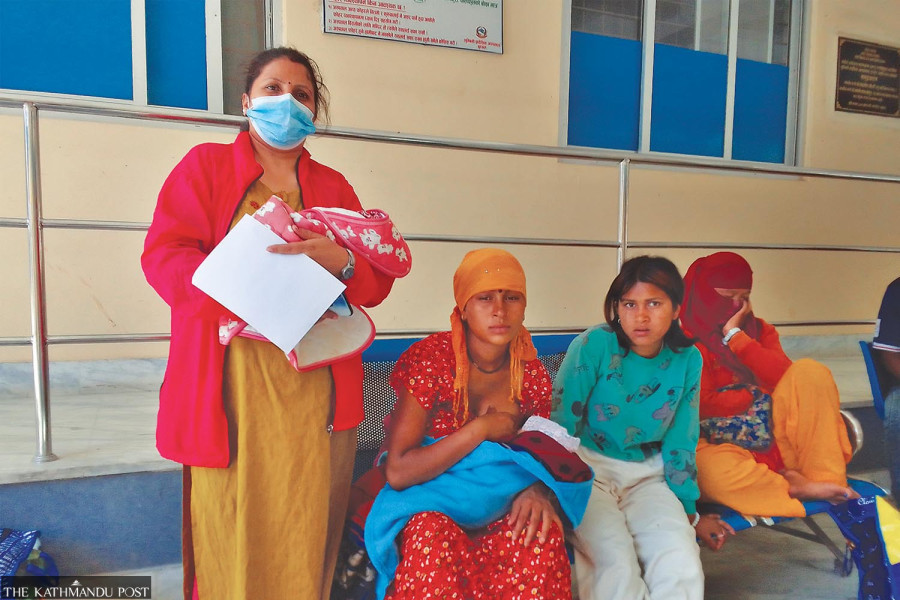
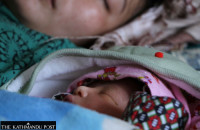
Experts warn of serious setbacks from budget cuts to crucial public health programmes, which could threaten years of Nepal’s healthcare gains. Post file photo
Thousands of contract employees serving under the Ministry of Health and Population lost jobs following the decision of the erstwhile Sushila Karki-led non-partisan government to dismiss all those appointees hired mainly due to their political connections.
The incumbent Rastriya Swatantra Party’s government, led by Balendra Shah, has not only barred the hiring of contract employees but also lowered budget ceilings across federal, provincial, and local levels for the upcoming fiscal year. The move is likely to affect most of the public health programmes.
Safe motherhood, one of Nepal’s priority health programmes credited with saving hundreds of maternal lives, is likely to be hit hard by the government's decision to reduce the budget for the fiscal year 2026–27.
According to the Maternal and Newborn Section at the Family Welfare Division of the Department of Health Services, the government has slashed the ceiling of the new budget by 20 percent in all three levels of government—federal, provincial and local—compared to the budget for the last fiscal year.
“The budget ceiling given for public health programmes such as the safe motherhood programme is sufficient only for four months,” said Dr Madan Kumar Upadhyaya, director at the division. “Several programmes of public health, in which the country has invested a lot and has national and international commitments to, will be affected if the budget is not increased.”
Officials at the division said there are over 2,700 birthing centres across the country. Most of them are operated by skilled birth attendants hired by local governments on contract basis. Likewise, many health posts across the country have been running lab services by hiring technicians on contract basis, as the government does not have posts of lab technicians in health posts.
“We have not planned a new programme of public health for the upcoming fiscal year due to a low budget ceiling,” said Nisha Joshi, a public health officer at the division. “If the ceiling for healthcare budget is not revised, birthing centres and lab services will be stopped in a few months.”
Officials at the division said they already owe millions of rupees to hospitals and birthing centres providing services under the ‘Safe Motherhood’ programme. The programme, which is credited with reducing maternal and child mortality rates by over 70 percent over two decades, is at risk due to a funding crunch, officials warn.
“Unfortunately, I too could not continue jobs of contract health workers serving in the ministry, departmental divisions and other agencies under the ministry during my tenure,” said Dr Sudha Gautam, the health minister in the Sushila Karki-led Cabinet. “Health workers serving in provincial and local levels on contract basis will lose jobs. This will have serious repercussions for public health programmes. The incumbent government must think about the adverse effects of budget cuts in healthcare sectors.”
The government’s Safe Motherhood Programme is credited with saving hundreds of maternal and neonatal lives every year. A new report by the World Health Organisation published last year stated that Nepal reduced maternal deaths by over 70 percent since 2000.
The UN health body, in its report, said that currently 142 Nepali women die from maternity-related complications per 100,0000 live births. A 2021 study carried out by the National Statistics Office showed 151 maternal deaths per 100,000 live births.
Neonatal mortality now stands at 16.6 per 1,000 live births, and stillbirths have dropped to 13.5 per 1,000 births, according to the UN health body.
Officials at the division said that the government provided over Rs4.1 billion budget for a safe motherhood programme for the current fiscal year. However, for the upcoming fiscal year, the government gave a ceiling of Rs3.3 billion for all three tiers of government.
In addition to free delivery services at health facilities run by local governments, district hospitals and provincial hospitals, the programme provides mothers and babies with free medical treatment, a transportation allowance, and cash incentives for antenatal checkups.
Women in the mountainous, hilly and Tarai districts receive Rs3,000, Rs2,000 and Rs1,000, respectively. Additionally, a cash bonus of Rs800 is provided to mothers who complete all eight antenatal checkups.
The institutional delivery rate, which was around 18 percent before 2009, when the government declared free institutional delivery services, has now increased to 90.5 percent by 2025 according to the Nepal Multiple Indicator Survey 2024-025 report.
As the ‘Safe Motherhood Programme’ is a national priority initiative, the free services cannot be discontinued, according to officials.
Nepal had cut the maternal mortality rate from 539 per 100,000 births in 1996 to 239 per 100,000 births in 2016—for which the country even received a Millennium Development Goals award.
Sustainable Development Goals, a follow-up on the MDGs, aim to end poverty, hunger, and all forms of inequality in the world by 2030. Nepal has committed to meeting the goals.
Arjun Poudel is a health reporter for The Kathmandu Post. Before joining the Post, he worked for Sagarmatha Television, Naya Patrika, Republica and The Himalayan Times.




 19.72°C Kathmandu