Drizzle fails to wash away Kathmandu Valley’s haze
The Valley ranked third globally for air pollution on Wednesday. A street vendor under a brolly tends her cart of roasted corn cobs at Chabahil, Wednesday. Suryams Upreti/TKP
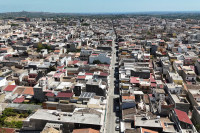
Kathmandu Valley witnessed dangerously high air pollution on Wednesday, with air quality hovering at very unhealthy and hazardous levels throughout the day. At 1 pm, the capital city also ranked third globally for air pollution on Wednesday, behind only Cairo, Egypt, and New Delhi, India.
Parts of the Valley—Kathmandu, Lalitpur, and Bhaktapur—also witnessed light rain, which meteorologists called a ‘drizzle’, but it could not wash away the dust pollution that shrouded the city in haze.
“Haze covered the Kathmandu Valley, but visibility is not so poor,” said David Dhakal, a meteorologist at the Meteorological Forecasting Division under the Department of Hydrology and Meteorology. “Light rainfall occurred in some places, including at the Tribhuvan International Airport, but it was not sufficient to clear the dust pollution.”
An Air India plane was diverted to Varanasi due to poor visibility at the Tribhuvan International Airport in the morning.
Nepal experiences the worst air pollution during the dry season, when PM 2.5 levels reach hazardous levels. It has become the new normal for the country’s capital city to be ranked the world’s number one polluted city.
IQAir, a Swiss group that collects air-quality data, ranked the Kathmandu Valley the third most polluted globally on Wednesday, with PM2.5 levels in the Pulchowk area reaching 340 micrograms per cubic metre (μg/m3), a hazardous level.
While the New Baneshwar area recorded a PM2.5 level of 245 micrograms per cubic meter, the Syambhunath area 255, Khokana 251, Lagankhel 224, Rabibhawan 240, Kuleshwar 240 and Thapathali recorded 234. The air quality in most areas of the Valley was at a very unhealthy level throughout the day.
The air quality monitoring station in Birgunj recorded a PM 2.5 level of 346 micrograms per cubic meter, which is also hazardous.
PM2.5 refers to particulate matter (solid or liquid droplets) in the air less than 2.5 micrometres in diameter. It is among the most dangerous pollutants, as it can bypass the nose and throat to reach the lungs and even the bloodstream. PM2.5 particles are small and are likely to remain suspended in the air for a long time, increasing the risk of people inhaling them.
As per the US Environmental Protection Agency’s air quality index, an air quality reading of 151–200 is considered unhealthy; everyone may experience problems, with sensitive groups feeling more severe effects. When air quality reaches 201-300, it is considered a very unhealthy level, and health risks increase for everyone in the area. When it exceeds 300, it enters the hazardous range, indicating extremely poor air quality that poses serious health risks to everyone.
Met officials say the Western low-pressure system developed in the Arabian Sea is responsible for light to moderate rainfall across various districts of Sudurpaschim, Karnali, Lumbini, Gandaki, and Bagmati provinces.
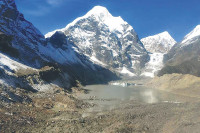
Mountain districts, including Humla, Dolpa, Rasuwa, Manang, Myagdi and Mustang, witnessed heavy snowfall that affected daily life. Districts of the Koshi province could also witness light rainfall, according to officials.
“Ongoing weather will improve from Thursday, and there is no new system in place to cause rainfall in the next couple of days,” said Dhakal.
Meanwhile, updated data from the met office shows that Kathmandu witnessed 2.2 mm rainfall in 24 hours on Wednesday evening. Dadeldhura recorded 29.6 mm rainfall followed by Birendranagar 16.1 mm, Dhangadhi 14.7 mm, Dipayal 13.1, Nepalgunj 12.9 mm, Ghorahi 11. 2 mm, Jumla 8.5 mm and Pokhara 6.3 mm.
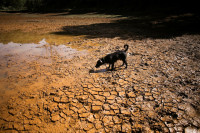
The department had earlier forecast a hot and dry winter (from December 1 to February 28), with both maximum and minimum temperatures expected to remain above average. No rainfall has occurred since the start of the winter season, and this has caused a dry spell across most parts of the country and worsened air pollution.
Nepal has been experiencing a hot, dry winter for the past four years. Experts say extreme weather events—excess rainfall in short periods, continuous rains for several days after the monsoon, dry spells, droughts, below-average precipitation, and above-normal winter temperatures—have become more frequent in recent years.
Despite the early onset of the monsoon last year, many places, especially the plains of the Tarai, which is also the food basket of the country, witnessed mid-monsoon droughts, which prevented farmers from cultivating their land.
The country is one of the world’s most vulnerable countries to the climate crisis and has witnessed extreme weather events in the past decade and a half.
Evidence indicates that the maximum temperature in Nepal is rising at a greater rate (0.05 degrees Celsius per year) than the minimum temperature (0.03 degrees Celsius per year).
Numerous studies over the past decade and, more recently, the IPCC report, have warned that since Nepal is one of the most vulnerable countries to the climate crisis, a business-as-usual approach will not be sufficient to tackle the impacts of the disasters.
Arjun Poudel is a health reporter for The Kathmandu Post. Before joining the Post, he worked for Sagarmatha Television, Naya Patrika, Republica and The Himalayan Times.




 19.85°C Kathmandu