Dengue continues to spread through Nepal even in the dead of winter, as 146 people were infected in January and 136 in February this year, according to the Epidemiology and Disease Control Division shows. Like in the previous years, infection of the deadly virus continues year-round.
“Compared to the same period last year, the number of reported cases is lower this year,” said Dr Gokarna Dahal, chief of the Vector Control Section at the division. “Since dengue has become endemic in our country, people get infected throughout the year.”
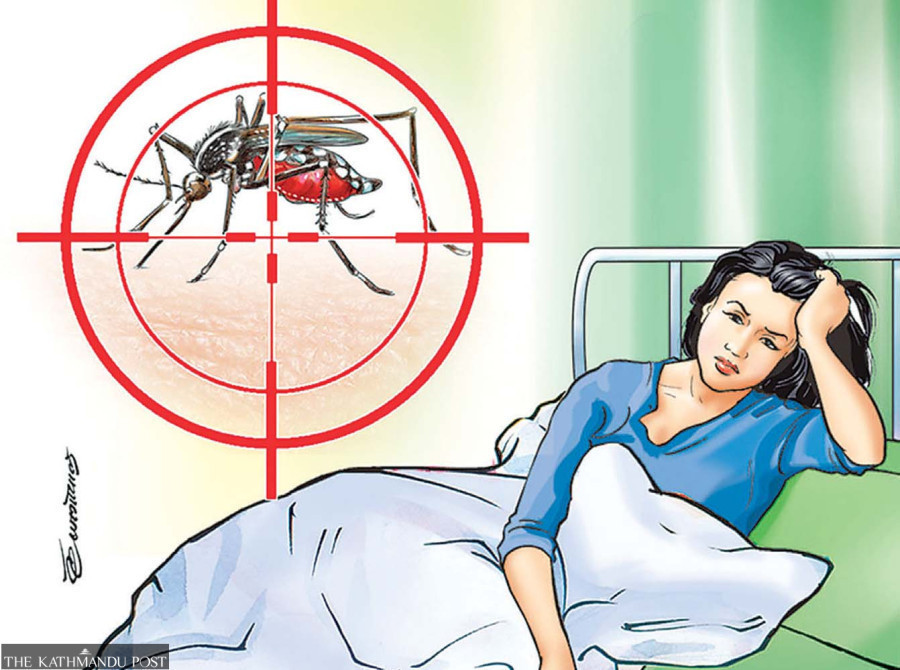
Dengue is a viral disease transmitted by female Aedes aegypti and Aedes albopictus mosquitoes. According to the World Health Organisation, the same vector also transmits chikungunya, yellow fever, and the Zika virus.
Dahal said that around 500 dengue-positive cases were recorded in December 2024 and in January and February of 2025. Since dengue became endemic in Nepal years ago, health authorities no longer classify new cases as outbreaks.
In 2025, at least six died and around 9,000 were infected with dengue virus, which has spread to 76 out of 77 districts of the country. All mountain districts except Humla reported dengue virus infection this year. It was previously believed that dengue-spreading mosquitoes could not survive in very cold climates, thus there was no risk of dengue in mountain districts. However, the division’s data show otherwise.
Experts say even though winter maximum temperatures have dropped, they remain above 15 degrees Celsius, which is warm enough for dengue mosquitoes to survive.
Multiple scientific reports including the United Nations ‘Climate Change 2022: Impacts, Adaptation and Vulnerability’ report states that at least six major vector-borne diseases influenced by the climate drivers have recently emerged in Nepal and are now considered endemic.
Global warming has extended the elevational distribution of Anopheles, Culex, and Aedes mosquito vectors above 2,000 metres in Nepal. Of about 460 species of Anopheles, over 100 transmit malaria. Over 950 species of Aedes spread dengue, chikungunya, Zika, yellow fever, and the West Nile virus.
Experts say reported cases likely represent only a fraction of the true scale, as around 90 percent of the infected people are asymptomatic, and many deaths and infections often go unreported.
Health officials say that ongoing election activities overshadowed the vector control efforts.
“We have not taken any preventive measures this year, as only sporadic cases of dengue infection have been recorded across the country,” said Dahal. “No large-scale outbreak has been reported anywhere.”
Officials attributed that decline in dengue infection is due to decline in infection rate in 2025.
Dengue mosquitoes breed in clean water and bite during daytime. Uncovered water tanks and discarded objects such as plastic cups and bottles can serve as breeding grounds.
Symptoms of the disease include mild to high fever, severe muscle pain, rashes, severe headache and pain in the eyes, among other things. Doctors advise those with these symptoms to seek immediate treatment. While there is no specific cure for the disease, early detection and access to proper medical care can lower fatalities.
Many people infected with dengue show mild symptoms, which do not need any treatment or can be managed with paracetamol at home.
Nepal reported its first dengue case in a foreigner in 2004 in Chitwan district. Since then, an increasing number of dengue infections, including major outbreaks, have been reported from many districts.
The World Health Organisation says there is no specific cure for severe dengue, but early detection and access to proper medical care can save lives.




 17.29°C Kathmandu