After lowering the ceiling for outpatient services to Rs25,000 for patients and their family members from Rs100,000 in January, the Health Insurance Board has now halted outpatient care at private hospitals under the government health insurance scheme, citing a growing financial burden.
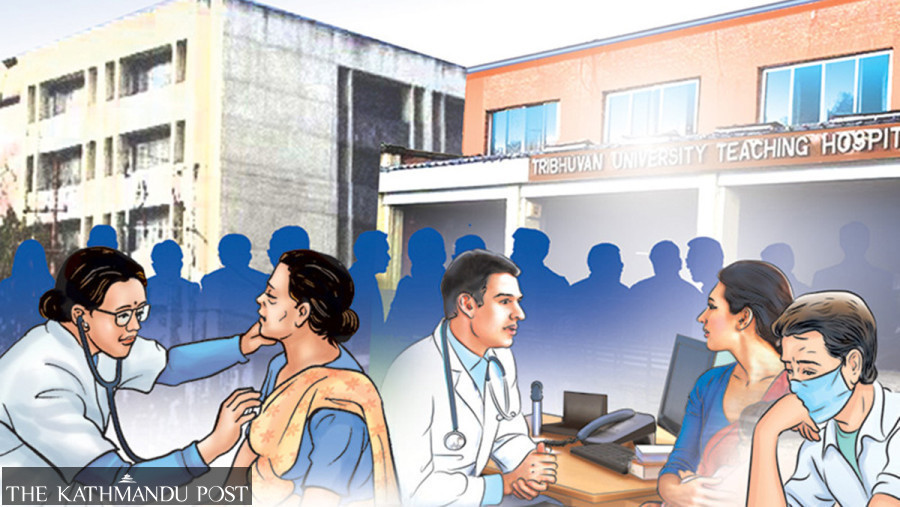
Prior to this, major hospitals in the country, including Tribhuvan University Teaching Hospital, Manmohan Cardiothoracic Vascular & Transplant Centre, and several medical colleges, halted services under the government health insurance scheme, as they were not reimbursed for the services they had provided to patients.
Even state-run hospitals—Bir Hospital and others, which have been operating with grants from the government and others—and Shahid Gangalal National Heart Centre, which also receives some government funding, have been providing only partial services to patients under the health insurance scheme.
All these developments have taken place over the past five months. Patients who bought the policy and are seeking care at listed hospitals complain they have been cheated by the government.
“What can we do when the government goes back on its commitments it made while selling the policy?” asks Dr Krishna Man Shakya, a public health expert. “What can a poor patient do when the government itself deceives. Why would anyone trust the government when it did not fulfil its commitments made while selling a policy?”
Hundreds of thousands of patients seeking care under the health insurance scheme have borne the brunt of frequent policy changes. Some have been denied health services, including surgical services, at major hospitals. Others have been forced to pay out of pocket.
Patients who bought the government’s health insurance policy lodged complaints at the board, saying they are being discriminated against by hospitals in treatment, made to wait in long queues, given surgery dates months later, and forced to pay for lab services and medicines that are supposed to be covered by the scheme.
“The board meeting held on Monday decided to halt outpatient care at private hospitals until further notice,” said Bikesh Malla, information officer at the board. “The decision aims to ease the growing financial crisis faced by the board.”
Officials say the board owes hospitals Rs18 billion for health care services provided under the government health insurance scheme until mid-May, and that additional liabilities of around Rs20 million are accruing each day.
When asked whether the government can withdraw from its commitments and make decisions that breach public trust, Malla said that the board was forced to reach the harsh decision due to growing liabilities.
Shakya argued that the government is not a trader seeking profit, and that frequent decisions to cut services and schemes will erode public trust in the government.
“How can we achieve universal health coverage by denying services for which the public has paid in advance?” he questioned. “People will be helpless when the government itself behaves in this manner.”
The health insurance scheme is the government’s priority programme aimed at ensuring universal health coverage. However, it has been mired in financial problems and has almost collapsed.
With the government limiting the ceiling for outpatient services, the renewal rate of the health insurance scheme has declined to around 50 percent. Officials say they do not worry about the declining renewal rate, as it reduces the burden.
Officials had hoped that problems with the health insurance scheme would be resolved once the new government was formed, but the problems remain as they are. Instead, many hospitals and medical colleges stopped providing services under the programme after the new government took charge.
A family of up to five members pays Rs3,500 for treatment, including medicines, check-ups, and counselling, under the original scheme. As per the rule, one family member can use the insurance coverage worth Rs100,000 per year, or the amount can be divided among five members. Families with more than five members pay Rs700 per additional member for an extra Rs20,000 in health insurance coverage. People covered by the insurance can access healthcare services at designated facilities by presenting their identity cards.
Arjun Poudel is a health reporter for The Kathmandu Post. Before joining the Post, he worked for Sagarmatha Television, Naya Patrika, Republica and The Himalayan Times.




 14.69°C Kathmandu