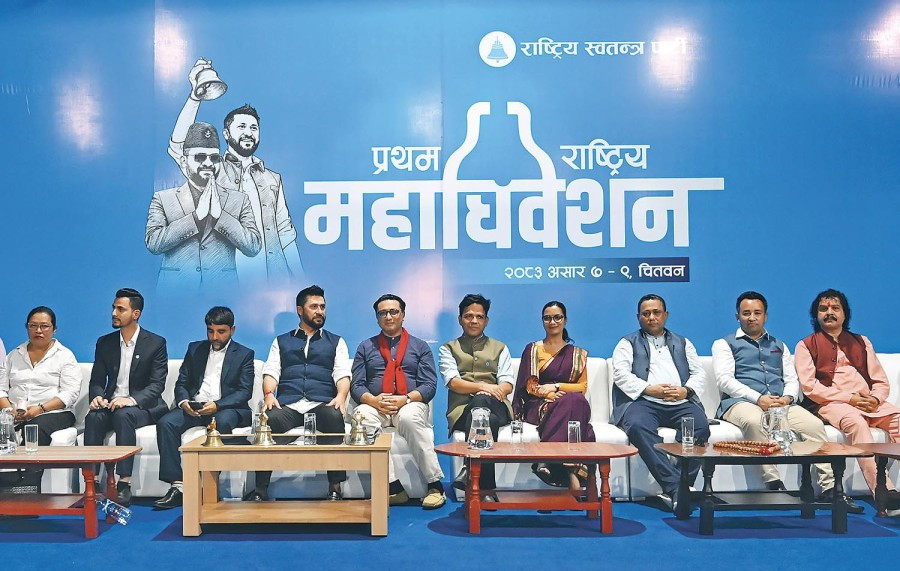
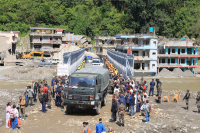
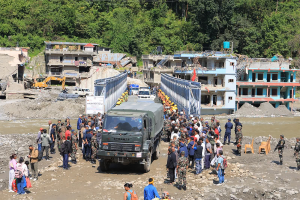
The Rastriya Swatantra Party leadership had been hyping up the party’s general convention, saying it would set an example for other parties. Instead, it largely followed the same flawed path of the older parties that the RSP had long criticised. The RSP’s shortcomings and incompetence were exposed right from the beginning. The blue billboards and garish entrance gate, which even obstructed the passage of lorries, seemed to have been copied from the handbook of traditional parties.
Finalisation of representatives is among the first things any party needs to accomplish before holding a general convention. However, it took four days after the convention’s start for the RSP to finalise its representatives. Interestingly, the RSP’s political and economic papers, which set the party line for the next four years, were endorsed even before the representatives were finalised. The way the political and economic dossiers were endorsed is not without questions. Through its political paper, the party adopted positions on major constitutional and governance issues. The paper envisions transforming the National Assembly into a non-partisan chamber of experts chaired by the Vice President. Presented by party president Rabi Lamichhane during the closed session of the general convention, it also backs a directly elected executive head, a fully proportional electoral system, non-partisan local elections and the abrogation of provincial assemblies.
These are important proposals which, if implemented, will have far-reaching consequences for Nepali politics and hence call for intense discussions on their implications. But these issues were never put up for discussion. The party president read out the document and convention representatives were asked to endorse it. They did. The paper was approved without any member being allowed to put forward views, questions or objections. The process was turned into a rubber stamp that even party leaders mocked, remarking that the “intensive deliberation conducted by 4,200 delegates lasted just seven seconds”. The mismanagement, too, was not limited to the delayed finalisation of representatives. It was also evident in the party’s inability to effectively manage the voting process to elect its leadership. The convention, which was scheduled to end on Tuesday, has already been extended by two days, and whether it will conclude even within the extended period remains uncertain.
The immense support the RSP received to be a major political force within just four years of its formation owed not just to the failure of the traditional parties to perform while in power. It was also because people were frustrated by how those parties functioned internally and how they bulldozed policies through party structures without adequate debate. It cannot be deemed healthy for a party that has projected itself as the torchbearer of alternative politics to face criticism from its own leaders and cadres for barring democratic discussion on key policy issues and on something as fundamental as the party statute.
The party had the opportunity to set the bar high and demonstrate how a party’s general convention could be held in a true democratic spirit. However, on every front—from convention management and the finalisation of representatives to policy discussions and leadership selection—the RSP’s first general convention has fallen short of expectations. This is an insalubrious development for the health of the RSP and as by far the largest party in parliament, for Nepali democracy.




 14.7°C Kathmandu