



 22.94°C Kathmandu

Thu, Oct 22, 2026
Money
Nepal’s development spending short of even half of annual allocation
Development spending reaches only 46.79 percent of the annual budget’s allocation, with authorities citing political instability, elections and supply disruptions for delays in project implementation.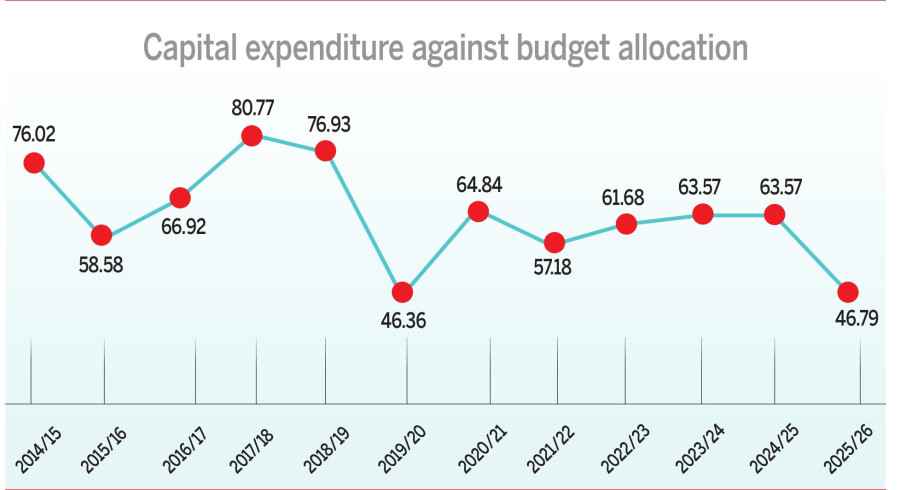
bookmark
Yagya Banjade
Published at : July 17, 2026
Updated at : July 17, 2026 06:45
Kathmandu
The government has fallen far short of its development spending target, underscoring a persistent problem that has slowed infrastructure expansion and weakened the impact of public investment.
Despite repeated commitments to improve budget execution, successive governments have struggled for years to convert allocated funds into completed projects. Low capital spending in Nepal has often been blamed on delays in project preparation, procurement hurdles, weak implementation capacity and frequent political disruptions.
The problem has continued despite changes in government and repeated calls for reforms in public spending systems. Economists say poor capital expenditure not only slows infrastructure development but also limits economic growth by reducing demand for construction, materials and related industries.
The government spent less than half of the capital budget allocated for the current fiscal year, with development expenditure reaching only 46.79 percent of the annual target a day before the fiscal year ended.
For the fiscal year 2025-26, the government had allocated Rs407.89 billion for capital expenditure. By July 15, only Rs190 billion had been spent, according to government data.
The government failed to spend even half of the capital budget allocated for the current fiscal year, recording the country’s weakest development spending performance in six years.
This is the lowest capital expenditure rate since the fiscal year 2019-20, when the government spent only 46 percent of its annual capital budget. That year, Rs408 billion had been allocated for capital expenditure, but only Rs189 billion was spent.
Since then, capital spending has remained above that level, reaching 57 percent in one fiscal year and between 60 and 65 percent in each of the subsequent four years.
Government officials attributed this year's weak performance to the Gen Z protests of September last year, the March 5 federal parliamentary elections earlier this year, the subsequent formation of a new government, and disruptions to the supply of construction materials caused by the conflict in West Asia.
Nepal has long struggled to utilise its capital budget effectively, but this year marks one of its poorest performances, with development spending falling below 50 percent of the original allocation.
Economists say the change in governments following the Gen Z movement failed to translate into better fiscal management.
The protests, which demanded good governance, action against corruption and improvements in public service delivery, led to the fall of the Nepali Congress-CPN-UML coalition and the appointment of a new government. However, fiscal indicators show little improvement since then.
Economist Dilli Raj Khanal said the current government, which came as an outcome of the Gen Z movement, had failed to prioritise development works, resulting in another year of poor capital spending.
“The government came to power on the promise of good governance, but it has neglected governance in development spending,” Khanal said. “There is a high risk that the same pattern of poor capital expenditure will continue next year because the budget itself has not been designed in a way that addresses financial misgovernance and ensures its effective implementation.”
He said the budget should be formulated only after ensuring that projects are ready for implementation, but argued that the new fiscal budget also fails to ensure that.
Nepal's poor record on capital spending is not new. Over the past three decades, governments have spent only around 60 percent of the capital budget on average each year. Experts say addressing the problem requires structural reforms, including changes to procurement rules and project implementation procedures.
“We blame everything from earthquakes to Covid-19 and now the Gen Z protests for poor capital spending while ignoring our own institutional weaknesses,” a Finance Ministry official said. “These are excuses to avoid acknowledging the real problem. Broad structural reforms are essential if Nepal wants to improve capital expenditure.”
Amrit Lamsal, spokesperson for the Ministry of Finance, acknowledged that spending only 46.79 percent of the original capital budget was low.
“Based on the figures up to July 15, capital expenditure stands at around 47 percent of the annual target,” Lamsal said. “The final figures may increase slightly after incorporating July 16 data.”
He said the Gen Z protests had disrupted regular government operations after several public offices were damaged, while the March 5 election diverted the attention of civil servants and contractors. At the same time, the conflict in West Asia disrupted supplies of construction materials and pushed up prices, slowing implementation of infrastructure projects.
According to Lamsal, shortages of materials such as bitumen and rising construction costs also contributed to the poor spending performance.
“The Ministry of Finance delegated budget reallocation authority to line ministries and repeatedly urged them to accelerate spending while facilitating implementation,” he said. “Despite these efforts, capital expenditure did not increase as expected.”
He said the government had laid the groundwork for stronger capital spending and expressed confidence that implementation would improve from the beginning of the new fiscal year.
Meanwhile, the government collected Rs1.225 trillion in revenue in the fiscal year 2025-26. This represents a seven percent increase from the previous fiscal year’s collection but only 82.76 percent of the annual target.
Last year, the government achieved 80.35 percent of its revenue target. For the current fiscal year, it had set a revenue target of Rs1.48 trillion.
Lamsal said revenue collection had reached around 84 percent of the annual target.
“The target for the current fiscal year was Rs1.48 trillion,” he said. “By Wednesday, revenue collection had reached around Rs1.25 trillion. We had hoped to reach at least Rs1.3 trillion, but that now seems unlikely.”
Although revenue grew seven percent year on year, Lamsal said stronger capital spending would have generated higher tax collection.
“Had capital expenditure increased, revenue collection would also have been higher,” he said. “Weak development spending has directly affected revenue mobilisation.”
Despite missing the revenue target, he said the government's fiscal position remained manageable.
Recurrent expenditure reached Rs1.045 trillion during the fiscal year, equivalent to 88.51 percent of the annual target and higher than the spending during the same period last year.
Officials said recurrent expenditure increased partly because the government financed election-related activities from recurrent expenditure and other budget headings.
The government also spent Rs347.33 billion on debt servicing and investment in public enterprises under the financial management heading, equivalent to 92.56 percent of the annual allocation. In the previous fiscal year, spending under the same heading stood at Rs320 billion, or 87.14 percent of the target.
Foreign grants received during the fiscal year amounted to Rs31.25 billion, representing 58.5 percent of the annual target. In the fiscal year 2024-25, Nepal received Rs23.20 billion in foreign grants, or 44.34 percent of the target.
By Thursday, the government's fiscal deficit had reached around Rs358.61 billion. Total revenue stood at Rs1.264 trillion while total expenditure reached Rs1.583 trillion.
In the previous fiscal year, the fiscal deficit stood at around Rs347.75 billion.
The government had initially announced a budget of Rs1.964 trillion for the current fiscal year but reduced it to Rs1.688 trillion through the mid-term review after failing to mobilise sufficient resources and carry out spending.
Interim government’s finance minister Rameshore Khanal cut the budget by Rs275.78 billion during the mid-term review after it became clear that both revenue collection and expenditures would fall short of expectations.
The original budget of Rs1.964 trillion had been presented by Bishnu Prasad Paudel while serving as finance minister in the KP Sharma Oli-led government.
According to the mid-term budget review report for the fiscal 2025-26, recurrent expenditure was revised down from Rs1.181 trillion to Rs1.126 trillion.
Capital expenditure was reduced from the original allocation of Rs407.89 billion to Rs243.30 billion. Even that revised target was not achieved.
Likewise, the allocation for financial management was cut from Rs375.24 billion to Rs319.04 billion through the mid-term review.
Yagya Banjade
Banjade covers government finance, banking, capital markets, and the economy for Kantipur Daily.

Most Read from Money
Nepal travel agents threaten to stop selling Thailand trips over visa rules

Why does an hour long flight to Dhangadhi cost more than a flight to New Delhi?
Malaysia rejects Nepal’s demand to open recruitment to all manpower agencies
No school, but a graduation cap for women dairy farmers
Nepal arrests four medical service providers as Malaysia recruitment row deepens
Editor's Picks




E-PAPER | October 22, 2026

×