NOC faces backlash over ID requirement for LPG buyers
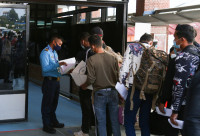
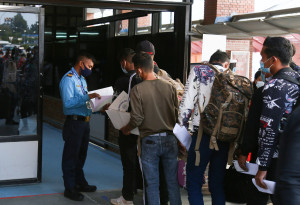
The state oil monopoly says requiring citizenship certificates or National IDs is an initial trial to prevent hoarding during shortages. NOC notice on Friday stated that customers would have to present either a citizenship certificate or a National Identity Card to purchase a cylinder. Dipesh Darshandhari/TKP
Nepal Oil Corporation’s decision to require customers to show official identity documents to buy liquefied petroleum gas (LPG) has drawn widespread criticism, prompting the state-owned oil monopoly to indicate that it could review the requirement.
On Friday, the corporation issued a public notice saying LPG cylinders would be distributed at five designated locations in the Kathmandu Valley on Saturday from 10am to 6pm. The notice said customers would have to present either a citizenship certificate or a National Identity Card to purchase a cylinder.
Nagendra Sah, executive director of NOC, said the requirement was aimed at making distribution fairer and preventing hoarding during supply shortages.
“We introduced this measure to ensure fairness during times of crisis. Knowing that certain individuals exploit shortages to acquire multiple cylinders, we sought to prevent duplicate purchases,” Sah told media representatives.
The directive, however, drew criticism from lawmakers, rights activists and members of the public, who said requiring identity documents to buy an essential household commodity was unnecessarily bureaucratic and impractical.
Gyan Bahadur Shahi, a member of the House of Representatives, questioned the need for such documentation in a social media post.
“Must citizens now carry a citizenship certificate or National ID just to purchase cooking gas? People are being made to queue with identity cards as if they are crossing an international border,” Shahi said. “While we do not expect the government to transform the country overnight, it must at least resolve the basic, day-to-day hardship of the general public.”
Privacy concerns have also emerged over the handling of personal information at distribution points. Journalist Bishwas Khadkathoki questioned the practice of collecting sensitive identity details at local LPG outlets.
“On the one hand, the government makes a display of protecting personal privacy; on the other, it demands that citizens hand over highly sensitive identity documents at street corners and alleyway gas depots,” he said on social media.
Amid the backlash, Sah said the ID requirement was not intended as a permanent policy and could be changed if it proved impractical.
“This was our initial trial practice,” Sah said. “If it proves ineffective or overly burdensome, we will certainly review and revise the decision.”




 15.31°C Kathmandu