DNA report contradicts gang-rape case against four juveniles
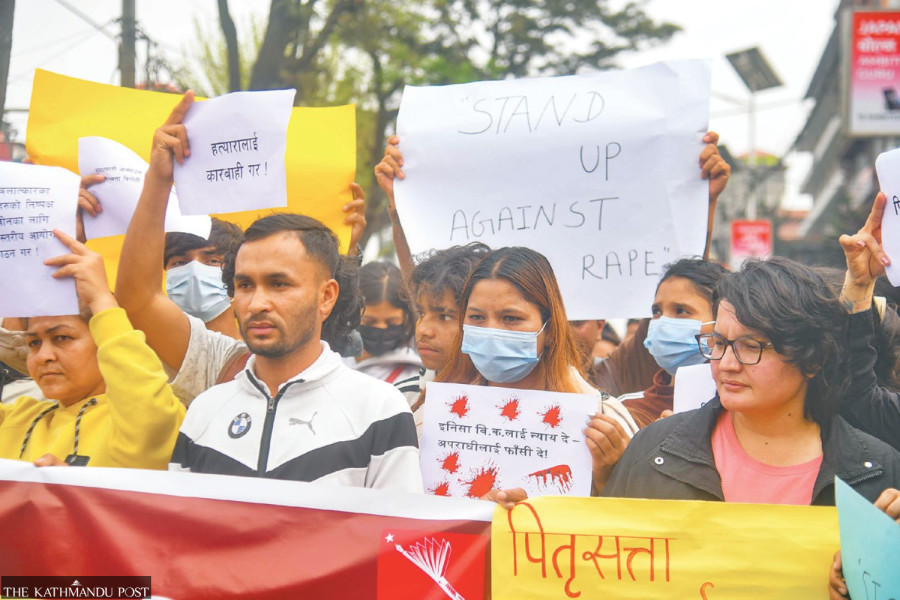
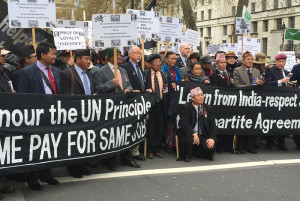
Findings link only the main accused to the victim, raising fresh questions over prosecutors' decision to charge all four with rape and murder. A demonstration held in Kathmandu in March demanding justice for Inisa BK Post file photo
When the Surkhet District Government Attorney's Office filed a case on March 28 against four juveniles on charges of the gang-rape and murder of 16-year-old Inisha BK, the evidence considered definite in a case of this nature had not yet been produced.
Samples collected from Inisha's body and clothing, a condom recovered from the crime scene, and samples collected from the bodies and clothing of the four juveniles had been sent to the Nepal Police Central Forensic Science Laboratory in Kathmandu for examination. The 41-page charge sheet produced at the District Court listed 163 pieces of evidence. The laboratory's final DNA and serology reports arrived nearly two months later, on June 2.
The reports, obtained by Kantipur, show that only the main accused, identified by police as "Birendranagar Pa," had physical sexual contact with Inisha. They show no such connection with the three other juveniles, identified by police as "Birendranagar Pha," "Birendranagar Dha," and "Birendranagar Na", to protect their identities. Samples collected from their bodies and clothing did not match the samples collected from Inisha's body and clothing.
However, all four juveniles, who were arrested on March 7 and 8, are still in custody. On March 31, the Surkhet District Court ordered that they be held at the Juvenile Correction Home in Nepalgunj pending trial.
Uttam Acharya, lawyer for the three juveniles, claimed that the forensic reports confirm all three are innocent.
"The forensic report clearly establishes who was involved in the incident, how they were involved and to what extent. It proves that only one person was involved, while the other three were not," he said.
The charge sheet states that all four juveniles raped Inisha inside Janajagaran Community Forest in Surkhet on the morning of March 7 before killing her. At the time the charges were filed, the case against three of the four juveniles was based on circumstantial evidence. The new findings from the DNA and serology tests, which do not indicate the involvement of three of the four juveniles prosecuted for the rape and murder of Inisha, have raised questions over the prosecution itself.
On the morning of March 7, Inisha went to the community forest in ward 5 of Birendranagar Municipality, Surkhet, with "Birendranagar Pa," who is said to have been her boyfriend. She did not return alive.
The post-mortem report states that she died of excessive bleeding caused by a deep injury to the internal part of her genital tract. "Such an injury is consistent with forcible sexual intercourse," the report said.
Police immediately arrested "Birendranagar Pa" from the crime scene. The following day, they also arrested his three friends, "Birendranagar Pha," "Birendranagar Dha," and "Birendranagar Na."
Except for "Birendranagar Pha," all of them were grade 11 students at Usha Bal Batika School and were in the same class as Inisha.
All four accused, between 16 and 17 years old, have been charged in the District Court with gang-rape and murder, with prosecutors seeking life imprisonment. Under Nepal's juvenile justice law, offenders aged between 16 and 18 are liable to a maximum of two-thirds of the sentence prescribed for adults if convicted. They, therefore, face a maximum sentence of 16 years and eight months.
During police interrogation, the prime accused, identified as "Birendranagar Pa", said that he called his friends for help after the girl lost consciousness due to excessive bleeding during sexual intercourse. He told investigators that he alone was responsible and did not implicate the other three juveniles.
The statements given separately by the three other juveniles were also consistent with Birendranagar Pa's account.
The Nepal Police's Central Investigation Bureau (CIB), after analysing CCTV footage collected from various locations in Surkhet and call detail records between those allegedly involved, concluded that the three juveniles had not arrived at or near the scene until long after Inisha had already lost consciousness.
After all four were charged in the Surkhet District Court with gang rape and murder, District Judge Deepak Dhakal, during the preliminary hearing on March 30, ordered that they be sent to a juvenile correction home until the case reaches its final verdict. On May 7, a division bench of judges Hari Prasad Joshi and Khem Raj Bhatta from Surkhet High Court upheld the order.
The three juveniles have since petitioned the Supreme Court, seeking to be released from custody and allowed to attend court on scheduled hearing dates while the trial proceeds. The petition was scheduled for hearing before Justices Binod Sharma and Shanti Singh Thapa on June 30, but the bench did not hear the case. The next hearing has been scheduled for August 4.
Police had recommended charging "Birendranagar Pa" with rape and murder, while recommending charges against the other three youths only for having reached the scene but failing to take any action to save Inisha. However, the Office of the Government Attorney sought prosecution of all four on charges of gang-rape and murder. The forensic reports that have now become available are consistent with the police's initial recommendation and with the statements that the prime accused, "Birendranagar Pa", had been giving since the outset. They do not support the government attorney's claim that Inisha was gang-raped.
The Central Forensic Science Laboratory prepared the DNA profiling report on May 5, 2026 and the serology report on June 2, 2026, based on samples registered on March 13, 2026. By the time the latter report was issued, the four juveniles had already spent nearly three months in detention. Even before the forensic reports were available, charges had been filed against them, the District Court had ordered their remand into judicial custody, and the High Court had upheld the District Court's order.
The laboratory has already returned to the District Police Office in Surkhet the samples collected from the crime scene, the victim and the accused, along with the corresponding forensic reports.
The two reports were prepared after detailed examination of more than 40 pieces of evidence. These included vaginal swabs and clothing collected during Inisha's post-mortem examination, the condom recovered from the crime scene, penile swabs, underwear and clothing belonging to all four juveniles, as well as their blood samples.
The DNA report establishes that the prime accused, identified as "Birendranagar Pa", had sexual contact with Inisha. Because Inisha was a minor, such sexual intercourse constitutes rape under the law.
According to the DNA analysis, Inisha's DNA profile was detected on "Pa’s” pubic hair, shirt and white vest. The report also confirmed that the male DNA found on both the inner and outer surfaces of the condom recovered from the crime scene, as well as the male DNA found beneath Inisha's fingernails, belonged to "Pa". Furthermore, samples collected from "Pa"'s body and clothing matched samples collected from Inisha's body and clothing. The report therefore concluded that "Pa"'s involvement "cannot be excluded."
According to the serology report, human blood was detected on "Pa"'s penile swab, shirt, white vest, underwear and pubic hair. The DNA report confirmed that the blood found on his pubic hair, shirt and vest belonged to Inisha. The post-mortem report prepared by Bheri Hospital in Nepalgunj had also concluded that Inisha died from excessive bleeding caused by a deep internal injury to her vagina.
The laboratory also prepared complete DNA profiles of the other three defendants, identified as "Birendranagar Dha", "Birendranagar Na" and "Birendranagar Pha". None of their DNA profiles matched any of the samples collected from Inisha's body, the crime scene or the condom. The report states that the male DNA found on the condom and under Inisha's fingernails belonged solely to "Pa" and was completely different from the DNA profiles of the other three juveniles.
Likewise, unlike "Pa", no traces of blood were found on the penile swabs or underwear of the three co-accused juveniles.
"We have maintained from the very beginning that these three boys are innocent," the father of one of the accused, told the Post. "The forensic reports have now confirmed that."
However, the findings of these reports do not, by themselves, amount to the court's final verdict. They also leave several important legal questions unanswered. For instance, the reports cannot determine whether the sexual intercourse was consensual, as "Pa" claims, or was forced. Likewise, the absence of a person's DNA does not conclusively prove that they played no role in the incident.The DNA report itself notes this limitation, stating: "This result is limited to the samples examined." The serology report also states that the laboratory lacked the facilities to conduct more detailed tests for vaginal secretions.
The forensic reports are primarily relevant to the rape allegation. They neither prove nor disprove the prosecution's allegation that all four defendants jointly planned both rape and murder.
Instead, the new reports raise further questions about the Office of the Government Attorney's decision to prosecute all four juveniles for rape and murder, despite the police recommendation that only "Pa" be charged with both offences and that the remaining three be prosecuted only for reaching the scene but failing to intervene to save Inisha.
At the time, then District Government Attorney Karna Bahadur Mahat defended the decision, describing the police report as "incomplete."
"The injuries described in the medical report are so severe that it is difficult to believe that only one person could have been responsible," he had told the Post. "If the police believe these three were involved in the murder, how can they be separated from the rape? Conversely, if they were not involved in sexual assault, on what basis can those who allegedly arrived later be charged with murder?"
Current District Government Attorney Tulasa Bhandari said the prosecution should be viewed in the context that the forensic reports had not yet been received when the charges were filed.
Asked about the new reports, which do not indicate any forensic link implicating the other three accused, she said, "That is now for the District Court to decide. We cannot comment at this stage."
She added that, because the matter is sub judice, she could not discuss it further.
"Charges are not amended simply because a forensic report is received. I don’t know what my predecessor did or why," she said.
Sudhir Raj Shahi, the then Surkhet police chief, had earlier told the Post that the police role was limited to investigating the case and that the authority to frame charges rested with the government attorney. Asked about the new forensic findings, the current Surkhet police chief, Thakur Prasad Pokharel, declined to comment.
"I will not comment on a matter that is already before the court," he said.
So far, only the accused, their witnesses and those who gave statements to the police claiming to have seen or heard about the incident have testified before the court. Inisha's mother and other prosecution witnesses have yet to record their testimonies. Only after the witness examination process is completed will the case proceed to a full trial.
Inisha's mother, Tila BK, complained that neither she nor the other prosecution witnesses had yet been called to testify.
"I've heard that only a few people who were at the scene have been called to give statements," she said. "They called me once, but I haven’t been contacted again."
On one side is a family that lost its minor daughter and continues to wait for justice. On the other are the families of the three juveniles, who insist they have been falsely accused and are also waiting for justice.
The father of one of the accused juveniles, said: "It feels as though they have already been punished despite doing nothing wrong. The boys are under tremendous psychological stress."
As the legal process continues to move slowly, the wait for justice has become increasingly painful for both families.
Tila BK says she does not understand the legal complexities surrounding the case. Instead, she fears that procedural delays may ultimately deny her justice. She saw her daughter's blood-soaked body at the crime scene, yet no authority has officially informed her of the contents of the forensic reports.
"I've only heard rumours that the reports have arrived," she said. "We lost our daughter, and we still haven't received justice. It feels as though everyone has deceived us."




 14.2°C Kathmandu