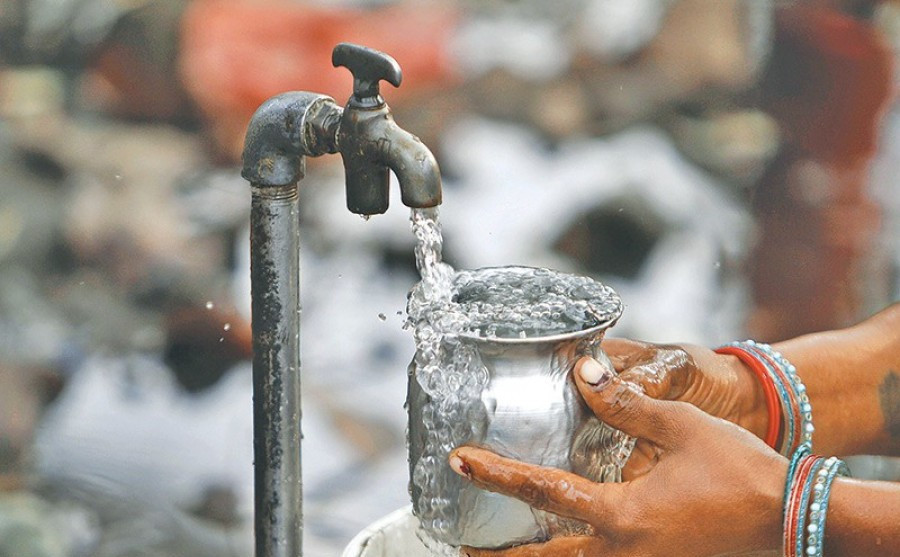
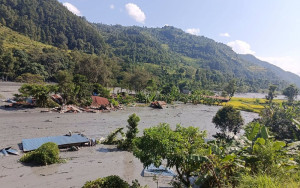
It is that time of year again when monsoon rains, flooding and landslides contaminate drinking water sources around the country, including in the Kathmandu Valley. In fact, the situation is particularly alarming in the federal capital, where recent government tests have confirmed the presence of hazardous faecal coliform and E. coli in every drinking water sample collected from households and public taps across five locations. This suggests that sewage is contaminating the water people consume every day. What is particularly disturbing is the presence of such harmful microbes in nearly every test. Similar tests in previous years had detected these microbes in tap and even in jarred and bottled water. Over time, little seems to have been done to make water safe for people to consume.
Nepal claims that around 95 percent of its population has access to basic drinking water, but a survey conducted by the Nepal Multiple Indicator Survey (MICS) 2024-25 earlier this year revealed that 60 percent of the water people drink is contaminated with E. coli and other harmful microbes. This contradiction exposes the culture of measuring success solely by the breadth of infrastructure distribution. But many of the pipes and taps supplying water to households are aging, leaking or installed near sewer lines. It is one thing to have access to water, another to ensure that it is potable. Furthermore, people are increasingly polluting water resources; rivers, streams and springs are becoming dumping sites for hospitals, households and companies.
When reports of water contamination surface, officials often ask water suppliers to chlorinate water before distributing it and to conduct regular quality tests. Instead of repairing the rickety water supply infrastructure, they shift the responsibility to citizens. People are asked to boil water, buy filters or purchase jarred and bottled water. Yet there are not feasible options for everyone. As a result, many continue to consume tap water and thus suffer from waterborne diseases such as diarrhoea, cholera, dysentery, typhoid, as well as hepatitis A and E, and in severe cases, succumb to them. The sense of urgency also soon dissipates when the monsoon ends and people no longer suffer from these diseases. There is little in terms of repairs and monitoring, and the same problems recur year after year.
Officials must stop blaming monsoon rains as the main culprit because rains only expose their failure to ensure access to safe drinking water, which is one of people’s fundamental rights and among the government’s most basic responsibilities. Better planning, stronger infrastructure and regular maintenance of leaking pipes would go a long way towards reducing contamination. Additionally, water suppliers should be held accountable for public health and required to comply with the National Drinking Water Quality Standard. Moreover, more water quality inspectors need to be hired and deployed to test water samples nationwide and provide real-time information about the safety of drinking water. The manpower should be adequate to ensure continuous, year-round monitoring.
Widespread faecal contamination of drinking water represents the state’s blatant abdication of responsibility to meet people’s basic needs. Health experts warn that the risk of a major outbreak of waterborne diseases remains high this monsoon. More people will fall ill and die if the government does not heed them.




 14.83°C Kathmandu