Government, victims of predatory lending close to agreement
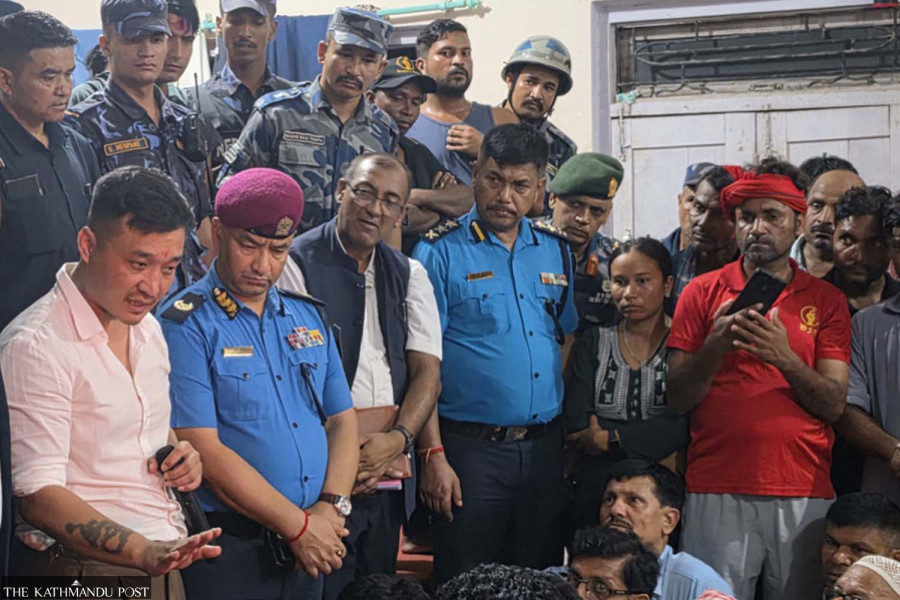
Home Minister Gurung agrees to declare usury a serious economic crime, cancel fraudulent loan documents and set up a special tribunal. Home Minister Sudan Gurung (left) holds talks with predatory lending victims at the Nijgadh Chamber of Commerce and Industry hall in Bara on Wednesday night. Shiva Puri/TKP
Talks between the government and victims of predatory lending have moved in a positive direction, although the two sides failed to reach a formal agreement on Thursday.
A meeting was held at Singha Durbar between a five-member government team led by Pushkar Sapkota, secretary at the Office of the Prime Minister and Council of Ministers, and representatives of the Farmers and Labourers' Movement Against Usury, a network representing loan-sharking victims. The formal negotiations followed an understanding reached earlier between Home Minister Sudan Gurung and the victims after several rounds of discussions.
Under the understanding, the government will classify usury as a serious economic crime and establish a dedicated legal framework to tackle predatory lending. It has also agreed to declare usury an institutionalised form of economic exploitation, invalidate fraudulent debt documents, and draft a special law within three months.
"The first day of talks has ended on a positive note," said Nirg Navin, a member of the victims' negotiating team.
He said the two sides will resume negotiations at 9 am on Friday. The talks are expected to formalise Thursday’s understanding in a written agreement.
A group of victims on June 25 commenced its march from Janakpur to Kathmandu to pressure the government for justice. Gurung on Tuesday visited Nijgadh in Bara for talks after the march reached the town.
Once usury is declared a serious economic crime, the government will begin invalidating all fraudulent financial documents associated with such practices, including forged promissory notes, fraudulent mortgage deeds, coerced cheques, and land transfers carried out under duress.
To provide a legal basis for these measures, the government will introduce a special law to combat usury.
The proposed law, to be drafted within three months, will define usurious transactions, establish criteria for identifying victims, provide compensation mechanisms, facilitate the return of land and property seized through usurious practices, expand access to institutional credit, and regulate private moneylending.
The understanding also outlines a comprehensive list of acts to be defined as usury-related crimes. These include preparing debt documents for loans that never existed, inflating loan amounts, capitalising interest into the principal to create new debt documents, charging interest above the legal limit, using threats or violence to recover debt, illegally seizing a borrower's movable or immovable property, forcing borrowers to issue blank or inflated cheques, compelling them to sign unnecessary documents, and authenticating financial documents without evidence of banking transactions.
The understanding also paves the way for establishing a special tribunal to hear usury-related cases. The proposed mechanism would be empowered to conduct forensic examinations of disputed documents, scrutinise bank statements and the sources of assets, initiate money laundering investigations into suspicious property, and provide legal mechanisms to review cases that have already been decided by courts or remain sub judice.
The move signals the government's intention to treat usury as a criminal offence rather than an ordinary civil debt dispute, according to victims.
The understanding also provides for a special task force to draft the proposed legislation and prepare an implementation roadmap within seven days of the formal agreement. The task force will include officials from the ministries of Home, Finance, Law, and Land Management, the Office of the Attorney General, Nepal Police, and representatives of the movement.
While in Nijgadh, Gurung met farmers, labourers and other victims who described how exorbitant interest rates, fraudulent debt documents and the threat of losing their homes and land had pushed them into severe hardship.
The minister remained in Nijgadh and nearby Simara for three days.
Without elaborate security arrangements or official ceremony, Gurung joined the victims in the meeting hall of the Nijgadh Chamber of Commerce and Industry, sitting among them as they recounted their experiences. He listened to each victim’s account of exploitation by moneylenders and the legal obstacles they had encountered, often sitting on the floor while taking notes in his diary.
Throughout the discussions, he asked detailed questions about how moneylenders inflated debts using forged documents, what support victims had received from local authorities, and where existing laws had failed. He repeatedly urged them not to judge his government by the actions of previous administrations and sought to reassure them by saying, "I am with you. I stand by you."
Representatives of the victims presented the home minister with a six-point demand. From the negotiation venue, Gurung called the prime minister and the chief secretary to brief them on the issues raised. He asked the victims to form a negotiation team and accompany him to Kathmandu for talks with the government.
During negotiations that continued late into the night over two consecutive days, representatives of the victims reiterated their long-standing demands: the cancellation of fraudulent debt documents, the strongest possible legal action against predatory moneylenders, the return of land and property seized by lenders, and the withdrawal of false criminal cases filed against victims.
On Thursday afternoon, Gurung reaffirmed that the government was fully committed to addressing the victims' demands and invited their representatives to Kathmandu to finalise the agreement with the government.




 14.69°C Kathmandu