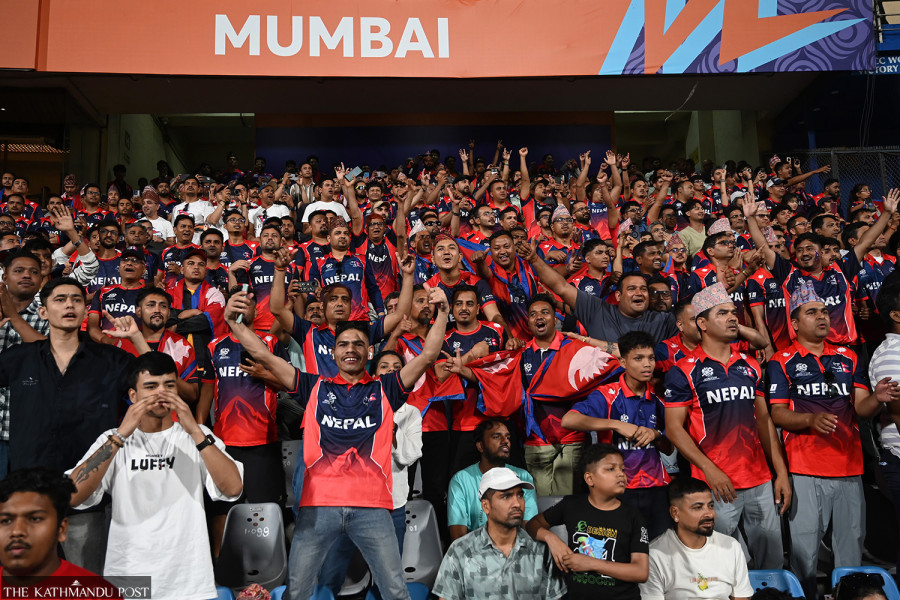
Authorities must ensure the Rhinos are not left waiting another decade for a taste of top-tier cricket.Nepali fans celebrate during the match against Scotland at Wankhede stadium on Tuesday. Angad Dhakal/TKP
Nepal’s journey in the 2026 ICC Men’s T20 World Cup might be over, but the incandescent spirit of the Rhinos continues to illuminate a nation on the cusp of navigating a way out of a political crisis. With the polls less than a fortnight away, there is a lesson to be learned from the 15 men in red and blue. While the political landscape back home remains precarious, the national cricket team has achieved what no manifesto can: Generating a singular, heart-thumping pulse of national unity. It is high time the governmental authorities and the Cricket Association of Nepal (CAN) took a proactive role as the architects of cricket's future.
The recent exploits in the World Cup were nothing short of a sporting catharsis. To see the Wankhede—the cathedral of Indian cricket—swallowed by a sea of Nepali fans, many of whom travelled from as far as the US, Europe, and across Asia, was a declaration of Nepali cricket’s global footprint. This was not a moment of emotional overachievement but a statement of arrival. When the Rhinos stretched the two-time champions, England, to the very last ball, losing by a mere four runs, they earned the world’s respect. Icons like Dale Steyn, Ravichandran Ashwin and Darren Sammy have rightly noted that Nepal is no longer an underdog, but a ‘giant in the making’, outgrowing the patronising labels of the past.
However, the heartbreak of that four-run loss to England and the consecutive defeats before the final victory over Scotland exposed a glaring lack of experience in high-pressure situations. Nepali players were assessed not on spirit, but on tactical execution and composure—areas where the finishing touches were noticeably absent. As skipper Rohit Paudel candidly admitted, the team desperately needs regular series against Test-playing nations to understand where they truly stand. One-off matches every few years are insufficient to bridge the chasm between Associate status and the elite tier.
To secure bilateral series with full members, the government and CAN must now display the same lightning-fast footwork shown by Dipendra Singh Airee on the field. Nepal must demand, not request, more exposure. The players deserve more than the ‘cardiac kids’ label; they deserve a schedule that pits them against the best in the world consistently, not just during ICC events. The lack of experience is not a failure of talent, but a failure of opportunity—a failure that rests squarely on the shoulders of the sports bureaucracy.
Fortunately, the foundation for this leap forward has already been laid by the Nepal Premier League (NPL), which has transformed into a vital ecosystem for the sport. By generating at least Rs400 million this season, CAN has shown that cricket is a viable, thriving industry capable of attracting massive sponsorship even when other sectors struggle. The NPL has been the great healer in the aftermath of the Gen Z movement, proving that Nepal is ‘back to normal’ and capable of hosting world-class events.
As the March 5 elections approach, political leaders would do well to observe the unifying effect of the sport. Cricket has shown that despite the things that divide us, we have enough commonalities to celebrate together and pull through difficult times. The time for tangible backing is now. The authorities must amp up their diplomatic and administrative efforts to ensure the Rhinos are not left waiting another decade for a taste of top-tier cricket: secure the matches, build the stadiums, and let the Rhinos roar with the experience they have so valiantly earned.




 26.12°C Kathmandu