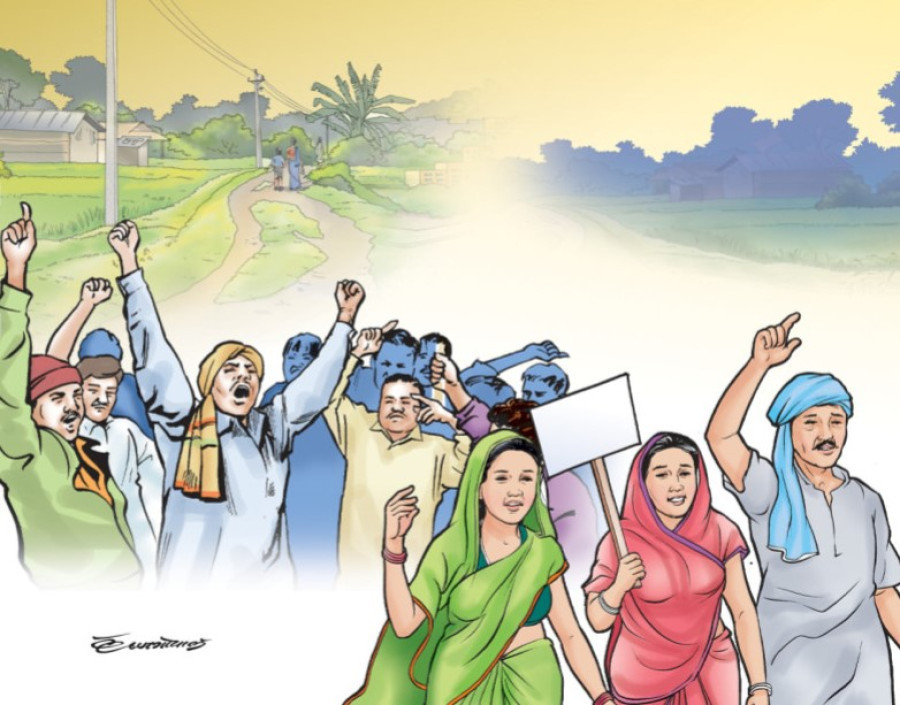
The political outreach to Madhesh of political forces has intensified in the run up to the March 5 elections. Rastriya Swantantra Party (RSP) senior leader Balendra Shah chose to hide his Madheshi identity while contesting for Kathmandu Metropolitan City mayor. Now, he projects himself as a son of Madhesh. In a mass address in Janakpur in the third week of January, Shah and other RSP leaders appealed to people to vote for the party in order to elect the ‘first prime minister from Madhesh’. The Nepali Congress, on the other hand, has fielded its president, Gagan Thapa, from Sarlahi-4. He claims to have moved away from a comfortable seat in Kathmandu-5 with the larger goal of transforming the entire Madhesh region. The grand old party has also chosen Janakpur, the provincial headquarters, to unveil its election manifesto. With more than two weeks still to go to the vote, other parties are expected to come up with similar targeting of the Madheshi constituency.
Many fail to understand Shah’s sudden portrayal of himself as the son of Madhesh, and the Congress decision to field its president and unveil the poll manifesto from Madhesh. The country’s most densely populated province is home to a fifth of the country’s 18.9 million voters, even as it covers less than seven percent of the landmass. With 32 seats under the first-past-the-post system, it sends a total of 55 lawmakers to the federal parliament when proportional representation is included, making its role in national politics pivotal. This electoral weight has prompted parties across the spectrum to develop strategies to appease Madheshi voters.
Historically, Madhesh has openly and unreservedly embraced leaders, regardless of their party affiliations or communities. After being beaten twice from Kathmandu in 1991 and 1994, then Nepali Congress veteran leader Krishna Prasad Bhattarai was elected with thumping votes from Parsa-1 in 1999, which opened the path for him to assume the country’s leadership for the second time. The example of former prime minister and incumbent Nepali Communist Party co-ordinator Madhav Nepal, who has enjoyed a spate of electoral victories from Rautahat, also proves that Madhesh does not discriminate on the basis of caste and ethnicity. Even the CPN-UML, the second largest party in the dissolved House, often billed as an ‘anti-Madhesh’ force, did well in the province, winning the most first-past-the-post seats for the federal parliament and becoming the largest party in the provincial assembly.
Despite electing leaders who went on to shape national politics, Kathmandu’s response has fallen short of meaningful reciprocity to Madhesh. The home of the country’s most fertile lands falls behind in every socio-economic indicator, largely because of Kathmandu’s indifference. It ranks sixth, just above Karnali, in the Human Development Index. Districts such as Sarlahi and Rautahat have some of the country’s worst illiteracy rates, alongside limited access to healthcare and sanitation. A large number of migrant workers are from Madhesh, reflecting the scarcity of local jobs. Inequality remains pronounced, while the representation of the Madheshi communities in state institutions continues to fall well short of their proportional share.
The country is now 16 days away from the March 5 elections, and a new government will be in place within the next month and half. And the political parties and their leaders are again offering Madheshis all kinds of promises. This kind of vote-bank politics in Madhesh does great disservice to this province that provides food and sustenance to the rest of the country but is mired in poverty and inequality.




 14.69°C Kathmandu