Until a few years ago, the big fear in Nepal was that it could go the way of Sri Lanka, which in 2022 overthrew the Rajapaksa regime following an economic crisis and nationwide protests that it sparked. Then, in July 2024, a student-led movement in Bangladesh threw out the Sheikh Hasina government, as at least 1,400 people were killed in the violent protests. In September 2025, Nepal witnessed its own Gen Z revolt, which led to the ouster of the KP Oli government and the formation of an interim electoral government. By the time of the protests in Nepal, it had been over a year since the ouster of Hasina in Bangladesh. Yet the country on the Bay of Bengal appeared nowhere near prepared to hold elections. Many reckoned that Nepal too would struggle to hold timely elections. There was no political consensus on March 5 elections; the country’s security situation was fragile.
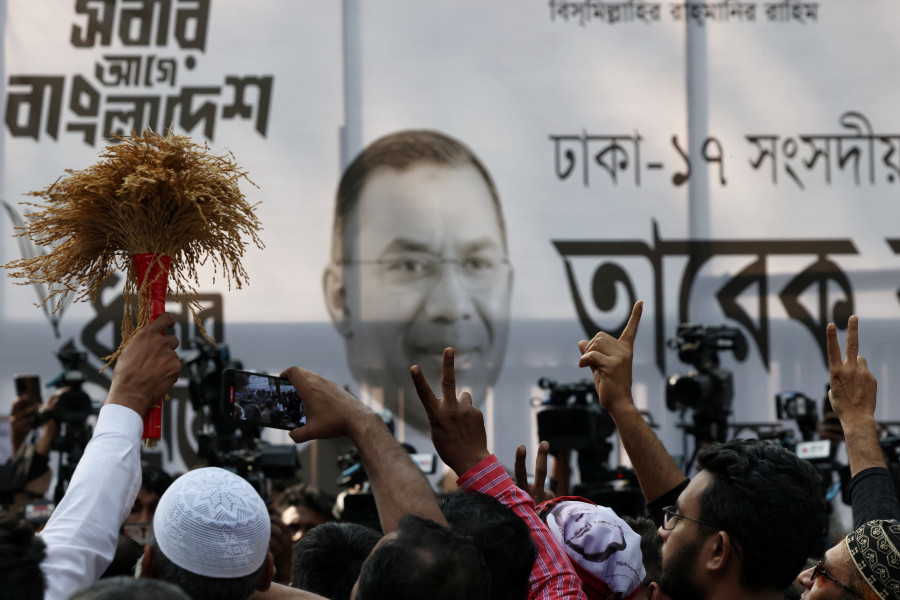
Yet this comparison no longer holds true following the successful February 12 Bangladeshi elections, which saw over 60 percent of eligible people cast their ballots. Not only did the caretaker Muhammad Yunus government prove its doubters wrong by holding (the mostly peaceful) elections. The worst fears over electoral outcomes have also been removed as the Bangladesh Nationalist Party (BNP), a centrist force, got an absolute majority, winning 209 of the 300 contested seats. The big fear was that the Jamaat-e-Islami, an Islamist party that had threatened to impose Sharia laws and ban women’s participation in politics, could sweep the polls. The party’s electoral prospects had been boosted when they made common cause with the leaders of the 2024 student movement. Yet in the February 12 elections, the Jamaat won only 68 seats, in what was still its best electoral haul in history. But its version of Bangladesh clearly did not resonate with most Bangladeshis.
The coming to power of a moderate force like the BNP is in the interest of Bangladesh as well as the region. With over 170 million people, it is not a small country. Events there have ramifications near and far. We would like to take this opportunity to congratulate Bangladeshis for overwhelmingly choosing a path of moderation, something they can now build on to create a more egalitarian and prosperous country. It also opens the door for more amicable ties with India, the regional giant, whose relations with Dhaka have reached an all-time low. Such thawing of Dhaka-New Delhi ties in turn would have a salubrious effect on regional trade and connectivity. Nepal, for instance, could be a direct beneficiary as it would be able to sell more electricity to Bangladesh via India. Yet such positive developments are not a given. The prime minister in waiting, Tarique Rahman, will face a raucous opposition in Jaamat, while he will also be under pressure to enact the reforms mandated by the 2024 uprising, which, among other things, entail women’s greater representation in politics, a two-chamber legislative and more decentralised national leadership. Improving ties with India is also easier said as there continues to be a big gulf in understanding the message of the 2024 uprising between Dhaka and New Delhi.
Again, Bangladesh offers a heartening lesson for Nepal. If Bangladesh, which witnessed such bloodshed and where religion was such a divisive electoral issue, could successfully hold elections, there is no reason Nepal, a much less troubled and contested country, cannot do so. Even for regional peace and stability, we hope Bangladesh will continue to walk down the path of moderation charted by the new elections.




 14.82°C Kathmandu