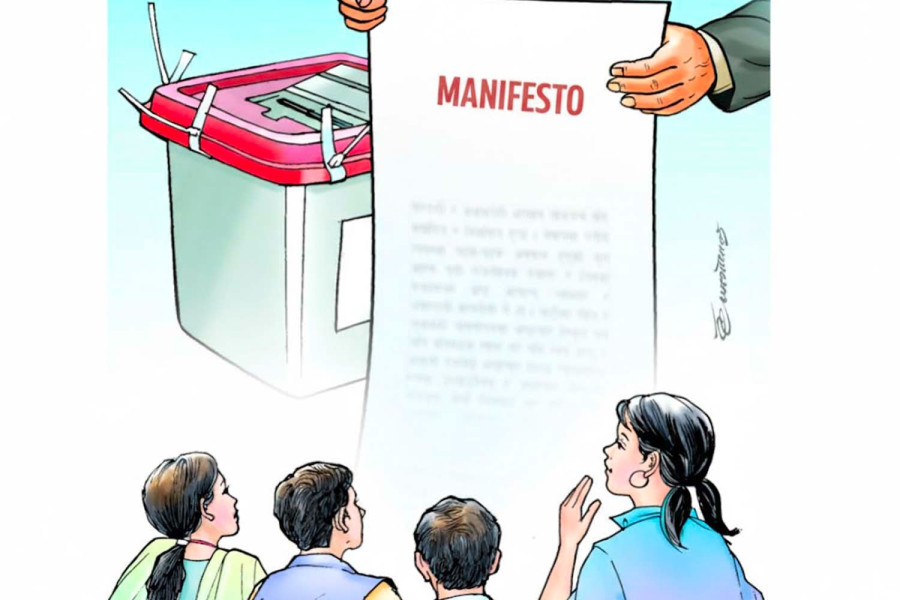
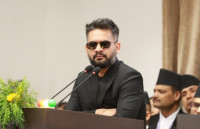
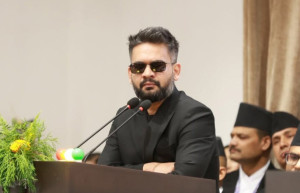
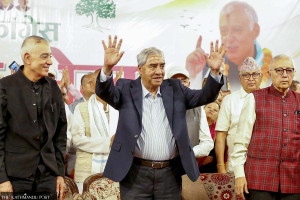
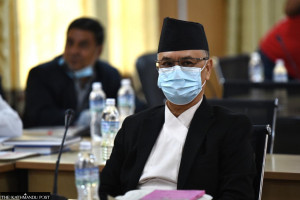
The Rastriya Swatantra Party’s prime ministerial candidate Balendra Shah has calculated that his electoral cause will be best served by saying as little as possible on the campaign trail. This is in keeping with the image he cultivated as the mayor of Kathmandu, when he gained popularity by ‘speaking less and doing more’—or the exact opposite of how most Nepali political leaders function. The March 5 elections, he reckons, will turn more on his cult of personality than anything he or his party put forth as their agenda. Perhaps realising that most Nepalis want ‘delivery’ over ‘doctrines’, in place of a party manifesto, the RSP will publish a “contract” document. “We will present our agenda to citizens and enter into a contract with them,” says the party. This business-like approach to electioneering is in contrast to the election plan of the CPN-UML, the party of KP Sharma Oli, the controversial prime minister at the time of Gen Z protest. Beside “economic development, good governance and service delivery,” its new manifesto will also keep harping on the old communist tropes of “protecting national sovereignty and unity,” while also emphasising the ‘destructive’ nature of the Gen Z protests.
Likewise, “Vision 10” of the Nepali Congress will supposedly lay out the party’s economic priorities and address the major demands of the Gen Z uprising. Perhaps the most jargon-laden manifesto will be that of the Nepal Communist Party, which prioritises “development of a self-reliant economy, practising socialism right from local level, and advancing socialism with Nepali characteristics.” But, one might argue, what is the use of these formal documents which, based on Nepali history, have little bearing on how the respective political parties govern after the elections? One technical answer is that the Election Commission requires all the parties to submit their manifestos pre-election. The real purpose of these manifestos is of course to hold these political parties accountable on their promises. Even if few read them, such documents provide a window through which to gauge individual parties’ priorities. Yet as the ‘Balen phenomenon’ suggests, the upcoming elections are likely to turn on personality cults of leaders rather than promises of political parties. This is again plausible in a polity where politicians have repeatedly sold people short on their tall promises.
Yet the paucity of ideological and policy debates in the lead up to the polls is still dispiriting. Irrespective of the individual capacities of political leaders, politics based on personality cults tend to be authoritarian and anti-democratic. Perhaps for this very reason official party documents as election manifestos will have their use. Besides revealing the parties’ biases and leanings, they also serve as some kind of a benchmark with which to measure their performance if they get to form the government. A reflection of their priorities for the elections, the parties must also write them with care. In the process, certain public agendas, which the parties might otherwise have ignored, tend to get fleshed out. In this way, these documents will serve a vital function both before and after the ‘post-ideology’ March 5 elections.




 15.26°C Kathmandu