The foundational responsibility of any democratic state is to ensure that every citizen gets to cast their ballot without undue pressure. Yet, as Nepal gears up for the March 5 snap elections, this responsibility may not be uniformly honoured. For the voters in the restive fringes—remote districts like Bajura and Bajhang—the democratic exercise feels like a recurring nightmare. In these areas, the act of voting has historically been a spectator sport where local strongmen dictate the outcome while voters are sidelined by intimidation. If the government and security forces are to claim the legitimacy of the electoral process as ‘free and fair’, they must move beyond the optics of deployment of security officials and confront the entrenched culture of booth capture and ballot manipulation in these areas.
The incidents that unfolded in these areas in previous electoral cycles paint a grotesque picture of what happens when the state’s political will disintegrates, and security’s grip falters. In the 2022 general elections, Bajura became a grim theatre of electoral malpractice where 24 polling stations were reportedly captured, and two young lives were lost to the madness of partisan clashes. The accounts from these remote areas represent a systemic disenfranchisement of the vulnerable. Voters recall reaching the polling station only to find their votes cast by others, while women have spent decades reaching the booths only to have their ballots snatched by party cadres and election employees.
The security landscape for the March 5 polls is relatively complex in Nepal’s recent history, marked by an alarming rise in ‘highly sensitive’ polling stations. Of the 10,967 polling stations across the country, 3,680 have been categorised as highest-risk, a significant increase from 3,412 such stations in the last election. This risk is exacerbated by the unconventional challenges following September’s Gen Z movement. Security agencies are currently struggling with the aftermath of the uprising, which left hundreds of weapons in the wrong hands, while many escaped prisoners remain at large.
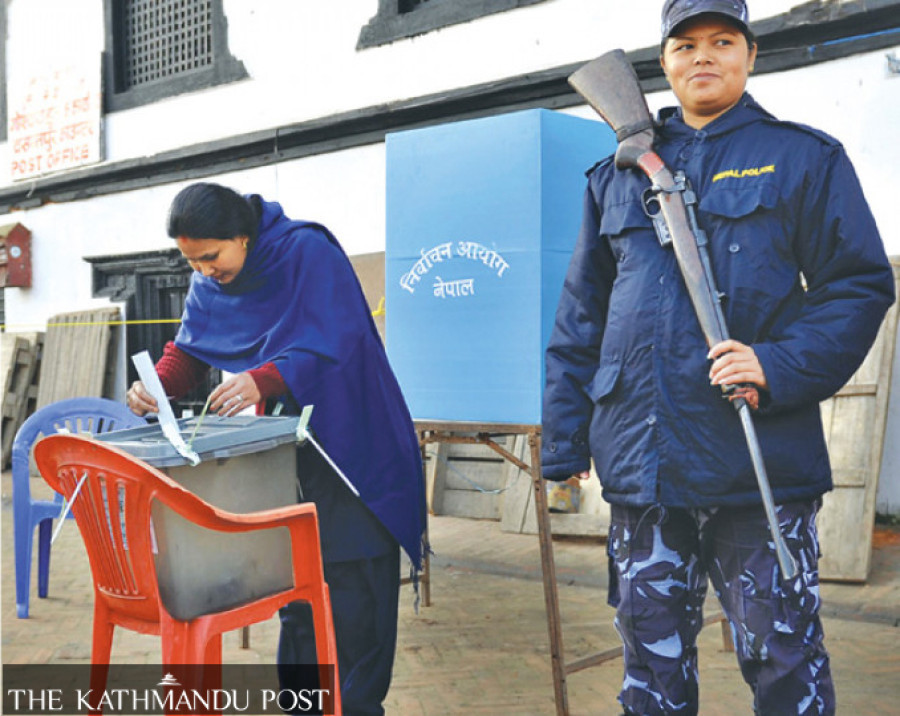
The state is mobilising a massive security apparatus of 338,000 personnel, including the Nepal Police, Armed Police Force, and a temporary election police force. However, the true test of this deployment lies in its ability to prevent the traditional threats of booth capture and proxy voting that have historically marred remote areas. Technical safeguards like CCTV and drone cameras are being extensively planned for high-risk districts. But technology is only as effective as the persistence of the human will behind it.
Security forces must maintain an agile posture against the inflammatory political rhetoric that often precedes physical clashes. While the police are using specialised software, eMonitor+, to track disinformation, misinformation and voter manipulation online, they must also amp up the process to strictly book the offenders. The 150,000 newly recruited election security personnel should be strictly trained to intervene if they witness proxy voting or ballot snatching.
The March 5 election is a milestone opportunity for change in Nepali politics. That change cannot be built on a foundation of rigged results and the silence of intimidated voters. No voter should be ‘assisted’ into silence by party cadres. No voter should reach the polling booth to find their vote already cast. The heavy presence of 80 personnel per polling station must actually translate into safety rather than just more boots on the ground. The state’s duty is to protect the democratic right of 18.9 million citizens to cast their ballots without intimidation. Anything less would be a betrayal of the movement that sought a new dawn for Nepali politics.




 14.82°C Kathmandu