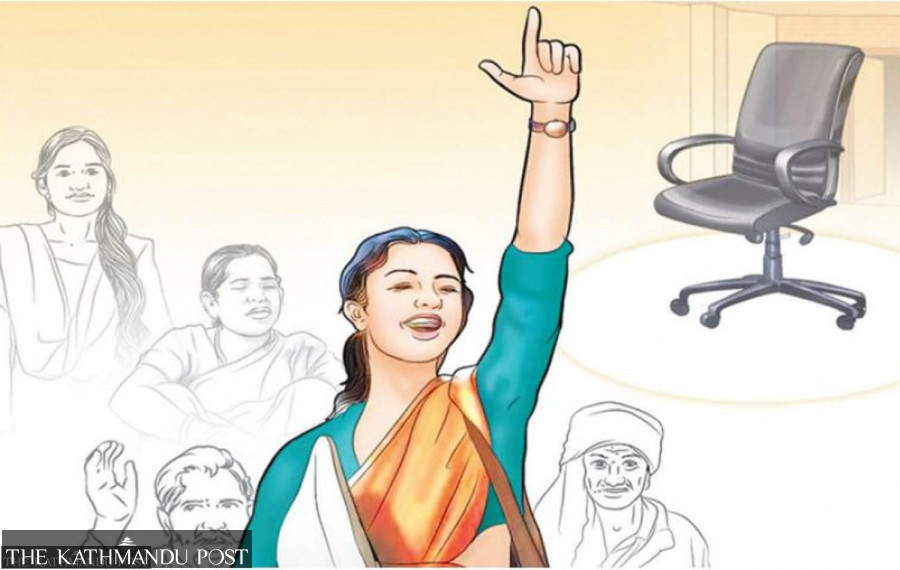
No matter how much we talk about creating a level playing field between men and women in Nepal, the ground continues to be heavily tilted in men’s favour. Even in Nepali politics. Often, it appears that all the discussions and debates aimed at addressing the gender imbalance have fallen on deaf ears. The Nepali society, it seems, is just not ready to accept that men and women have equal rights, including to contest elections. The parties across the political spectrum were rightly criticised when it emerged that just 11 percent of the direct election tickets for the March 5 polls were going to women, giving a clear message that women are not capable of being elected through a direct vote. Yet why only blame the political parties when even society at large does not easily accept women’s candidacy? Even the 11 percent women who have been picked as direct candidates are being harassed and body-shamed, especially on social media. Ranju Darshana, a direct election candidate from the Rastriya Swatantra Party (RSP), who also happens to be pregnant, is being told to stay at home, as she is seemingly unfit to campaign. Others have body-shamed her. In other words, instead of encouraging this courageous woman who has not let a personal issue come in the way of her desire to serve society, she is being hounded and discouraged.
But Darshana is far from the only woman who is a victim of our entrenched patriarchy that is finding free expression online. Tashi Lhazom, another direct election candidate from the RSP, also has had to constantly justify her presence in the race. Earlier in her campaigning, Tashi was told to ‘go back to where you came from’. Questions were also raised about her Nepali identity when she was reportedly considered for a ministerial position in the interim government. The anonymity afforded by the online social spaces has made the problem worse. There has, in fact, been a steady increase in cases of online violence against women in Nepal, and this election-eve, the women candidates are at the receiving end. While male candidates are judged based on their agenda, for women candidates, the judgment starts with how they look and present themselves. And if they don’t measure up on some arbitrary standards of ‘decency’, they are relentlessly trolled.
Our politics is only a reflection of our society. If the electorate expects their politicians to be upright and holds them to the highest moral standards, people must also start questioning their own biases against certain genders, ethnicities and areas. Yet this kind of self-policing is unlikely in the chaotic world of social media. Successive governments in Nepal have tried to stifle free speech by passing restrictive laws that police social media content. Their goal has not been so much to ‘regulate’ social media but to ‘restrict’ it. This, in turn, has fueled doubts about any such effort to prevent the spread of fake news and hate speech online. But as it is becoming clear this election season, there is an urgent need to start nuanced debates on how best to prevent the worst excesses online. When elections, the bedrock of democratic societies, are systematically tilted against women, who make up over half of the national population, the democratic process might itself come under threat.




 14.82°C Kathmandu