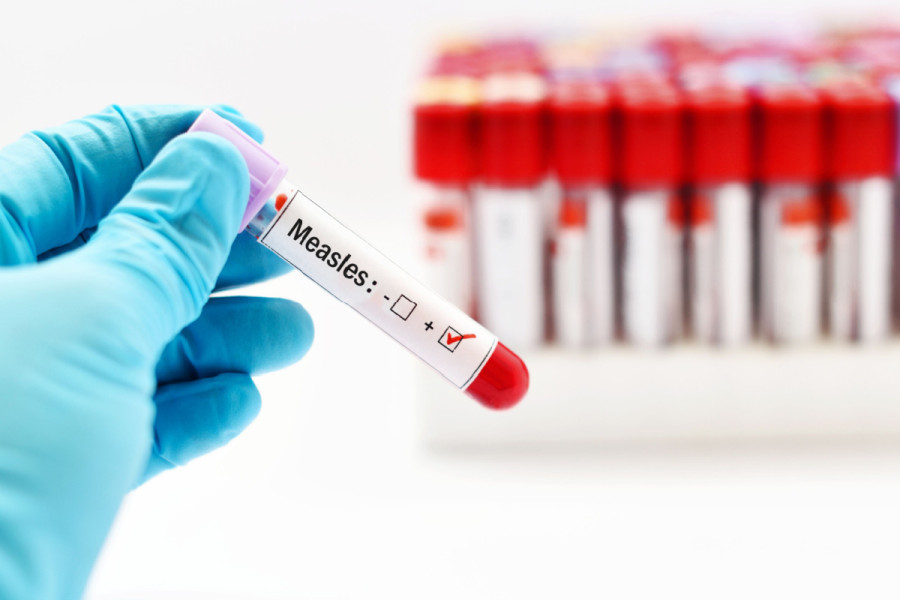
Measles, a ‘highly contagious’ viral disease, is far from gone in Nepal. The country had promised a measles-free future by 2026, but it has resurfaced in Malangwa Municipality of Sarlahi district, where 23 children have been infected. Of them, seven tested positive, while others were epi-confirmed (or confirmed based on symptoms and exposure patterns). The outbreak, the first in more than two years, is apparently the result of a vaccination gap and a lack of public awareness. The fact that the deadly disease continues to trouble primarily children—even with the government providing free vaccines against measles by including a two-dose Measles-Rubella (MR) vaccine at 9 and 15 months of age—suggests the misplaced priorities of our health authorities.
The re-emergence of measles is not only a setback for Nepal’s aim to eradicate the disease but also a gross neglect of public health. Measles, being an airborne disease, first infects the respiratory organs and then fans to other parts of the body. Symptoms appear 10-12 days after infection and include high fever, a runny nose, red and watery eyes and tiny white spots inside the cheeks. Following this, rashes appear on the face, upper neck and other body parts. In worst cases, it can lead to blindness, pneumonia, ear infections and encephalitis, and even death in people of any age.
As per the World Health Organisation, vaccination is the best way to prevent measles, and those who are not vaccinated are the most vulnerable. Studies show that globally, immunisation activities played a vital role in reducing deaths, from 780,000 in 2000 to 95,000 in 2024. Working with the commitment to vaccinate all and robust surveillance systems, three sub-Saharan countries—Cabo Verde, Mauritius and Seychelles—successfully eradicated measles and rubella last year. Nepal has much to learn from these small developing countries.
But rather than pulling off mass and targeted vaccination campaigns, Nepali authorities often rush to declare the country measles-free. In doing so, they have gone so far as to produce a faulty report, as had happened in Dhading district in 2020. In the Soldanda village of Benighat Rorang Municipality, children were found to be infected with measles even though the district was declared fully immunised in 2018. None of the children in the village was immunised. Because of such lapses, Nepal has repeatedly missed its measles-elimination goals for three years—2019, 2023 and 2026. In response to the recent outbreak, the government on Monday initiated a vaccination drive for all children under 15.
The resurgence of measles in Sarlahi also points to the possibility of measles infection in other settlements with poor vaccination status and awareness. A study titled “Measles-rubella surveillance and its facilitators and barriers in Bagmati province, Nepal” shows that the second dose of the Measles-Rubella (MR) vaccine coverage of 95 percent, which is a key strategy to eliminate measles, was not realised in most municipalities of Sindhupalchok, Makwanpur and Chitwan districts. Health authorities must take a cue from such studies and immediately vaccinate children, as well as deploy health workers to enhance surveillance of vaccine-preventable diseases. People’s fear and scepticism about vaccination and religious values also prevent them from getting vaccinated; they must be taken into confidence to ensure full vaccine coverage.
Failing to prevent vaccine-preventable diseases such as measles would further strain an already struggling healthcare system. This warrants adequate investment in the health sector, with a focus on full vaccine coverage. Without this, doing away with the highly contagious disease will remain an elusive goal.




 19.27°C Kathmandu