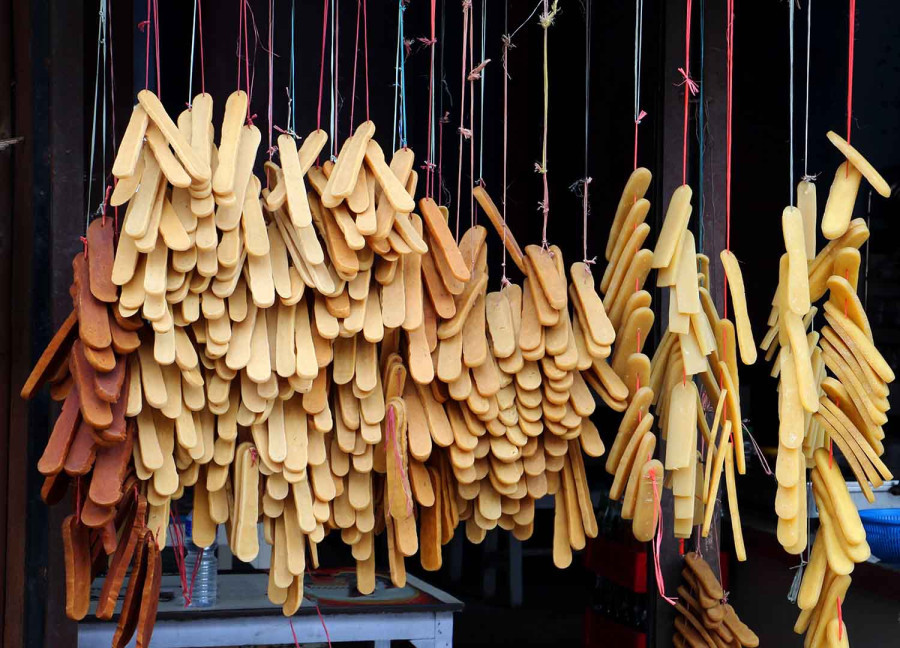
Nepalis’ love for chhurpi is unmatched. Made from yak, cow or buffalo milk (sometimes mixed) using traditional techniques and cut into small cubes, this hard, fermented cheese gradually softens and gets chewier with every bite. Over the years, chhurpi, especially made for pets such as dogs and cats and known as ‘dog chew’, has seen remarkable export growth. In the previous fiscal year alone, the country exported Rs4.51 billion worth of the stuff. Of the total dog chews produced primarily in the eastern hill districts of Ilam, around 90 percent make it to Western countries. For instance, in the same year, the US imported more than 1,800 tonnes, followed by Canada, the UK and other countries. Despite this, Nepal for long lacked a quality standard for chhurpi, which hindered the product’s growth potential in a competitive global market. No more. The Department of Food Technology and Quality Control has just introduced quality standards for traditional Nepali foods, including chhurpi.
A quality standard is a prerequisite for any food product, be it in the domestic or global market, as it protects producers and consumers from health and safety risks. Although Nepal pioneered chhurpi production, several other Asian countries have followed in our footsteps, so ensuring its quality to sustain global competitiveness is vital. Most importantly, with exports rising substantially, the need to monitor and verify product quality to maintain the popularity it has gained over the years has become more important than ever.
Chhurpi must be edible and free of fungus and pests. It should not have been refined, and must taste and smell good. Moreover, because it is prepared manually using traditional techniques, the risk of contamination with stones, sand, plastic, metal, hair, straw and livestock waste is high. So, it should also be free of such substances. Furthermore, the standard also seeks to enhance the nutritional value and hardness of chhurpi by requiring at least 60 percent total milk protein by dry weight. It also classifies high-fat chhurpi (5 percent or more milk fat) and low-fat chhurpi (less than 5 percent milk fat).
Standards have also been set for its packaging and labelling, which are vital to smooth export and build trust among buyers. In order to keep up with the growing demand for this product, some businesses are found producing soft cheese from cow milk and mislabelling it as yak cheese. With new standards in place, such unscrupulous entities and individuals will be held accountable for up to six months of imprisonment, a fine of up to Rs300,000, or both. Concomitantly, if the product is found to be contaminated, individuals may face imprisonment for up to five years, a fine of up to Rs500,000, or both.
By setting these quality standards for this most-loved local product, Nepal has sent a clear message to the world that chhurpi is a high-value food item. Nonetheless, more effort is needed in its implementation to increase market reach and ensure compliance with quality and standards. Chhurpi producers are also concerned about high milk prices and lack of government subsidies, which in turn is making it difficult for them to compete in the global market. The southern neighbour, India, where milk prices are lower than in Nepal, is emerging as a key competitor in dog chew manufacturing. There is thus an urgent need to incentivise Nepali chhurpi producers in various ways. Only then can Nepal take chhurpi exports to new heights.




 21.87°C Kathmandu