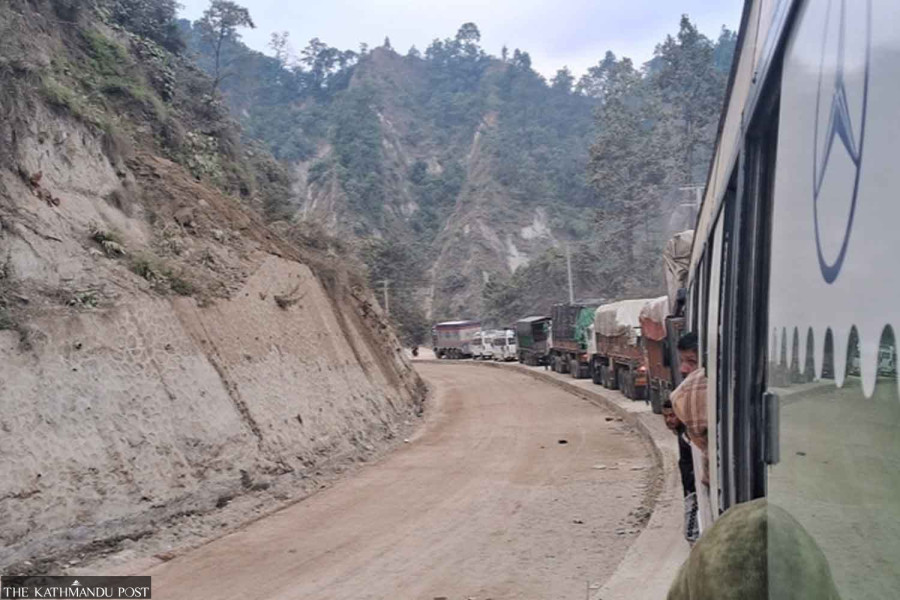
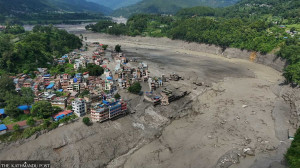
The Narayanghat-Butwal road widening project has become yet another example of Nepal’s poor development track record. The upgrade of the 114-km stretch along the East-West Highway started in February 2019, with the revised completion date of July 2024. In seven years, the project is nowhere complete as the work is again stuck, particularly in the difficult 14-kilometer Daunne section. Seven years after the project commencement, the engineers and officials involved are still confused on the design of the road section. Traffic movement on this road, one of the busiest highway sections in the country, was obstructed at least 32 times in under six months between July 17, 2025 and January 4, 2026, according to local police. It is not the first road project in Nepal to progress at a glacial pace. The 88-km Muglin-Pokhara road widening project, which began in 2021, is supposedly near completion. But its deadline has already been extended for the fourth time.
When it comes to the debate on development in Nepal, people in power and those linked to them try to mislead. They argue that a lot of things have happened, particularly in terms of expanding road connectivity across the country. They say Nepal has made significant progress, based on examples such as the upgraded parts of Muglin-Pokhara road, Butwal-Bhairahawa section or Maitighar-Baneshwar stretch in Kathmandu. But these are the exceptions that only prove the rule of overall delay. Many of our highways and key roads that were built decades ago literally look like inner Kathmandu roads where two buses coming from opposite directions can’t easily pass. Even a big boulder can block such ‘highways’ for days.
Nepal is scheduled to graduate from the ranks of the Least Developed Countries category this year. For that, it is vital to strengthen its competitiveness in trade and entrepreneurship. This cannot be done without roads that ensure reliable and predictable mobility of people and goods. Also, as a country that is ever-aspiring to expand tourism, Nepal must urgently upgrade road infrastructure and quality of transport services. For one, quality roads are essential to extending tourist stay. Roads also lead to the expansion of the tourism-related eco-system to the grassroots.
Historically, Nepal depended on other countries to build major roads. The situation is the same. The country couldn’t develop even the expertise to operate built highways, let alone build new ones. The situation is dire. For instance, when a gas tanker coming from India overturned in Rautahat a week ago, it blocked the East-West Highway. It took 24 hours for authorities to resume traffic there. In September last year, Karnali Highway was blocked for days just because a boulder there could not be removed.
This way, Nepal can neither develop economically nor make much progress in the social sectors such as health and emergency services. It is thus high time to revisit policies to strengthen Nepali agencies’ efficiency. If needed, the private sector, which can now build roads only as contractors, can be given a greater role, like they have in the development of the hydropower sector. The business-as-usual approach is clearly not working.




 19.27°C Kathmandu