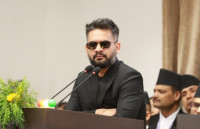
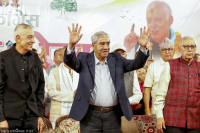
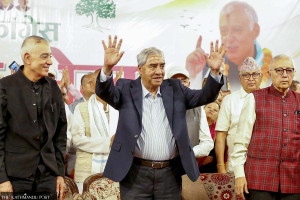
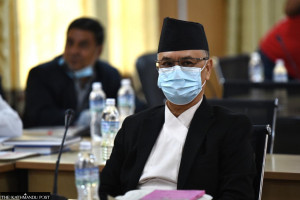
Delegates must think of their and their party’s long-term future when they vote for a new leader today. UML chair KP Sharma Oli (right) and senior vice-chair Ishwar Pokhrel Dipen Shrestha/TKP
The CPN-UML’s 11th general convention started with an open session at Sallaghari, Bhaktapur, on Saturday. The next day, the party’s central committee and later the convention delegates passed a proposal to expand the number of officebearers to 19, a move considered favourable to party chair KP Oli’s quest to hold on to power. It was not a surprise; in fact, considering how everything related to the convention has been favourable to Oli, people are forced to ask: Is this a UML convention or an Oli convention? The statute convention, held just three months ago, had lifted the 70-year age limit and the two-term moratorium for the party chair, enabling septuagenarian Oli to contest the position again. Earlier, former President Bidya Devi Bhandari was blocked from returning to active politics when she posed a threat to Oli’s stronghold. His already solid grip on the party has been further solidified with each of these political moves.
The general convention was supposed to bring about a change in the party leadership, at least change its top leader. A dissident faction rallied behind senior vice-chair Ishwar Pokhrel to challenge Oli. Pokhrel, a long-time trusted Oli lieutenant, is perhaps not the ideal candidate to take over the party right now. Yet he seemed to be the only viable option to Oli. And even so, the playing field was already tilted. The convention delegates have supposedly been picked based on their loyalty to Oli. As it will be the same individuals who vote in the election for the party’s officebearer positions today, it is an open secret who will win the leadership contest.
September’s Gen Z uprising had sent a clear message: The youth want reform in political parties and accountability from political leaders. It has been more than three months since, and among the three mainstream parties, the UML under Oli has been the most reluctant to heed the protesting Gen Z-ers, making the party seem out of touch with the country’s ground reality. Yet most delegates are again in a mood to re-elect Oli.
In supporting Oli and by extension his political malpractices, they assault the party’s charter, undermine the sentiments of party cadres, downplay the spirit of the Gen Z movement, and undercut the very foundations of communist philosophy. The party has opted to tread a precarious path. The party, under Oli’s leadership, has cultivated a politics of negation, whereby the party cadres who question his leadership do not make it to the convention. If the internal democracy of a party is in such a dire state, how can we expect it to uphold the larger democratic values?
The UML, otherwise a large and well-organised democratic outfit, again risks setting a flawed precedent under Oli. If the convention delegates give their stamp of approval to the proponents of such blatant favouritism, they will have to shoulder the blame for what befalls the UML after the convention. Otherwise, they must reflect on the party’s recent trajectory and take a stand against Oli’s autocracy when they vote for their new leader today. It is never too late to do the right thing and safeguard both their as well as their party’s long-term interests.




 20.85°C Kathmandu