



 25.92°C Kathmandu
Tue, Oct 27, 2026
Editorial
No more delays
Slow reconstruction in the quake-hit areas littered with compromised infrastructure is unacceptable.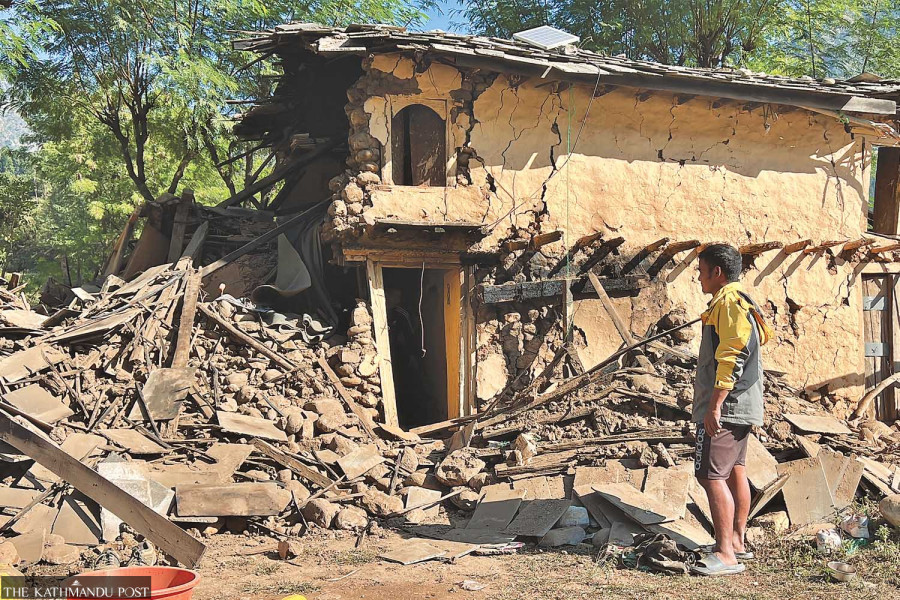
bookmark
Published at : December 3, 2025
Updated at : December 3, 2025 06:46
The magnitude 6.4 earthquake in November 2023 badly shook Jajarkot, Rukum and Salyan districts. More than 250 people died, and hundreds were injured. In Salyan alone, it destroyed 4,374 structures and displaced over 6,000 people in the district’s Darma Rural Municipality. Yet the district authorities have only recently started assessing the extent of the damage, without which there can be no reconstruction of houses. Following the National Disaster Risk Reduction and Management Authority’s (NDRRMA) training for municipal technicians this week, they have reportedly been deployed to affected areas. Though late, this is a much-needed step. However, the delay hints at the state’s lax disaster response and suggests that post-quake assessment has not been a priority for successive governments. In fact, fragmented mandates from the federal government, poor coordination among governments and uncertainties in operational decisions have often been the norm in post-disaster recovery.
Even as Salyan sustained extensive damage, the assessment process dragged on as the government focused on Jajarkot and Rukum districts. Nonetheless, even in Jajarkot, the assessment began almost 15 months after the quake, with many families still waiting for reconstruction activities and funds. The assessment is yet to conclude, and the victims aren’t satisfied with what has happened so far. In Salyan, as of now, more than 2,000 displaced families in the district await the first instalment of the Rs50,000 emergency relief the then Pushpa Kamal Dahal-led government had declared. As a result, earthquake-affected families in the districts are still forced to live in makeshift, patched-up houses where they will have to deal with yet another harsh winter.
Reconstruction assessments in Salyan’s Darma Rural Municipality’s ward 2 have now begun, but work in other wards also cannot be put off any longer. The authorities must act swiftly. The reconstruction process should begin soon after assessments, and people get the promised funds to either build (Rs400,000) or retrofit their homes (Rs250,000), with clear classification of habitable, repairable, partially damaged, fully damaged and houses needing new construction. These assessments must be quick so the NDRRMA can disburse reconstruction funds. Past experiences have also highlighted technical and procedural hurdles while disbursing funds to the beneficiaries. To avoid this, local governments need to put in more effort in order to identify genuine victims, and federal and provincial governments maintain effective collaboration with local authorities. The decision to begin assessment has buoyed many earthquake survivors—yet there is a long way to go to complete the process.
Delays in reconstruction activities are not healthy signs for an earthquake-prone country like Nepal. Nepal’s 2015 devastating earthquakes and their aftershocks, along with frequent shocks in the areas adjoining the Himalayas, expose the seismic vulnerability of these areas. Nepal, being in a high-seismic risk zone, cannot afford to slow down reconstruction activities in the quake-hit areas littered with compromised infrastructure.
Already, in the winter months since the 2023 earthquake, over 35 people have succumbed to the cold in Jajarkot; those who survived have also had to deal with monsoon-related disasters and landslides and floods. These most vulnerable pockets of the national population deserve more attention.


Most Read from Editorial


Editor's Picks

What to know about the US trial over Mamta Kafle’s disappearance
NPL returns with bigger ambitions and global recognition
What’s new in the Nepal Premier League’s third season?

After Nepal’s recent disaster, it wants to test whether COP31 can deliver climate justice

Why does an hour long flight to Dhangadhi cost more than a flight to New Delhi?
E-PAPER | October 27, 2026

×