



 25.92°C Kathmandu
Tue, Oct 27, 2026
Editorial
No bigger cause
Cutting air pollution that leads to suffering and deaths should be the new government's top priority.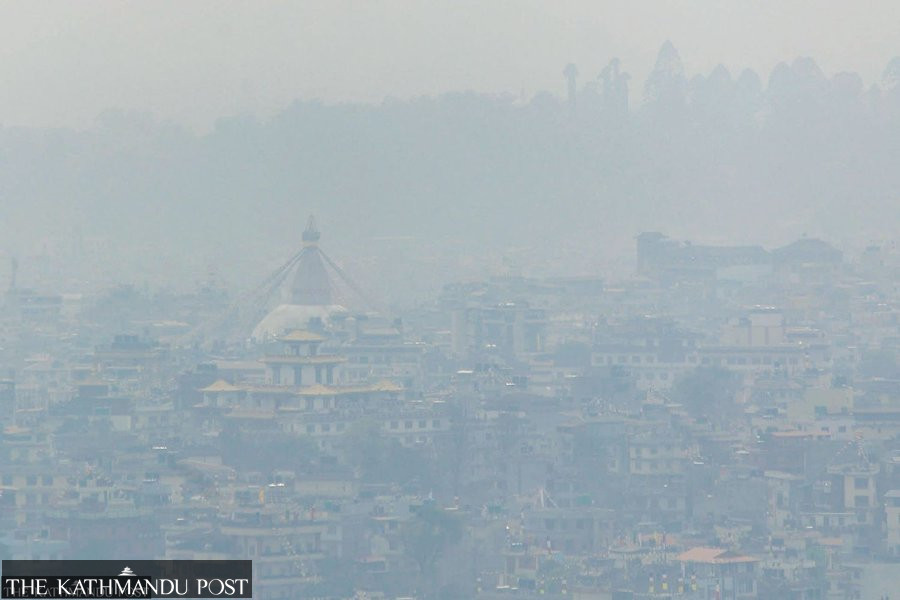
bookmark
Published at : March 12, 2026
Updated at : March 13, 2026 07:17
A thick haze has enveloped most parts of Nepal for a week now, with no relief in sight until the country receives ample rainfall. Over the past few years, during the winter and pre-monsoon seasons, Kathmandu is often ranked the world’s most polluted city. With an Air Quality Index of 184, Kathmanduites suffered the same fate this Sunday as well. But the air pollution stretches well beyond the federal capital. As of Thursday afternoon, Dhangadi, a sub-metropolitan city in Sudurpaschim Province, had the most polluted air in the country with an AQI of 272, which is considered ‘very unhealthy’, according to IQAir, the Swiss air quality technology company. Overall, the air pollution level in Nepal is currently much higher—8.6 times—than what the World Health Organisation considers safe (10 micrograms per cubic metre) for human health.
What worsens PM2.5 levels in Nepal is rapid urbanisation, smoke, construction dust, burning fuels and forest fires. Even as open burning is illegal, people carelessly and brazenly burn plastics and household waste. Also, the practice of setting fire to stubble in fields, knowingly or unknowingly, contributes to large amounts of smoke and fine particles in the air, poisoning the air we inhale. Little do people know that smoke from wildfires and stubble-burning practices, even in northern India, can travel across the border, fanned by westerly winds. In Kathmandu, the air is also worsened by vehicles that spew toxic gases.
An unhealthy air warrants urgent action from authorities, but Nepalis gasping for air are being forced to wait for the rains to do the job as governments have often failed to prioritise air pollution. For instance, efforts to mitigate air pollution by conducting vehicular emission inspections have largely stayed symbolic, as neither are vehicles routinely checked, nor do vehicle owners follow emission guidelines or maintenance schedules. As per a recent report published in this paper, the post of a focal person responsible for overseeing forest fires has been vacant for five months. This shows that Nepal is far from prepared to reduce air pollution this year, too.
It is due to such apathy that air pollution leads to approximately 26,000 premature annual deaths in Nepal. According to a World Bank report, filthy air cuts life expectancy by 3.4 years and is the leading risk factor for death and disability. Elderly people, pregnant women, children and immunocompromised people are always at risk of catching respiratory illness, pneumonia, skin allergy and influenza. But when the PM2.5 concentrations reach a very unhealthy level, even healthy people are exposed to health problems and are prone to get ulcers, lung and intestinal cancer and heart complications in the long run.
As the public also shares responsibility for toxic air, they must give up practices that pollute it, but the primary onus of tackling the issue rests on the state. The to-be-formed government emerged by a large youth presence can be expected to take measures to clean up the environment, through measures like incentivising and making a bigger transition to Electric Vehicles. Nepal has started on this route, but it has yet to achieve large-scale EV adoption. Another measure that will help Kathmandu and other polluted locales around the country move down the list of the world’s most polluted places is strictly enforcing rules against waste and stubble burning.
We believe time has come to work to mitigate the risks of air pollution by declaring a public health emergency. People are literally choking to death. Filthy air is the leading risk factor for death and disability in our country. There could hardly be any other state intervention that would prevent unnecessary suffering and deaths of so many people.

Most Read from Editorial

Editor's Picks

What to know about the US trial over Mamta Kafle’s disappearance
NPL returns with bigger ambitions and global recognition
What’s new in the Nepal Premier League’s third season?
After Nepal’s recent disaster, it wants to test whether COP31 can deliver climate justice

Why does an hour long flight to Dhangadhi cost more than a flight to New Delhi?
E-PAPER | October 27, 2026

×