



 15.28°C Kathmandu

Thu, Oct 15, 2026
Columns
The intersection of human agency, political dynamics and ecological challenges in the Bhotekoshi flood
Challenging events like the Bhotekoshi flash flood highlight the need for mutual understanding and cooperation.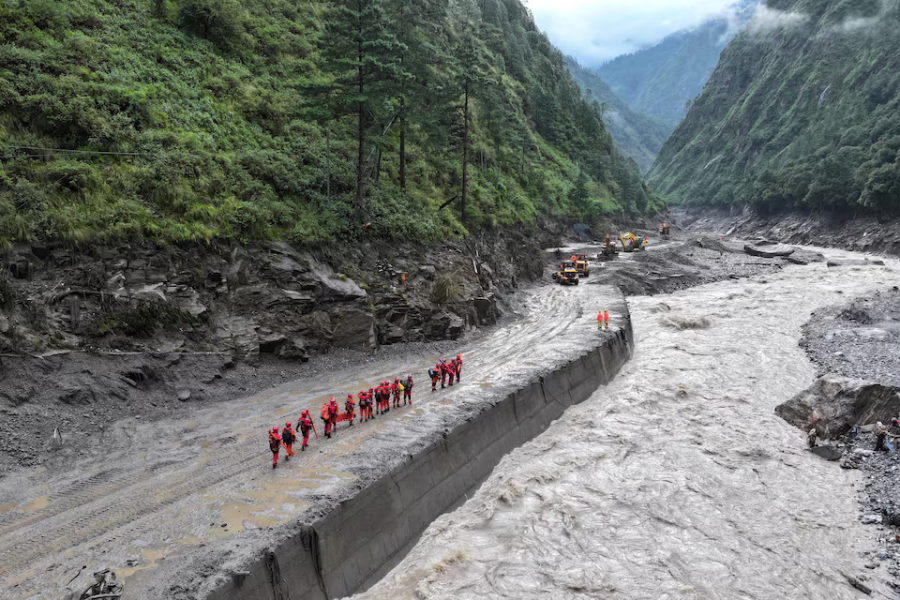
bookmark
Abhi Subedi
Published at : August 29, 2026
Updated at : August 29, 2026 21:46
The Himalayan deluge known as the Bhotekoshi flash flood, which occurred on August 26 along the border between Nepal and Tibet, has caused shock and pain to the people of this land and drawn the attention of the world. More than 600 people have been reported dead, with hundreds missing. There is some heartening news, too. The Nepali Army, Armed Police Force and Nepal Police are giving their best in search and rescue. They have rescued over 4,000 people. The government has dispatched relief materials, and our immediate neighbours and even distant friends have offered assistance.
When the disaster made headlines, scientists, geologists and disaster experts discussed the possible causes of the flash flood. Did an avalanche of ice and rock trigger this terrible flash flood, or did a strong landslide down the mountains block the river’s flow, causing it to burst and swell the river below? All the topics of the ecological parlance come here; melting glaciers due to global warming are one. As a result of the commotion, it was also believed that the glacial lake may have burst open, causing a massive flood. Later, footage obtained by The New York Times showed the glacier breaking off the mountain. Human activities are also believed to have worsened the disaster. Deforestation, the formation of small hills by piling boulders along riverbanks, and reckless hill-cutting to build motorable roads are all too common.
The role of planners and governments is also under scrutiny. This paper has published a package of advice for stakeholders in its editorial column. Another article by an environmental scientist centres on human agency, the role of planners, and their procrastination. These articles stress that prudence and action are important factors.
Evoking ecological themes has become a passion for many people. The world observes and listens but does not act. This has become a mantra pronounced by the mighty and the weak alike. Carbon emissions in the world’s richest countries make riverside settlements like ours vulnerable to natural hazards that occur at different scales. The disaster near Rasuwa on the China-Nepal border, and along the Bhotekoshi and Trishuli river corridors, speaks eloquently about the geology of the Himalayan region. It also encompasses other factors, such as ecological or climatic changes caused by humans breaching their covenant with nature. This flash flood is one such example. But this catastrophe should be seen in the global context as well.
Another factor that has struck me at this moment is a shift in the modus operandi of this country’s political parties, who have vowed to work together to alleviate the pain of the people. To show solidarity with affected people, political parties have mobilised their members, instructing them not to hoist party flags during relief distribution. Another gesture is that parties holding different ideological positions and acting as opposition forces would support the government in its relief operations.
Generally speaking, this is a common psychology. But it reminded me of the polarities and bitterness that the political parties have developed vis-à-vis the government and the ruling party in recent days. A binary of the government and the opposition is an important structure of the democratic system. But flexibility—where and when it is needed—is equally important to create a healthy democratic milieu. That mode is in short supply in Nepal’s democratic system. Challenging events such as the Bhotekoshi flash flood teach mutual understanding and cooperation.
I see the poetry of anguish in ecology and the energy that it generates. Ecological anguish has a universal character. A disaster such as the Bhotekoshi flood is not an isolated phenomenon. What the earth is experiencing today manifests in major or minor incidents globally. Powerful countries and their visions of ecological balance become manifest in every natural phenomenon these days. I see a dichotomy between what happens in nature as a result of human actions and how understanding accrues with the changing times. As a poet, I feel anguish in this dichotomy, this binary.
I am reminded of a poem by the poet laureate Lekhanath Poudyal. In this poem, he describes the Himalayan river cascading down the mountain with great speed. He does not see the fearsome nature of the river in the poem. I present the gist of the poem—“thadai kailasha dekhi drutatara gatile gadgadaera jhardi”, or “Oh you, who cascade straight down the Kailash mountain with a thundering sound. In that process you meet rivulets and streams who also cascade down calling you—oh mother. You take them onto your lap and rush down”. We ask—was the ecology different then? Was the speed of the rivers fast but harmless? Were they only making the landscape beautiful? Have things metamorphosed in such a way that today the river has become a subject of fright?
We can interpret the politics of discord and cooperation in other ways too. As politicians have realised at different times, we need to create conditions for people with different views and ideologies to work together, at least when it becomes necessary to address the larger interests of the people, the country and humanity. For that, I would say, it is necessary to acquire inner strength and a human sense of joy and happiness. Such faculties of mind are hard to earn if one keeps the doors shut. Inculcating hatred and extreme mistrust dampens positive energy.
In Nepal, we writers, teachers and students of literature and arts have one suggestion for politicians and those vying for power: cultivate a mind of trust, but be ready to discuss your differences, put forward your ideas, and justify them as an open, democratic person. Extreme mistrust and hatred drain that positive energy out of you. I am encouraged by the change of politicians’ hearts at such a moment of crisis. Make that your forte of action, a source of energy and inner strength.
Abhi Subedi
Abhi Subedi is a poet, playwright and a columnist.


.PNG&w=200&height=120)

Most Read from Columns

Before you take credit for Khula Manch, read its history

Shah went to the UN to speak for Nepal, then left before he could make the most of it

Bhotekoshi flood wasn’t a freak event. It’s the Himalaya doing what it does

Lesson learned after the death of Ronaldo
What Lubra can teach Nepal about climate-induced migration and resettlement
Editor's Picks

Constitutional Bench caught in seniority, ‘pick and choose’ dispute

A Dom boy’s long road to becoming a doctor

From blankets to handmade dolls, two foreign women bring comfort to flood survivors

News Analysis: When institutional defence exposes institutional fault lines

It’s a bird … it’s a plane … it’s the Indian ambassador’s farewell tweets
E-PAPER | October 15, 2026

×