The United States’ recent renaming of the Indo-Pacific Command to the Pacific Command reveals its shifting geopolitical thrust, which has been swinging between the pivot to Asia and involvement in the war in Iran. However, over time, some Indo-Pacific countries have reinvigorated ties with the US, keeping China’s rise in mind. These countries don’t necessarily share the US perspective on China but have their own concerns regarding China’s rise and its implications for the region.
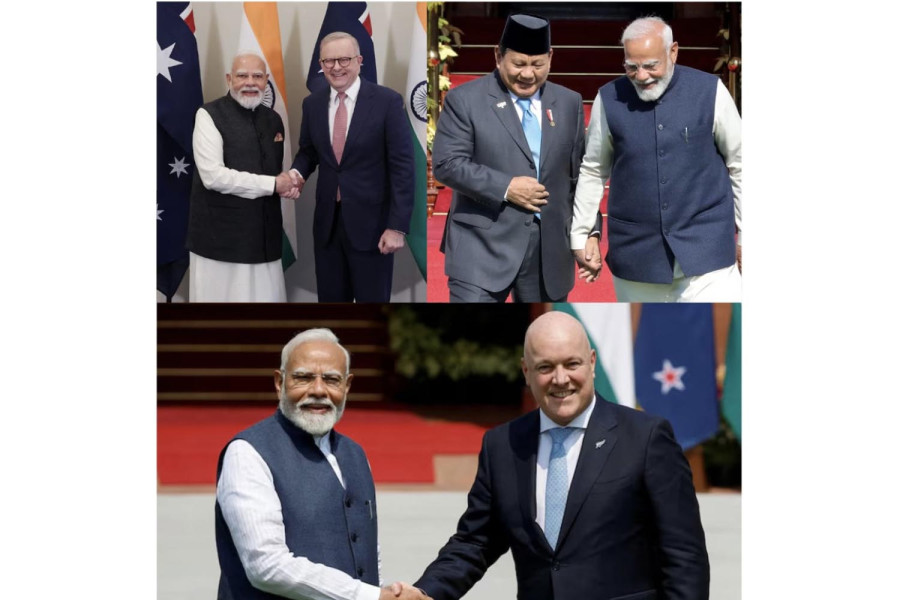
In this context, Indian Prime Minister Modi’s visit to Indonesia, Australia and New Zealand carries significance. Before Modi’s visit, Japanese Prime Minister Sanae Takaichi visited India on July 1-3 to attend the 16th India-Japan Annual Summit. This cooperation includes enhanced training and exercises in maritime areas, including the Indian Ocean, satellite-based maritime domain awareness, naval maintenance, repair and overhaul cooperation, and defence equipment and technology cooperation.
Free and Open Indo-Pacific (FOIP) remains relevant to these countries despite the US’s non-committal attitude and transactional approach. The US-led rule-based order is over, as the conflict in West Asia demonstrates. Therefore, it is imperative to frame a security order by building relationships with countries that would be affected by any reordering of international politics.
Modi’s visits
Defence and maritime cooperation emerged as a key area of focus during Modi’s visit to Australia, New Zealand and Indonesia. During his visit to Indonesia, New Delhi and Jakarta discussed strengthening defence cooperation and referred to their ‘Shared Vision of India-Indonesia on Maritime Cooperation in the Indo-Pacific’ agreed in 2018. After years of discussion, Indonesia decided to procure the BrahMos cruise missile, which would bolster its security, also deciding to develop ports in the Andaman and Nicobar Islands and to expand Sabang Port in Aceh to serve as a strategic link overlooking the Strait of Malacca. Indonesia also proposed the third edition of the India-Indonesia Security Dialogue and stepping up cooperation in maritime affairs and the blue economy.
In Australia, the two countries unveiled a new Joint Declaration on Defence and Security Cooperation, strategic consultations, enhanced interoperability between the armed forces and greater collaboration in defence science, technology and industrial supply chains. They also agreed to advance civil nuclear cooperation. An agreement to this effect was signed in 2014, ensuring commercial contracts for the supply of uranium.
India and New Zealand have decided to elevate their bilateral relationship to a ‘strategic partnership’ and to maintain regular structured engagement at the Defence Ministry and service levels. They also concluded a Maritime Cooperation Arrangement (MCA).
Australia and Japan are members of the Quadrilateral Security Dialogue (QUAD). In the past, they have noted the emerging convergence between India’s Indo-Pacific Oceans Initiative (IPOI) and ASEAN Outlook on the Indo-Pacific (AOIP). Some of the issues this trilateral flagged are maritime domain awareness, marine pollution and blue economy cooperation, with a commitment to cooperate within the framework of IPOI and the Indian Ocean Rim Association (IORA) mechanism. This dialogue needs to be taken forward.
China factor
China carried out a long-range ballistic missile test on July 6, drawing criticism from the Pacific island nations and the US. While some analysts argue that this test is targeted towards the US as a show of advanced technology, it has implications for Indonesia, Japan and Australia, especially as US interests appear to be shifting.
Countries in the Indo-Pacific reacted strongly to this missile test, with the Philippines describing it as a ‘reckless display of military power’. The display of military power even prompted China’s strategic partner, the Solomon Islands, to respond. These concerns were dismissed by China, which stated that it does not seek a ‘sphere of influence’ and that Pacific islands are ‘not someone’s backyard’. Some see this as a reaction to Australia strengthening its ties with Pacific island countries by signing an alliance partnership with Fiji.
In the context of a growing Chinese footprint and its assertive manifestations, Modi’s visit assumes strategic importance. India’s Act East policy is anchored in its historical socio-cultural ties with the countries of the Indo-Pacific. Over the years, India has bolstered both security and economic ties, as reflected in high-level visits among the QUAD countries.
Strategic imperatives
The closure of the Strait of Hormuz has brought the Malacca Strait chokepoint into focus. Energy security has received much attention in countries in this region, as elsewhere. The Quad Initiative on Indo-Pacific Energy Security held its meeting in May and has decided to convene a Quad Fuel Security Forum. Therefore, it is not surprising that in Indonesia, India emphasised cooperation in LNG, green hydrogen, bioenergy, solar energy and energy-efficient technologies.
As countries celebrate the decade since the Hague tribunal’s verdict regarding the South China Sea, which emphasised freedom of navigation as legally binding on China, India also issued a statement emphasising ‘freedom of navigation and overflight, other lawful uses of the sea, and unimpeded commerce consistent with international law’. It endorses a rule-based maritime order in the sea and adherence to the peaceful resolution of disputes in accordance with the United Nations Convention on the Law of the Sea (UNCLOS). China has rejected this verdict, terming it null and void. It has overlapping sovereignty claims with the Philippines, Vietnam, Malaysia, Brunei and Taiwan—all of which are equally concerned about China’s maritime posture.
As the US moves away from its focus on the Indo-Pacific, it is the countries of the region that need to unite as security actors to enforce a rule-based order. The countries have articulated their Indo-Pacific policies and strengthened their maritime security by engaging key partners to safeguard their maritime interests. Whether it is Asia-Pacific or Indo-Pacific, it is not the terminology that defines the region, but rather the common challenges that shape security relationships in this oceanic space.




 14.77°C Kathmandu
.PNG&w=200&height=120)