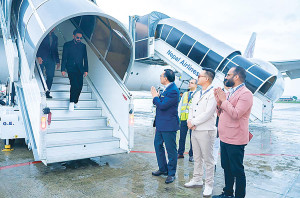
While the US is not yet a major player in the region’s infrastructure development, China is poised to become one despite debt concerns. Photo: Khanal’s X
Following a visit to India, Nepal’s foreign minister Shisir Khanal visited China from June 14 to 17. As expected, the question of Lipulekh and Limpiyadhura was featured in the bilateral talks between Nepal and China, which the latter refers to as Nepal’s bilateral matter with India. China also raised concerns over the US-funded Millennium Challenge Compact (MCC) project and State Partnership Programme. This project was ratified by Nepal in 2022. It is a $500 million grant project, Nepal signed in 2017, to ‘strengthen good governance, economic freedom and investments in the people of Nepal’.
China has looked at MCC with suspicion. Commenting on this, China’s foreign office spokesperson wondered whether it is a gift or Pandora’s box, and that such assistance should not interfere with Nepal’s internal affairs. The China Daily likened this to a Trojan horse, accusing the US of undermining Nepal’s sovereignty. Such concerns were also expressed by some Nepali policymakers and academics. In fact, MCC is seen as a part of the US’s Indo-Pacific strategy.
Sri Lanka and MCC
Sri Lanka had applied for the grant in 2005 but did not meet the criteria at that time. In 2015, the proposal was revived, and Sri Lanka qualified for the grant. MCC proposed to improve the transportation system and value land at a uniform price for civilian and commercial use, to create a parcel fabric map for 28 percent of the land area in Sri Lanka, to convert the land registry to a digital format, and to establish a land policy council to help the government. While 73 percent of the $480 million grant was devoted to transport, which was estimated to have an economic rate of return of 19 percent, the digitisation of state land records, however, raised suspicion.
In a country where land ownership in the North is securitised, which the US has been voting against in the United Nations Human Rights Commission, many suspected the US’s true intention. According to the Sri Lankan government, the proposed digitisation would have an economic rate of return of 26 percent. A 200 km corridor extending from Colombo to Trincomalee for the agriculture project was also part of the MCC. Presidential aspirant Gotabaya Rajapaksa, who was contesting the 2019 Presidential election, said he would not sign the MCC, but after the election, he set up a commission to look into the MCC proposals.
US presence in the region
It was argued that the US wants Sri Lanka to sign the Status of Forces Agreement (SOFA). Already, the Acquisition and Cross Service Agreement (ACSA), signed by President Sirisena in 2017, was creating controversy. Therefore, the US withdrew the MCC grant in 2020, saying it depends on whether Sri Lanka wants to be part of it. Soon after, Sri Lanka faced a severe economic crisis when it declared bankruptcy.
Interestingly, the debate over the MCC grant raised the issue of sovereignty as the US retained clauses that would give it a major say. Such debate over sovereignty is completely absent from the BRI projects that most South Asian countries have joined. The infrastructure war is not new in the region, where India, China, the US and Japan are vying to develop infrastructure. Japan has the Partnership for Quality Infrastructure Initiative and offers very low interest rates. The US initiative, MCC, is a grant; India also provides a soft loan, with an interest rate ranging from 0.75 to 1 percent. These connectivity infrastructures are not only meant to facilitate trade and commerce but also to give countries a geo-strategic presence.
Interestingly, China is very concerned about the US’s presence in South Asia. Not long ago, it reacted to Bangladesh’s Indo-Pacific outlook, threatening to damage its relations with China. Sri Lanka had also assured the Chinese Defence Minister during his visit to Sri Lanka that it would not yield to pressure from a major power or form an alliance with anyone. China has been vocal about the US’s Indo-Pacific strategy and geopolitical footprint in South Asia. Recent youth movements in South Asia, ostensibly against undemocratic regimes, corruption and misgovernance, have allowed the US to entrench its position in the region. China is more concerned about developments in Nepal that would impinge directly on Tibet.
Need for infrastructure
The importance of infrastructure in economic development and trade is known. For a very long time, and even more so after the introduction of the BRI, China has emerged as a major player in infrastructure development in this region. According to the South Asia Subregional Economic Cooperation (SASEC), at least 70 percent of freight is transported by road throughout South Asia, and it has one of the world’s largest railway networks, underscoring the importance of infrastructure.
Countries in the region also realise that without modern infrastructure, an economic turnaround is not possible. In this context, these countries have adopted a multi-pronged approach that engages both Japan and the US in infrastructure development. As discussed elsewhere, unlike China, India and Japan have offered funds at nominal rates while the US’s MCC is a grant, which makes the US proposition lucrative in spite of sovereignty concerns.
The US is not yet a major player in infrastructure development in the region, as evidenced by the fact that the offer of a grant through MCC projects did not appeal to Sri Lankans due to geo-strategic concerns about being trapped in a great-power rivalry that US engagement may entail for smaller countries in the region. China would remain a major player in infrastructure delivery despite debt concerns.




 14.77°C Kathmandu
.PNG&w=200&height=120)