Beijing raises concerns over US initiatives in Nepal
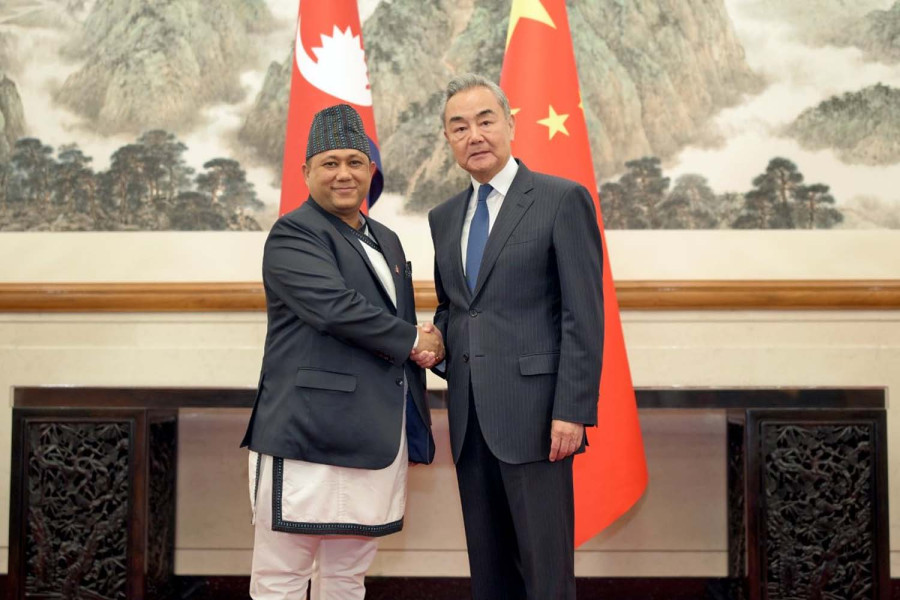
Foreign Minister Shisir Khanal discusses Lipulekh, says Nepal government has no role in Pokhara airport sub judice case. Foreign Minister Khanal with Wang in Beijing. Photo: khanal’s X
Hinting at China’s understanding of recent political developments in Kathmandu and the Western countries’ role in it, Chinese Foreign Minister Wang Yi told his Nepali counterpart Shisir Khanal that a neighbour nearby is better than a distant relative.
Khanal, who is on a four-day official visit to China, held talks with Wang on Monday night in Beijing, where the two leaders discussed a wide range of issues of mutual concern.
Wang, according to the Chinese foreign ministry, stated that “distant relatives are not as good as close neighbours. China will always be a reliable neighbour and reliable partner…," for Nepal.
During the meeting, according to one Nepali participant, the Chinese leaders including Wang had raised concerns over Western influence in Nepal, mostly about the American Millennium Challenge Corporation and State Partnership Programme. Though these US initiatives look good from outside but their intent is bad, the Nepali official who spoke over the phone from Beijing quoted his Chinese counterparts as saying. “These initiatives only create trouble for China.”
In the meeting, Khanal had proposed the development of four corridors connecting the northern border to mid-Nepal which also includes trans-Himalayan railway. He sought air routes from western Nepal near Hilsa in Humla district. On the boundary dispute, Khanal told Wang that though the Lipulekh issue is also something to be discussed between Nepal and India, repeated agreements between India and China have complicated the dispute.
Beijing was also concerned that a Chinese firm was being implicated in corruption in the Pokhara International Airport project.
In response, Khanal told Wang that the competent authority of Nepal has registered the case in court and it has nothing to do with the government. As Nepal and China have signed a protocol on Mutual Legal Assistance on Criminal Matters, the government is ready to share the chargesheet with the Chinese side to clarify the charges.
“Beijing was mostly concerned about the graft case against a Chinese firm in Pokhara airport, alleged corruption in the airport built with Chinese loans and about potential US actions in Nepal against China,” said the Nepali official.
“China will always be a trustworthy and reliable good neighbour and partner in Nepal’s development, revitalisation, and modernisation process,” Wang told Khanal, according to the Chinese foreign ministry statement.
Khanal, aware of China’s political and security concerns following last year’s Gen Z movement, assured the Chinese leaders in Beijing that Nepal is committed to improving its relations with China and tried to dispel the notion that the government in Kathmandu is increasingly tilting towards the West.
“The Taiwan and Tibet issues are China’s internal affairs,” the Chinese foreign ministry statement quoted Khanal as saying. “Nepal firmly adheres to the one-China policy, supports China’s complete reunification, and will never allow any force to use Nepalese territory to harm China’s interests.”
Khanal took to X after the meeting to say they held “a comprehensive discussion on the entire gamut of bilateral relations, including in the areas of connectivity, border management, trade, technology transfer and multilateral cooperation.”
“China’s development is an opportunity for Nepal. Nepal welcomes Chinese investment and is willing to provide a fair, rule-of-law, and friendly business environment for Chinese enterprises.”
Likewise, Wang emphasised that China appreciates Nepal’s firm adherence to the one-China policy and its unwavering support for China on issues concerning China’s core interests, such as Taiwan and Tibet.
“China has always placed its relations with Nepal at the forefront of its neighbourhood diplomacy, and its friendly policy towards Nepal is geared towards all the Nepalese people,” said the Chinese foreign minister who has travelled to Kathmandu multiple times during his long time in office.
Stating the priorities of the new government, Khanal said the Nepali government is committed to people-centred development and adheres to a non-aligned policy.
“Upholding principles while pursuing innovation is a Chinese philosophical concept and also Nepal’s value pursuit,” he added.
Wang said that China is willing to work with Nepal to jointly advance the Belt and Road Initiative (BRI), focusing on cooperation in areas such as power grids, highways, ports, and aviation, to help Nepal transform from a landlocked country to a land-linked country.
“Both sides should make good use of various cooperation platforms and mechanisms to deepen pragmatic cooperation and promote people-to-people exchanges,” he said. “China encourages Chinese enterprises to invest and do business in Nepal and hopes that Nepal will provide a more fair and transparent business environment. Both sides should strengthen multilateral cooperation and safeguard the common interests of developing countries.”
There has been growing concern from China that Chinese enterprises and investors might not be as welcome in Nepal as they were in the past.
Since the establishment of diplomatic relations, “regardless of changes in the international situation and Nepal’s domestic circumstances, the two countries have always adhered to the Five Principles of Peaceful Coexistence and maintained the sustainable development of bilateral relations,” said Wang.
China is willing to work with Nepal to continue the traditional friendship, enhance political mutual trust, and promote new achievements in China-Nepal strategic cooperation in keeping with the times, he said.
“China will, as always, support Nepal in safeguarding its national sovereignty, independence, and territorial integrity, support the new Nepali government in governing smoothly with the support of the people, and support Nepal in exploring a development path suited to its national conditions. History and facts prove that China-Nepal friendship is in the fundamental interests of Nepal and its people.”
Similarly, Khanal said that the friendship between Nepal and China has spanned millennia and remained strong over time.
He expressed gratitude to China for its long-term support for Nepal’s national development and improvement of people’s livelihoods, for consistently treating Nepal as an equal and respecting its national sovereignty and independence.
“Nepal is willing to learn from China’s governance experience, admires China’s achievements in poverty alleviation and environmental protection, and will actively participate in the high-quality Belt and Road Initiative, improve Nepal-China connectivity, promote mutually beneficial cooperation in various fields, strengthen multilateral coordination and cooperation, and achieve common development and prosperity,” the Chinese foreign ministry statement quotes Khanal as saying.
“Nepal recognises the concept of building a community with a shared future for mankind and is willing to actively support the series of global initiatives proposed by China.”
China has proposed and consistently requested Nepal to support and take part in BRI, Global Security Initiative (GSI), Global Development Initiative (GDI), Global Civilisation Initiative (GCI) and Global Governance Initiative (GGI). This time, too, they asked Nepal to do so.
However, according to a Nepali official, as Nepal has already signed the BRI agreement, it is taking support from GDI and some components under the GCI. The minister did not make any commitments on other initiatives, the official added.
The two sides also exchanged views on international and regional issues of common concern.
Earlier, Khanal held a meeting with Liu Haixing, the chief of International Department of Communist Party of China (IDCPC), and discussed expansion of party-to-party relations and Nepal-China ties.
During the meeting, according to the Nepali Embassy in Beijing, the Nepali side reaffirmed the Nepal government’s firm commitment to the ‘one-China’ principle, ensuring that Nepal territory will not be allowed to be used for any activities against China.
The Chinese side reiterated its firm commitment to Nepal’s sovereignty, territorial integrity and independence while assuring its full support to Nepal government’s priority in the areas of good governance and economic growth, said the embassy’s statement.
Acknowledging mutual respect and a shared commitment towards each other’s priorities and sensitivities, the talks focused on advancing cooperation across multiple sectors.
“These include infrastructures, connectivity, border management, energy, trade, investment, agriculture, technology transfer, information technology and the digitalisation, tourism, chemical fertilisers, petroleum and natural gas exploration, and people-to-people relations,” the embassy statement said.
Both sides expressed a strong commitment to expeditious implementation of programmes and projects agreed upon in the past, reads the statement, and emphasised more cooperation on matters of common interest in multilateral and regional forums.
“The Communist Party of China [CPC] has long maintained regular friendly exchanges with major political parties in Nepal, playing a vital role in the development of bilateral relations,” Liu Haixing told Khanal, adding that the CPC is willing to consolidate and develop friendly exchanges with Rastriya Swatantra Party, strengthen exchanges at all levels, enhance strategic communication, increase political mutual trust, deepen mutual learning of governance experience, and promote cooperation in various fields through the “party to party” channel, thereby strengthening China-Nepal relations.
Anil Giri is a Chief Sub Editor covering diplomacy, international relations and national politics for The Kathmandu Post. Giri has been working as a journalist for more than two decades, contributing to numerous national and international media outlets.




 23.78°C Kathmandu