It was late afternoon on the universally dreaded Monday. I had been staring at my computer screen all day, barely able to write two full paragraphs. I had a whole thesis to write, yet I was struggling with a mere introduction. A break was what I needed—from the computer and from the frustration of my writer’s block.
I’ve always been a nature lover; I appreciate nature and natural beings. Listening to the melody of birds, the fluttering wings of butterflies, the buzz of bees, the greens of the grasses, and the explosions of colour in the flowers rejuvenate me. As my PhD was forging me into a scientist, it was also forging me into a naturalist, more specifically a hard-core birder. I had been a birder for a long time, but the introduction to eBird—a global database and the world’s largest citizen science project, where you can log all the birds you see and identify—enhanced my birding experience and gave it a different turn.
Birding has always been my stress-reliever; it is my getaway from everything. I’d rather be in a forest with non-humans than in a social situation with more humans. This may be my bias as an ornithologist, but birds really do have something special compared with other animals. I’ve been asked what that is on multiple occasions, and my answer remains the same: “I have no idea.”
I shut down my computer, grabbed my jacket, and headed towards a park, hoping to spot a bird that would help relieve my stress. Spoiler alert: there aren’t many birds around in a Fargo winter, especially when the temperature is below freezing. However, you could get out for a few hours and log about 15-20 species if you’re lucky. But the best thing about a Fargo winter is the Owls! They migrate south (and stop in Fargo) to avoid the cold weather of the Arctic and Canada.
I started scanning the trees, conifers to be precise. Since most trees lose their leaves in fall, they aren’t ideal places to hide. So the owls, especially the smaller ones, tend to avoid deciduous trees and hide in conifers. To be honest, that does make it easier for people like me to find birds. Just scan the conifer trees; however, some parks can have over 50-60 of them, so you do end up scanning every single tree.
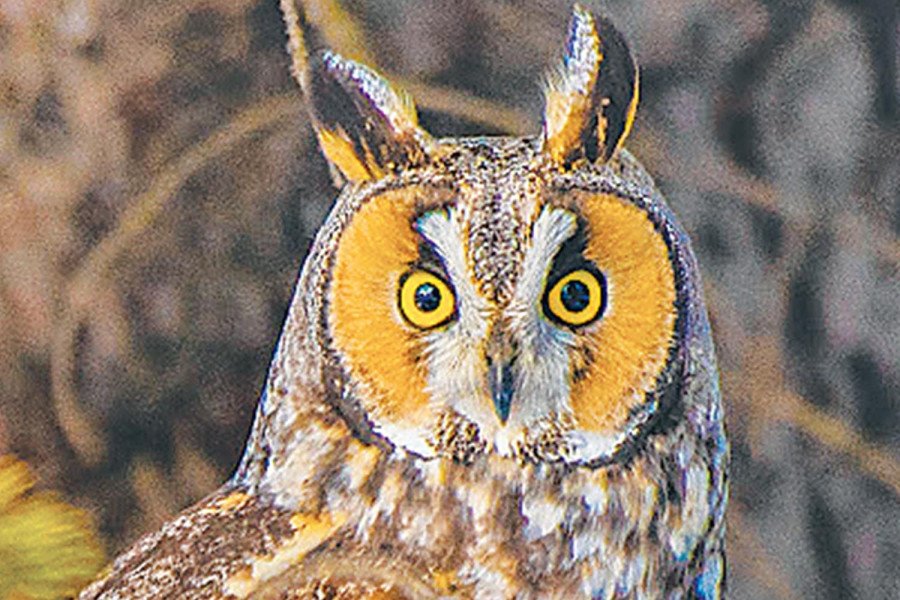
I was looking for this particular owl, the Long-eared owl, a classic Holarctic owl species. Holarctic refers to a biogeographic region spanning the Earth in the Northern Hemisphere. A vagrant species in Nepal, the Long-eared owl is a revered migrant species that draws quite a few birders in Nepal. For me, it is one of the most stunning owls because it has the classic owl face. As the name suggests, it has two pointy ‘ear tufts’ which aren’t technically ears; they’re just bundles of pointy feathers called plumicorns. It also has this barky look which makes it harder to recognise even if it is localised to a conifer tree.
As I started walking along the snow-covered trail, I flushed a few other songbirds of the north. No sight of any owls yet, but I was already feeling much better than I had an hour earlier. It was cold, but somehow it felt warm to be out in nature. As I was scanning for the long-eared owl, I saw something else move in a small conifer. It was another owl, not the one I was longing for, but one of my favourites: the Northern saw-whet owl. This tiny owl, barely eight inches tall, is one of the smallest in the world. I’ve probably seen hundreds of these owls in the last few years, and I will probably never get tired of finding them.
Northern saw-whet owl – Photo Anuj Ghimire
After 10 minutes of walking, I found my bird. There it was, sitting atop a centre branch of a conifer, a Long-eared owl. The beautiful creature stared back at me. I was as shocked to see it as it was to see me, so I had to step back a little to give the owl its space. I moved further back after a few clicks and stared at the owl through my binoculars for a long time. My hands were getting colder, but my heart was feeling the warmth of the sight. Just as I was lost in the beauty of the owl and of nature, my phone vibrated, jerking me out of the moment. It was my advisor calling, probably to ask why I wasn’t at work. I picked up the phone nervously, only to realise she’d called to ask if I was free to tag her along to look for owls. Not before long, she showed up, and we gazed at the bird for a while.
Fast-forward a few years, and I have been seeing a lot of new research and news stories about how birding can benefit one’s mental and cognitive health. I am not surprised. Multiple studies have suggested that bird songs can reduce anxiety, irrational thoughts and stress. There was a global boom in the birding community post-Covid-19 as people resorted to safe outdoor activities. The birding community is growing by the day; so is the stress and anxiety in everyone. Perhaps we shall all balance our stress with a little birding and time in the outdoors, maybe even have a surplus of birds’ melody in our lives, and little to no stress. Happy birding!




 20.12°C Kathmandu

.jpg&w=200&height=120)








.png&w=300&height=200)





