



 20.28°C Kathmandu

Sat, Oct 17, 2026
Columns
First regulate cannabis cultivation. Licence it after
Nepal might license cannabis cultivation. The science of what that demands must lead, not follow.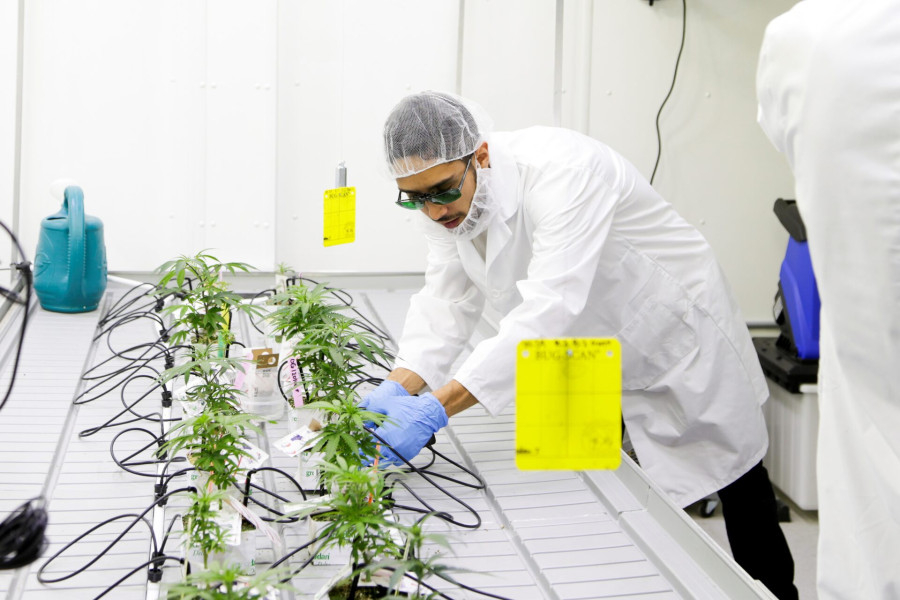
bookmark
Amrit Baral
Published at : April 27, 2026
Updated at : April 27, 2026 21:09
As a research fellow at Johns Hopkins Bloomberg School of Public Health, I am studying what cannabis does to the heart, the metabolism and the brain, alongside a team of leading researchers in cannabis and psychedelic science. This background gives me a unique responsibility and specialised perspective on this issue if Nepal moves towards licensing cannabis cultivation for medicinal and industrial purposes. I have spent years watching and learning cannabis programmes succeed and fail across Asia and the Americas to say clearly: The scientific and legal architecture must be in place before the first license is issued, not retrofitted after the first crisis. What follows are the irreducible requirements.
Classify the crop, test every batch
The foundational error in almost every premature cannabis regulatory programme is treating cannabis as a single substance. It is not. The spectrum runs from fibre-producing industrial hemp with negligible psychoactivity, commercially valuable for its stem and seed, to high-cannabinoid medicinal varieties with significant pharmacological activity. These require entirely different systems. The European Union separates them with a tetrahydrocannabinol (THC)—the primary psychoactive and intoxicating compound in the cannabis plant—threshold of 0.2 percent by dry weight; the US and Canada have a threshold of 0.3 percent. Without a legally defined chemical boundary, a person in charge of inspection cannot distinguish a legal fibre crop from a controlled drug crop.
Any jurisdiction that issues licenses without this boundary does not create a regulatory system. Every cannabis product, from raw biomass to finished medicinal preparation, must be fully and formally characterised and noted at each step of the supply chain. Knowing what category a plant belongs to is not the same as knowing what is in it.
Mandatory laboratory testing is the mechanism through which every other promise a cannabis law makes is either honoured or broken. Working in a Herbal Heart Study, which examined the cardiovascular effects of cannabis and routes of administration, I encountered the consistent problem of product mislabelling. A 2019 analysis found regulated cannabis products in US markets deviating from labelled tetrahydrocannabinol (THC) by more than 20 percent in a substantial proportion of samples. If that is the accuracy level in established markets, what should Nepal expect with no testing requirement at all? This inaccuracy could lead to substantial problems for the consumer who has no idea what they are purchasing.
Before any batch of cannabis moves from field to processor, processor to buyer, buyer to patient, it must be certified by an accredited laboratory against at minimum: cannabinoid profile, microbial contamination, mycotoxin levels, heavy metals and pesticide residues. Cannabis is a documented hyperaccumulator of heavy metals from contaminated soil. This is a known failure mode. Nepal currently has no accredited cannabis testing laboratory. That infrastructure must be built as a precondition for licensing, not as an afterthought.
Research with scientific governance
Nepal has no domestic evidence base for cannabis. No large-scale epidemiological data on use patterns in its population. No clinical data on how Nepali patients respond to cannabinoid treatments. No agronomic data on its indigenous landrace varieties adapted over generations have been formally characterised. Without this, every major regulatory decision will be made on borrowed evidence from foreign contexts that may not transfer.
The World Health Organisation’s Expert Committee on Drug Dependence has explicitly encouraged member states to create enabling legal frameworks for cannabis research. Canada, the UK and the United States all maintain distinct research license categories separate from commercial licenses. Nepal must do the same. What is the incidence of cannabis hyperemesis syndrome, a serious cyclical vomiting condition linked to heavy cannabis use, in a population newly exposed to commercial high-potency products? What are the health effects on agricultural workers cultivating it occupationally? These questions demand a legal research pathway. Without one, Nepal will regulate by assumption.
Research by the Global Drug Policy Observatory comparing cannabis programme governance across eight jurisdictions found that programs with independent technical oversight structures outperformed politically managed systems on product quality, enforcement consistency, and resistance to corruption. The decisions a cannabis regulatory authority makes—approving laboratory accreditations, setting contamination thresholds, and responding to an adverse event from a patient—are scientific. A governance body composed entirely of elected officials, however capable, is not designed to make them. The Netherlands and Germany both embed independent technical advisory boards with expertise in agronomy, analytical chemistry, pharmacology and public health as a structural requirement of their cannabis frameworks. Nepal must do the same.
Resolve the law
Nepal’s Narcotic Drugs (Control) Act 1976 classifies cannabis as a controlled substance at the national level. A provincial license cannot override national narcotics law without explicit federal enabling legislation or a clear constitutional basis. The 2020 UN Commission on Narcotic Drugs decision rescheduling cannabis gives member states greater space to develop a medicinal programme while remaining treaty-compliant, but that space must be activated through domestic law. A farmer who plants in good faith under a provincial license and faces prosecution under national law has to be protected by the regulatory framework.
The most comprehensive systematic review of cannabinoids for medical use by Whiting et al. in the Journal of the American Medical Association (JAMA), covering 79 clinical trials, found moderate-quality evidence for efficacy in specific conditions alongside significant adverse event rates. The evidence is neither the unqualified endorsement that commercial advocates prefer nor the blanket rejection that prohibitionists assert. It is complicated and context-dependent, which is precisely why the framework must be built to learn, adapt and correct course.
I am not arguing for delay. I am arguing for the minimum infrastructure that makes a license worth holding: Chemical thresholds that are enforceable, laboratory testing that is mandatory, a research pathway that builds domestic evidence, governance that includes scientists, and legal clarity that protects the farmer. Nepal has the geography, the tradition and the political will to participate in the global cannabis economy. What is required now is the scientific rigour to do so in a way that lasts.
Amrit Baral
Dr. Baral is a physician-scientist and Research Fellow at the Johns HopkinsBloomberg School of Public Health, where he studies cannabis, psychedelics, and theireffects on human health.




Most Read from Columns

Before you take credit for Khula Manch, read its history
Shah went to the UN to speak for Nepal, then left before he could make the most of it
Bhotekoshi flood wasn’t a freak event. It’s the Himalaya doing what it does
Lesson learned after the death of Ronaldo
Why passive neutrality won’t take Nepal anywhere
Editor's Picks

Dashain paints the country in festive colours
Buying a goat for Dashain? Look for the green mark

Explained: Why does an hour long flight to Dhangadhi cost more than a flight to New Delhi?
Bhotekoshi flood wasn’t a freak event. It’s the Himalaya doing what it does

How Tenzing Sherpa became Nepal’s breakout star at the Asian Games
E-PAPER | October 17, 2026

×