



 14.81°C Kathmandu

Sat, Oct 24, 2026
Columns
Predatory script of Panchayat in the post-truth republic
The state is delusional if it believes it can kill journalism and establish a monopoly over truth.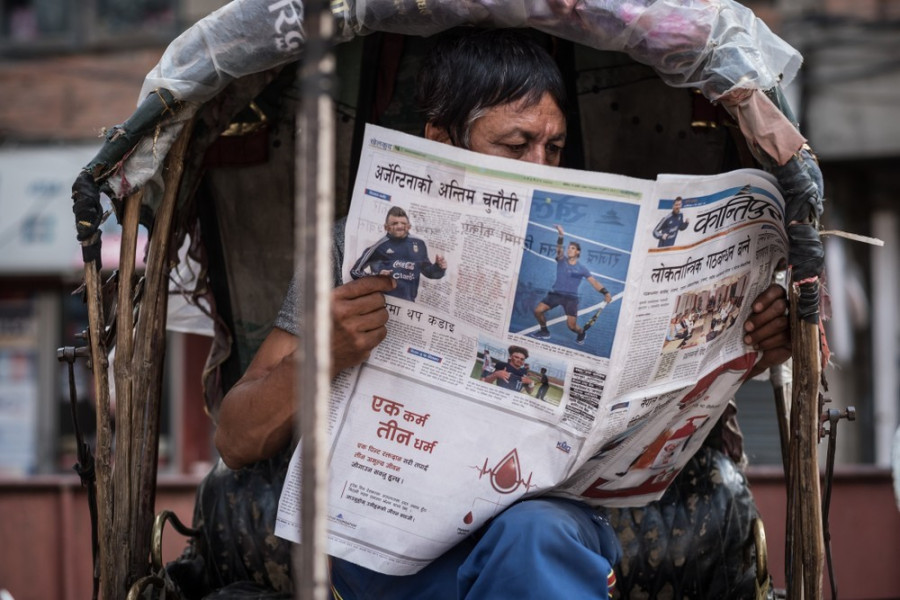
bookmark
CK Lal
Published at : April 21, 2026
Updated at : April 21, 2026 18:08
Addicted to the algorithmic aphrodisiac of populism, the post-truth government of Prime Minister Balendra Shah is performing almost exactly as scripted in the regime-change playbook of the Mahendra era in the 1960s. Acts of vengeance excite supporters and demoralise opponents, so it began its term by going after high-profile politicos without adhering to due process.
There is no potion as powerful as patriotism to raise the jingoistic pheromones of Khas-Arya ethnonationalists. The name of Mahendra Rajmarg was restored, a Madheshi minister was arbitrarily dismissed, and the colonial-era ‘buffer state’ trope was resurrected to recast Nepal as a passive shock-absorber—denying it the agency of a yam, the defiance of a rock, or the volatility of a stick of dynamite, the last being a Maoist descriptor. The metaphor of ‘vibrant bridge’ is a structurally unsound and geopolitically shaky proposition.
Orders have been issued to relocate some more Armed Police Force units to the Tarai-Madhesh. The Indo-Nepal border will be tightly monitored and heavily regulated to ensure that goods exceeding Rs100 in value are not brought in and do not undermine the country’s economic sovereignty. Having elected 30 out of 32 Pratinidhi Sabha members of the Rastriya Swatantra Party in the first-past-the-post system from Madhesh Pradesh, the province has discovered rather quickly that it has no one to speak for Madheshis in Parliament.
The regime’s pharmacopoeia of populism is both varied and potent; yet nothing reveals its intent more starkly than its attempt to emasculate the free press. In a diktat seemingly drawn from a handbook of media monomania, the Office of the Prime Minister and Council of Ministers (OPMCM)—an acronym with an almost Orwellian ring—issued a circular directing all government bodies and publicly funded entities to channel their advertisements exclusively through state-owned media. The choice of date was no less macabre: The financial fatwa against the free press was unveiled on April Fools’ Day, an occasion globally associated with the theatre of the absurd.
Sanitised newspeak
If the order of the OPMCM were to be presented in the pseudo-scientific manner of post-truth managerial politics, it would probably read as:
Primary goal: The technocratic government has a monopoly over truth.
Stated objective: The move is intended to ensure cost efficiency, promote fiscal discipline and enhance transparency. With a lucrative monopoly over government advertising, state-controlled media will be able to spend freely to enhance the image of Supremo Shah, whose silences speak louder than words.
Main outlets: The publications of Gorkhapatra Sansthan, the services of Radio Nepal and Nepal Television and any other media that the concerned ministry may deem fit to establish in future to keep the masses informed about the great deeds of the government.
Targeted media: Independent journalists in the mofussil who engage in shoe-leather reporting and maintain registered outlets to sustain themselves by advertising revenue from tenders and notices because they are friends of the people, not the government.
Likely supporters: Big media houses will either be indifferent or quietly pleased, as their sources of income differ. Government employees and managing agencies already take away such a large slice of the state advertising fund that media Goliaths will not mind journalistic Davids being pushed out of the ring.
Likely critics: Primarily the ‘jholes of disgraced parties’, the ‘12-bhai’ media persons, activists, journalists or entrepreneurs of the Federation of Nepali Journalists (FNJ), Nepal Media Society and the Media Alliance Nepal. In the national interest, they can safely be ignored.
Prospect: High chance of success with the mobilisation of the troll army and implementation of Discord techniques successfully tested prior to the Fall Protests.
Does the seven-point list above resemble an unclassified document of Soviet-era directives? In fact, it is closer to the propaganda manual of the Panchayat regime that the government may have dusted off from cabinets left unburnt in the Singha Durbar arson of the Fall Protests. In the post-truth republic of doers, the script is old, the actors are young, but the tragedy remains stubbornly, uniquely Nepali—because, come on, bro—‘Yo new Nepal ho!’
Survival strategies
Even though media conglomerates in Kathmandu are feigning indifference, they are perhaps as worried about the mindset—rather than merely the decision—of a government that appears ready to treat the free press as opponents. The blank question marks that recently haunted the front pages of some dailies were intended as a protest, but they seem to have failed to demonstrate to the public that the April Fool’s joke is on their right to know what the government does not want them to know.
Perhaps the entrepreneur, publisher, editor and reporter rolled into one at a four-page tabloid in the hinterland will be hardest hit. With revenue from tender calls, procurement notices and awareness campaigns gone, his income from ‘asocial media’, unlike the earnings of rapper Balen, will not be enough to keep a second-hand motorcycle—bought on instalments—running as he covers police excesses in the countryside.
Few ‘national media’ outlets consider it worthwhile to adequately pay their stringers who report on stolen livestock, murders disguised as suicides, or security personnel collecting informal tolls from traders of contraband. The independent press at the grassroots will fall into the hands of local moneylenders, fixers and corrupt officials willing to pay unofficially what they cannot do officially.
The competition is no longer between national media conglomerates; all of them must vie for the same advertising rupee that feeds the algorithmic behemoths of asocial media that once forced the government to withdraw its ban within a few days in September 2015. Legacy media everywhere are under pressure.
In the United States, The New York Times has begun blending old-school journalism of in-depth coverage with lifestyle, infotainment and timepass elements through multimedia. Even The Wall Street Journal, which appeals to a status-conscious niche, has begun to transform itself from subscriber-first to an audience-based strategy to retain its premium position. The Economist recently decided to lift the veil off its contributors and turn them into multimedia presenters.
There may not be a direct connection, but Anup Kaphle is back at this newspaper’s publisher in a new role as Group Editorial Director. Transiting through media, academia and management, Gokarna Awasthi has come full circle to lead the editorial team of the Kantipur Daily, while its former editor Umesh Chauhan has moved to synergise a leading news portal Onlinekhabar and Himalaya Television. The wryly inquisitive Sanjeev Satgainya comes back to Kantipur Publications in a new role as the Editor of Features & Investigations.
The rumbling in the media may seem proactive, but these strategies appear to be desperate attempts to survive the emerging challenges of a national predatory state and international algorithmic pillagers.
Perhaps life for journalists—‘content creators’ in tech-speak—will remain as fragile as ever: Poorly paid, when paid at all; prosecuted by the government; ridiculed by society; resented by businesses; and pitied by family and friends, the profession of the messenger in Nepal has never been for the faint-hearted. Yet a passion for truth triumphs over all else. The regime is delusional if it believes it can kill journalism and establish a monopoly over truth through manufactured realities disseminated by tightly controlled mouthpieces.
CK Lal
Lal is a writer and political analyst.




Most Read from Columns


Editor's Picks





E-PAPER | October 24, 2026

×