



 12.64°C Kathmandu

Sat, Oct 24, 2026
Columns
The continued decontextualisation and depoliticisation in Nepal’s development
Seven decades after the start of Nepal’s development history, the gap between ‘development’ as a global discourse and ‘bikas’ as a lived aspiration remains.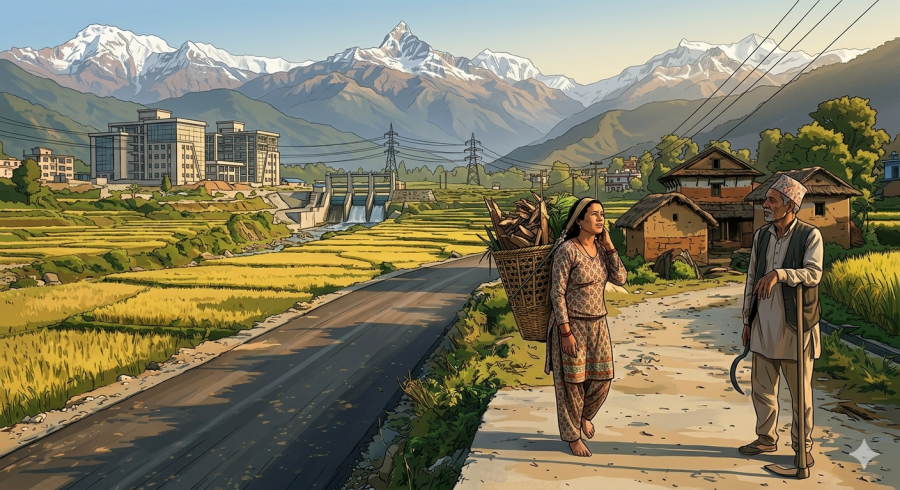
bookmark
Avash Piya
Published at : May 31, 2026
Updated at : May 31, 2026 23:01
Nepal’s developmental experiences have been characterised by structural contradictions throughout history, even under radically differing political systems and development paradigms. Two common tendencies are associated with these contradictions. The first is decontextualisation, which refers to the importing of universal frameworks without considering Nepal’s specific social, ecological and historical contexts. The second is depoliticisation, in which political questions of inequality and power are turned into technical problems to be solved through project-based solutions.
Development interventions have repeatedly decontextualised Nepal’s social realities and depoliticised its structural inequalities. An analysis of transtemporal (both historical and contemporary) experiences will help us reorient our outlook on development for the future.
Before 1951, under the Rana regime, development was not a national priority. The state was extractive rather than developmental. The political change of 1951 marked a turning point. Nepal’s opening to the world coincided with the rise of Cold War geopolitics, and development aid became a strategic resource. New global frameworks were introduced with the assumptions that development was universal, linear and easily replicable. The specific history, social structure and cultural dynamics of places like Nepal were irrelevant, and local knowledge was viewed as an obstacle rather than an asset.
In 1956, Nepal launched its First Five-Year Plan, shaped by state-led planning, which was dominant across South Asia. From the start, development was decontextualised. In this book, In the Name of Development, Professor Nanda R Shrestha documented that these plans overestimated institutional capacity and underestimated its structural barriers. Depoliticisation was also integrated into these development frameworks. In Nepal’s early plans, the root causes of poverty, such as land distribution and caste discrimination, were refined as issues of infrastructure, agricultural technology and institutional capacity. The political questions remained unaddressed.
From 1960 to 1990, the Panchayat system placed centralised bikas at the heart of state ideology. This ideology reflects what American political scientist and anthropologist James C Scott describes as ‘high modernism’—the belief in top-down planning as a means to reorganise society. The pattern of decontextualisation persisted, as Panchayat-era development programmes were designed using a binary rural-urban template, ignoring Nepal’s vast social and ecological diversity. The trend of depoliticisation intensified as well. The Panchayat development system systematically reinforced existing caste and class hierarchies. Furthermore, Western donors reinforced these dynamics, as Nepal’s stability as an anti-communist partner outweighed concerns for social equity.
The 1990 democratic transition changed Nepal’s development landscape. Reflecting global neoliberal trends, the state retreated while NGOs expanded rapidly. Depoliticisation adopted new institutional patterns. According to anthropologist David Mosse, global ideas of development spread throughout and brought new opportunities, producing a new class of experts. Even rural communities learned to ‘perform participation,’ aligning their needs with donor expectations instead of their own priorities. This development model established a new dependency—not on the state but on international funding cycles. Decontextualisation remained evident through the proliferation of imported concepts like ‘gender mainstreaming’, and ‘good governance’. For example, ‘women empowerment’ programmes were designed for a broad category of ‘women’ rather than being differentiated by caste, ethnicity and geography, further reinforcing hierarchies among women.
The Maoist conflict (1996-2006) exposed the political faultlines underlying bikas. The Maoists argued that development investment had reproduced rather than reduced the structural inequalities of caste, land tenure and regional marginalisation; and they made competing claims about what ‘genuine’ development should look like. The development community responded by treating the conflict as a security issue hindering development efforts, rather than acknowledging it as a political consequence of development failures. Both the state and the Maoists used the concept of bikas to assert legitimacy, and development projects became politically instrumentalised by both parties. This period also introduced the language of rights and recognition as marginalised groups argued that development frameworks often depoliticised their claims for recognition and political autonomy. The tension between development-as-service-delivery and development-as-rights remains one of the defining debates in contemporary Nepal.
The CPA (2006), the declaration of a republic (2008) and the 2015 constitution established a federal framework that has transformed Nepal’s development structure. Local governments now have constitutional authority over key development domains. Global agendas on climate change, digital innovation and governance reform dominate the development narrative.
Yet, decontextualisation and depoliticisation have persisted into the federal era. Federalism itself has been implemented through templates and guidelines. For example, local planning guidelines, though comprehensive, fail to account for the significant variations in capacity, context and social dynamics across different local governments. Inclusive planning at the local level has been ‘confined to mere formalities, restricting citizens’ space to voice themselves.’ Depoliticisation persists; for instance, agricultural development programmes continue to focus on technology adoption (improved seeds, fertiliser, irrigation, etc.) while avoiding issues of land tenure—the primary factor determining rural poverty.
Moving forward, development practitioners need to reorient themselves to avoid these tendencies. The first reorientation is contextual honesty. Practitioners must genuinely invest time in understanding the specific social structures and political economies of the communities where they work. Practitioners also need to continuously invest in relationships and local knowledge over the years, rather than months, to produce better outcomes.
The second reorientation is political honesty. Depoliticisation persists because it is institutionally convenient. Donors avoid challenging the political arrangements of partner countries, governments hesitate to confront elite interests, and NGOs are reluctant to alienate partners they need for implementation. For practitioners, political honesty means acknowledging the power influencing every programme, evaluating the political context and discussing both successes and failures openly.
Seven decades after Nepal’s development history, the gap between ‘development’ as a global discourse and bikas as a lived aspiration remains. This persistence trans-temporally is largely due to two tendencies in development practice—decontextualisation and depoliticisation. The bikas that Nepalis aspire to—reliable services, dignified livelihoods, recognition of their knowledge and agency, accountability from those who hold power over the resources that affect their lives—are not an unreasonable demand.
The development system has been structurally unable to meet this demand, not because it is technically difficult, but because fulfilling it would require a fundamental reorientation of who development is for and to whom it is accountable. Whether those conditions are realised depends on the political choices and commitment of international development partners, Nepali governments and institutions, civil society and communities to bridge the gap between what development promises and what it delivers.
Avash Piya
Piya is a development anthropologist and a social science researcher.





Most Read from Columns


.PNG&w=300&height=200)
Editor's Picks





E-PAPER | October 24, 2026

×