



 17.8°C Kathmandu

Mon, Oct 19, 2026
Columns
The geopolitics of the banquet table
State dinners cannot stop wars, but they create the atmosphere in which coexistence is imaginable.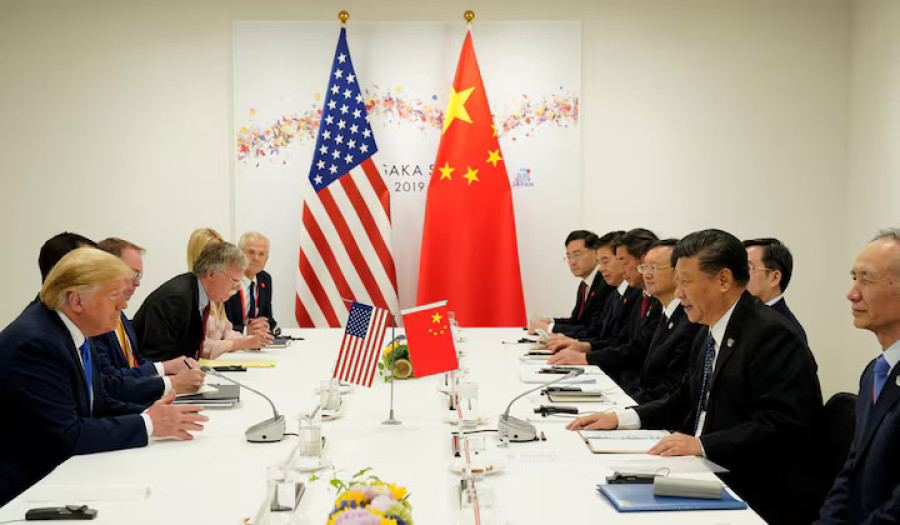
bookmark
Faisal Mahmud
Published at : May 30, 2026
Updated at : May 31, 2026 07:24
In the Great Hall of the People in Beijing, US President Donald Trump sat beneath the grand hall’s famous gigantic chandelier to endure…and enjoy a state banquet hosted by Chinese President Xi Jinping on May 14.
The menu was calibrated with the clinical precision of a trade tariff and the unsubtle theatricality of a Puccini opera. The Chinese kitchen offered a diplomatic bribe of crispy beef ribs to satisfy Trump’s famously carnivorous, ‘well-done’ instincts.
These sat alongside Beijing roast duck, lacquered to a “mahogany sheen that would make a luthier jealous,” and a supporting cast of lobster in tomato soup, pan-fried pork buns, and mustard-glazed salmon, as reported by the New York Times.
Dessert was a confusingly globalist parade that contained tiramisu, ice cream and a trumpet-shell pastry that looked like a “sugar-induced hallucination by Bernini,” NYT report said adding that to complete the “surrealism,” a military orchestra blared “YMCA” and “We Are the World.”
Apparently, in the new world order, geopolitical rivalry was served with a side of disco.
The dinner of course a statement Huaiyang cuisine, defined by a knife-work so obsessive it borders on the neurotically clinical, is the preferred dialect of Chinese hospitality. It signals refinement without the vulgarity of aggression. It is “safe” food…engineered to ensure no guest leaves offended, bewildered, or vibrating from Sichuan peppercorns.
It was edible diplomacy: Chinese enough to project civilisational ego, Western enough to coddle the American palate, and just restrained enough to imply that the host still possesses discipline.
Nations negotiate with aircraft carriers and sanctions, but they seduce with soup or biryani. Before the first communique is drafted, the chef has already set the emotional humidity. State dinners are where geopolitics unfastens its top button and attempts a charm offensive.
If diplomacy is the management of tension, the banquet is its soft-focus close-up…a brief, expensive fiction that rivals are actually discerning dinner companions.
Empires have always understood the political utility of the stomach. Louis XIV used Versailles as a monument to edible spectacle; Ottoman sultans measured prestige by the mile of their kitchens. Even today, the ritual remains unchanged…the conversion of appetite into influence.
The White House mastered this aesthetics of the dinner table in the modern world. In 1961, Jackie Kennedy turned a dinner for Pakistan’s Ayub Khan into a televised mythology of French chefs and candlelight. It was lifestyle branding for American soft power.
Similarly, Richard Nixon’s 1972 foray into Beijing domesticated the “Red Menace” through the medium of lacquered duck and Maotai toasts. Henry Kissinger, ever the realist, knew that a guest who feels honoured is more pliable, while a guest insulted by a cold soup never forgets.
India treats the state banquet as a civilisational performance. To feed a dignitary in New Delhi is to attempt the impossible: Condensing hundreds of languages and cuisines into a single plate.
When Prime Minister Narendra Modi hosted President Vladimir Putin, the menu was a strategic map that contained Himalayan jhol momo, North Indian achaari baingan and venison. It was a meal designed to communicate layered abundance rather than the thin luxury of the nouveau riche.
Conversely, when Modi visited the White House during President Barack Obama’s tenure, he was served mango crème brûlée—a French classic sweetened with Indian memory. The symbolism was almost embarrassingly tidy.
The Obama administration surely used food as an argument for American biodiversity and craftsmanship. The Biden era follows suit with a more strategic intimacy. For Japan’s Fumio Kishida, the White House offered house-cured salmon and dry-aged ribeye—polished, confident, yet reassuring.
In Tokyo, Prime Minister Shinzo Abe once served Trump a hamburger made with premium American beef—a brilliant stroke of flattery disguised as simplicity. It told the President he was home, while reminding him that the Japanese do “American” better than the Americans.
France, predictably, treats the dining table as a branch of philosophy. In the Elysee Palace, sauces are ideological statements and cheese courses are declarations of cultural supremacy. Paris remains the only capital that views gastronomy as a global language in which it is still unquestionably fluent.
Britain, by contrast, uses the banquet to project an effortless, dusty continuity. King Charles III served President Trump organic Norfolk chicken and Kentish raspberry sorbet that implied the UK has survived every catastrophe in history and still found time to polish the silver.
The Gulf monarchies opt for abundance as theatre. In Riyadh or Doha, gold leaf is applied where restraint would be more sophisticated, but sophistication isn’t the point—sovereign confidence is. Turkey invokes Ottoman ghosts through baklava and lamb, while Bangladesh’s Sheikh Hasina used regional fish preparations to the Indian head of state to signal that, despite the borders, the blood (and the spice) remains the same.
The irony is that leaders often eat like teenagers when left to their own devices. Trump prefers fast food; Putin likes the simple fare of a KGB canteen. Yet they must perform refinement. They are actors in a pageant where no one can admit they’d prefer a side of fries.
Today’s menus are increasingly “translated”—local ingredients processed through internationally legible techniques to avoid appearing provincial. China’s banquet for Trump was the ultimate hybrid: Peking duck for identity, tiramisu for cosmopolitan ease.
State dinners cannot stop wars, but they create the atmosphere in which coexistence is imaginable. In 2017, Trump informed Xi of missile strikes in Syria while they were eating chocolate cake at Mar-a-Lago. It was a grotesquely modern moment: Geopolitical menace served between dessert courses.
In this age of cyber-warfare and drone fights, it’s almost ironic that world leaders still rely on the persuasive power of a roasted bird. This is because eating together remains the oldest technology of trust. Power wishes to appear generous, and diplomacy remains the art of postponing catastrophe with elegance. And nothing performs elegance quite like state dinners.
Faisal Mahmud
Mahmud is a Dhaka-based journalist.




Most Read from Columns

Before you take credit for Khula Manch, read its history
Shah went to the UN to speak for Nepal, then left before he could make the most of it

Bhotekoshi flood wasn’t a freak event. It’s the Himalaya doing what it does
Lesson learned after the death of Ronaldo
Why passive neutrality won’t take Nepal anywhere
Editor's Picks




E-PAPER | October 19, 2026

×