



 14.4°C Kathmandu
Fri, Oct 16, 2026
Columns
Heirs prepare to strike back
Whatever social cohesion existed in Tarai-Madhesh, especially after the brutal suppression of the Madhesh Uprising in 2015, has begun to fragment further with the sudden and inexplicable spread of Hindutva politics..png&w=900&height=601)
bookmark
CK Lal
Published at : August 11, 2026
Updated at : August 11, 2026 21:43
Similarities between the late Tulsi Giri and Prime Minister Balendra Shah are striking. Both became heads of government in their mid-thirties. Their families were wealthy and highly regarded in the neighbourhood of Janakpur. The Giris are from Siraha and the Shahs from Mahottari, but, like most zamindars of the region, both families maintained a base in the spiritual capital of Mithila.
Giri’s rise—from joining the Nepali Congress to becoming foreign minister and then vice-chairman to chairman of the post-coup Shah regimes in the 1960s—was mysterious, but also spectacular. Beyond his rapid ascent to power, Giri was known among his peers for his exquisite tastes: Bespoke attire, neatly trimmed hair, haute cuisine, fine wines, fast cars and the company of beautiful women.
Shah’s rise has been equally baffling but considerably more dramatic. Within months of the Chartreuse Revolt of 2025, he succeeded in monopolising the Rastriya Swatantra Party, projected himself as a candidate for prime minister, secured a massive majority in Parliament, and became one of the youngest heads of government under a democracy anywhere in the world.
Shah’s platter of cheese, almonds and grapes suggested a healthier, but somewhat similar, appreciation of the good things in life. He dresses with elegant informality: All black, with white sneakers for contrast. Hirsute though he is, he wears his facial hair with élan. Even on the campaign trail, he chose a supporter’s Land Rover Defender over other options. His taste in wines isn’t publicly known. The company he keeps, however, appears to be predominantly male.
Both are professionals who chose unconventional paths before entering politics. Giri was a trained physician who had tried his hand as an innovative restaurateur in Patna, while Shah is a civil engineer who gained fame as a rapper in Kathmandu. It is even possible that Giri’s father knew Shah’s grandfather: Zamindars of Janakpur would occasionally encounter one another at the newly built manor of Bada Hakim Ram Shamsher, just outside the Parikrama Sadak near Kadam Chowk.
The comparisons don’t end there. Giri and Shah are known for speaking little in public. The royal nominee had the reputation of being a patient listener, which is clearly not the case with the republican premier. Giri—labelled the ‘Mother of Panchayat’—could throw tantrums at the all-powerful monarch, resigning over relatively minor issues in the conviction that he would be wooed back on his own terms.
Shah has no such illusions, but he too likes to walk out midway through a presidential address, apparently convinced that everyone had better put up with his idiosyncratic behaviour. Recently, he hit the headlines with a puzzling midnight asocial-media post: “It takes time for the right moment to arrive. It may be delayed, but it won’t be wrong. Don’t worry. Reality can sometimes differ from what is seen and heard. Sometimes one has to fight alone. This is not the first time.” It may not be the last time either, considering that his team of disrupters is failing on all fronts.
Turbulence ahead
With the formal sector stagnant and informal businesses in steep decline, banks have few borrowers as they sit upon piles of cash. Investors’ confidence has hit rock bottom, and remittance continues to be the primary source of income for a significant section of the population. Overall, the economy is in a tailspin. Whatever social cohesion existed in Tarai-Madhesh, especially after the brutal suppression of the Madhesh Uprising in 2015, has begun to fragment further with the sudden and inexplicable spread of Hindutva politics.
On the geopolitical front, the government composed primarily of nepobrats—the urban and entitled kids of beneficiaries of previous regimes—appears to have lost the confidence of old friends without acquiring the trust of new ones: The planned organisation and abrupt cancellation of the 17th Seminar of the International Association for Tibetan Studies (IATS) being just one example. The seminar has since been moved online to the embarrassment of its co-hosts in Kathmandu.
In the wake of widespread arson in September 2025 that damaged the presidential secretariat, the Parliament building, central secretariat, the Supreme Court, a premier media house and several prominent businesses, the then-aggressive face of the protests and present Home Minister Sudan Gurung had solemnly declared: “You can burn a Singha Durbar; you can build a thousand Singha Durbars.”
Perhaps there was an expectation of substantial external economic assistance after the regime change, just as there had been after the royal-military coup of 1960? But, as experiences from Afghanistan to Iraq and Sri Lanka to Bangladesh have shown, the equations of the Cold War no longer work. Every country has to clear its mess all on its own.
A placid exterior masking deep internal turbulence offers just the kind of opportunity that adroit political operators seek to rehabilitate themselves. Among the top guns of the post-2015 kleptocratic regime that was violently ousted last year, Pushpa Kamal Dahal appears to be the most sanguine. Perhaps he knows that his utility in history is over. Khadga Prasad Sharma Oli isn’t merely hubristic; he is also narcissistic and unlikely to loosen his grip over his party. A witty description of such ‘regressive communism’ in India’s Cow Belt is ‘Ram-Bam’—a politics that takes pride in an invented past rather than working for an imagined future. It suits the CPN (UML) in Nepal even better.
That leaves Sher Bahadur Deuba—the politician of destiny with neither a sense of history nor any particular belief in his ability to change its course. His scheduled return home after over five months of self-exile following the physical and mental injuries he suffered during the Chartreuse Revolt appears to have energised both factions of Nepali Congress—the establishment and the remnants—in equal measure.
Cardboard crowns
The names of claimants to the leadership mantle of the ‘old NC’, delegitimised through a special convention of the party, fail to inspire. Shashank Koirala, 67, comes from the political dynasty of the Koirala family in Biratnagar. Although a reputed ophthalmologist, he has not been able to offer a vision even for his party, let alone the country.
Prakash Man Singh, 70, is the son of legendary leader Ganesh Man Singh. He has been a lacklustre deputy prime minister. Bimalendra Nidhi, 69, is the son of the late Gandhian leader from Janakpur, Mahendra Narayan Nidhi. Also a former deputy prime minister, his newest claim to fame is accompanying a truck carrying ‘sacred rocks’ excavated from the Kaligandaki River to Ayodhya, where they now lie abandoned in a tin shed.
All these worthies possess names, networks and legacies, but not necessarily the political authority or popular appeal of those from whom they inherited them. The high point of the political tradition they inherited came in 1990, when the king was forced to re-establish multiparty democracy; its nadir came in 2015, when they collectively agreed to kowtow to UML supremo Sharma Oli’s brand of ethnonational majoritarianism.
The ‘new NC’ hasn’t been able to show what’s so new, let alone innovative, in its bag. BP Koirala—a secular agnostic, though not an atheist, and a democratic socialist of international stature in the late 20th century—is the ‘God’ of the party’s official president, whose own legitimacy is now before the court. Yet the latter consciously avoids taking a position on the Hindutva menace.
So, what do the ‘new’ challengers—led by ‘new NC’ President Gagan Thapa, seemingly afflicted with the curse of brilliance—have on offer? More of the same: Sanatan secularism, which is shorthand for so-called ‘soft Hindutva’; prosperity politics instead of socialism; ethnonationalism in the name of nationalism; and majoritarianism in the name of democracy.
Indeed, in the country of the one-horned rhino, the more things change, the more they remain the same. For now, Shah has nothing to worry about except his own party president—but that’s another story altogether. Giri would have resigned. Shah will likely stay put, for now.
CK Lal
Lal is a writer and political analyst.


.PNG&w=200&height=120)

Most Read from Columns
Before you take credit for Khula Manch, read its history
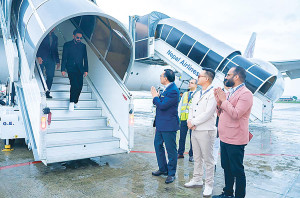
Shah went to the UN to speak for Nepal, then left before he could make the most of it

Bhotekoshi flood wasn’t a freak event. It’s the Himalaya doing what it does
Lesson learned after the death of Ronaldo
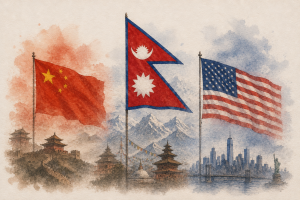
Why passive neutrality won’t take Nepal anywhere
Editor's Picks

Constitutional Bench caught in seniority, ‘pick and choose’ dispute

A Dom boy’s long road to becoming a doctor

From blankets to handmade dolls, two foreign women bring comfort to flood survivors

News Analysis: When institutional defence exposes institutional fault lines

It’s a bird … it’s a plane … it’s the Indian ambassador’s farewell tweets
E-PAPER | October 16, 2026

×