



 14.69°C Kathmandu

Sat, Oct 24, 2026
Columns
When narratives collide
Nepal’s tragedy has often been that stories outpace structures, and symbols substitute for systems.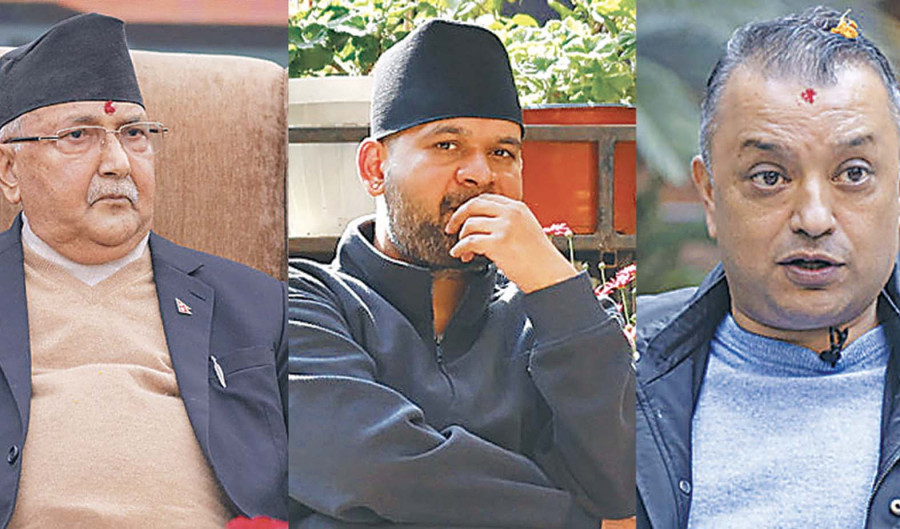
bookmark
CK Lal
Published at : February 11, 2026
Updated at : February 11, 2026 07:23
On the sidelines of the Kantipur Conclave 2026, one question surfaced repeatedly: Beyond merely legitimising the Fall Protest, what is this election actually about? The answer remains elusive.
This election is not about competing ideologies, nor is it about organisational strength, resource mobilisation, or even the personal virtues and vices of the main contenders. In a political landscape where most parties sound alike—recycling familiar promises of nationalism, stability, and prosperity—clear unique selling propositions are in short supply. What remains, and what increasingly defines the contest, is the battle of narratives: Who tells the most convincing story about the past they want to bury, the present they claim to understand, and the future they insist only they can deliver.
The March 5, 2026, general election is being fought less in streets and party offices than in the invisible architecture of stories. Voters are being courted not merely through manifestos and alliances but through carefully curated narratives that seek to explain the past, define the present, and pre-empt the future. At the centre of this contest stands Balendra Shah—Balen to his admirers—now recast from an iconoclastic mayor of Kathmandu into the prime ministerial face of the Rastriya Swatantra Party (RSP). What is unfolding is not just a political campaign but a referendum on how power is imagined in a restless republic.
Balen Shah’s story has been produced with professional precision. Its core claim is deceptively simple: Performance over promises. In a polity fatigued by unkept pledges, the appeal of measurable action is obvious. The protagonist of this tale is not Shah himself but a generational bloc—urban youth and first-time voters who feel betrayed by the revolving door of the Nepali Congress and the CPN-UML, a pattern that has repeatedly allowed a third force to punch above its electoral weight. The antagonist is the ‘old guard,’ portrayed as corrupt, slow and terminally out of touch. The promised resolution is a new era of administrative efficiency, good governance and youth power. It is a classic morality play, with clean lines and minimal grey.
The effectiveness of this narrative lies in its framing of Shah as a competent outsider. He is not sold as a politician but as a doer, closer to a technocrat with a moral compass than a party functionary with a vote bank. His communication style—short, sharp and commanding—feeds the perception of decisiveness. Supporters see his bluntness—even when it borders on rudeness—as honesty; critics call it arrogance. Either way, it cuts through the clutter of Nepali political rhetoric, which too often confuses verbosity with vision.
Public showdown
The choice of Jhapa-5 as Shah’s electoral battlefield is a narrative strategy at its most theatrical. By challenging Khadga Prasad Sharma Oli in his own stronghold, Shah has transformed a constituency race into a symbolic duel. It is framed as a battle of styles: The seasoned party patriarch versus the insurgent moderniser.
Equally telling is Shah’s attempt to scale up his story from city governance to national policy. His advocacy for stronger provinces, announced at a widely publicised meeting in Madhesh Pradesh, underscores a commitment to federalism—an issue many Kathmandu-centric leaders have treated as a constitutional inconvenience rather than a democratic promise. It is a notable shift from his earlier stance: He and his party had refrained from endorsing federalism in the previous election. Whether this represents genuine policy conviction or a convenient bridge to national relevance remains an open question; the narrative, however, is firmly in place.
Dissemination is where Shah’s campaign truly departs from tradition. He bypasses legacy media with ease, relying instead on the algorithmic reach of TikTok, Instagram reels and viral clips that speak the language of youngsters. This is politics compressed into seconds, emotion privileged over exposition. Alongside this high-tech trail runs a high-touch “spiritual” one. Visits to religious leaders, the invocation of indigenous names like Mukkumlung for Pathibhara, and the careful nods to faith and culture are designed to reassure older and rural voters that the outsider understands the civilisational grammar of Nepal. Notably, he has refrained from committing to secular politics to avoid alienating traditionalist voters. Add to this a soundtrack of popular and AI-generated songs praising Shah and RSP leader Rabi Lamichhane while lampooning old leaders, and there is a campaign that understands that in contemporary politics, rhythm often travels faster than reason.
Yet narratives seldom go unchallenged. Khadga Prasad Sharma Oli’s counter-story is built on institutional memory and organisational muscle. He dismisses Shah as a ‘hollow hero’, a social-media phenomenon whose mayoral achievements are exaggerated and whose resignation from Kathmandu is framed as abandonment rather than ambition. Oli’s claim is blunt: Governing a state requires experience, discipline and parties capable of delivering stability. New forces, he argues, may make noise but cannot make governments—at least not for the next two decades.
Sharma Oli’s debate challenge is a particularly shrewd narrative device. By offering a public face-off, he positions himself as transparent and policy-ready, while Shah’s reluctance is cast as evasion. The subtext is clear: Charisma may win clicks, but governance demands specifics. Whether debates still sway voters in the age of reels is another matter, but the frame serves Sharma Oli’s purpose—casting the outsider as unprepared.
Repackaged contender
Arriving later in the contest, Gagan Thapa offers a subtler counter-narrative that could prove more challenging for Shah. Thapa does not defend the old order so much as promise to reform it from within. He presents himself as the rational reformer, the democratic bridge between establishment experience and youthful aspiration. His contrast is not between old and new but between structured change and what he calls opaque rebellion. Shah’s low-contact, command-style governance is labelled impulsive popularity; Thapa’s years inside the Nepali Congress are rebranded as a refined democratic experience.
The ‘New NC’ narrative, reinforced by claims of internal reform after the Fall Protests and legitimised through a special convention, seeks to neutralise the outsider’s monopoly on change. Thapa’s supporters’ creative reclamation of a derogatory nickname through mutton.world, recast as ‘Greatest of All Time,’ is a reminder that the grand old party has learned to play the meme game. By juxtaposing Thapa’s detailed five-year roadmap with Shah’s perceived lack of specifics, this narrative appeals to voters who crave change but fear chaos.
At its core, the 2026 election is a battle over what kind of story Nepalis find credible. Is governance a matter of clean intent and decisive action, or of messy institutions and incremental reform? Can an independent wave dismantle entrenched networks, or will it crash against the hard rocks of coalition calculations and bureaucratic inertia? Shah’s high-handed moments as mayor provide ammunition to his critics, just as the establishment’s long record of failure fuels his appeal.
Narratives, however, are not mere propaganda; they are lenses through which voters interpret reality. Nepal’s tragedy has often been that stories outpace structures, and symbols substitute for systems. The coming days will reveal whether the electorate chooses the elegance of a well-told insurgent tale, the reassurance of institutional continuity, or the promise of reform from within. In that choice lies not just the fate of Shah, Sharma Oli, or Thapa, but the next chapter of democratic imagination.
CK Lal
Lal is a writer and political analyst.



Most Read from Columns


Editor's Picks





E-PAPER | October 24, 2026

×