



 24.79°C Kathmandu
Sun, Oct 11, 2026
Columns
Rethinking electoral systems
Any reform must respect our geographic diversity, cultural pluralism and historical political evolution.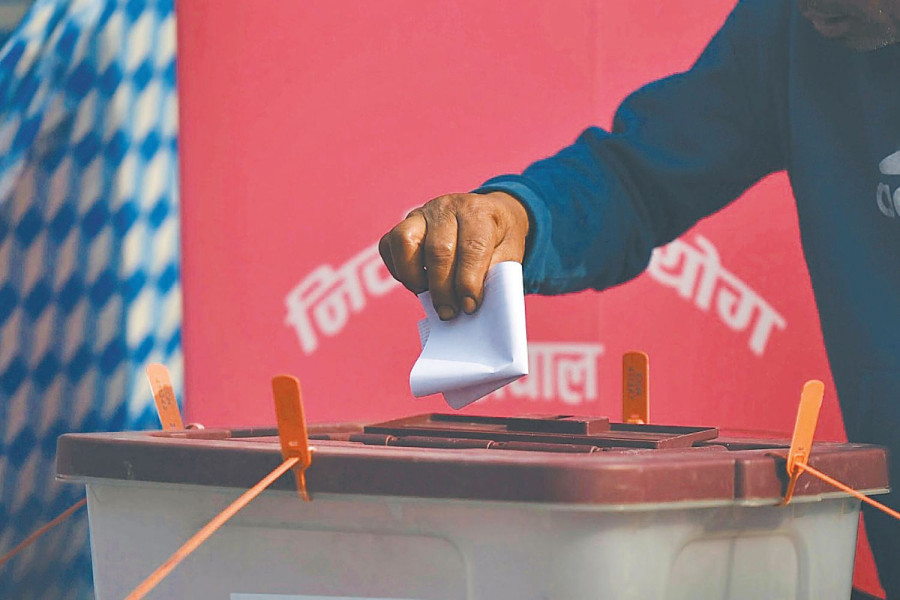
bookmark
Upendra Gautam
Published at : March 12, 2026
Updated at : March 12, 2026 07:55
The sweeping success of the Rastriya Swatantra Party (RSP) in Nepal’s March 2026 general election has revived an important institutional debate: Whether the country’s electoral system adequately balances representation, stability and legitimacy. The RSP itself has emphasised constitutional amendment as a policy priority, and one area that merits serious reflection is electoral design. The debate is not about weakening democratic pluralism; rather, it concerns how Nepal can refine its electoral rules so that plural representation, stable governance and institutional legitimacy evolve together.
Nepal’s parliamentary elections operate under the framework of the Constitution of Nepal 2015, which combines first-past-the-post (FPTP) and Proportional Representation (PR). Of the 275 members in the House of Representatives, 165 are elected through FPTP constituencies and 110 through PR lists. The intention behind this hybrid design was to combine local representation with nationwide proportional fairness after the democratic transition that followed Nepal’s Constituent Assembly elections of 2008. In principle, it sought to correct the limitations of the traditional Westminster model.
The Westminster electoral model—historically adopted across South Asia—rests on a simple rule: The candidate with the highest number of votes wins, even without a majority. Countries such as Nepal, India, Bangladesh, Pakistan and the United Kingdom (UK) adopted this model because of its administrative simplicity and its capacity to produce governments quickly. It also provides clear constituency representation and encourages direct political participation.
Yet the model carries a structural weakness: Plurality winners do not necessarily represent a majority of voters in their constituency. When multiple parties compete, votes become fragmented. A candidate can win with only a fraction of the total vote, while a larger combined share of voters may actually support other parties. As a result, aggregate vote strength and seat outcomes often diverge in FPTP systems.
Political scientists have long identified three consequences of such systems. First, vote fragmentation: When many parties compete simultaneously, the electorate is divided among multiple candidates. Second, a factual gap between votes and seats: A party may secure many parliamentary seats even if its overall vote share is significantly smaller than that of several parties combined. Third, legitimacy debates: If this pattern persists over time, sections of society begin to question whether electoral outcomes truly reflect the popular will.
This structural tension has not been purely theoretical in Nepal. The post-1990 democratic period, often celebrated as the era following the restoration of multiparty democracy, has also witnessed recurring variable phases of political agitation and institutional instability. Analysts argue that institutional design—including electoral systems—can influence such patterns of political turbulence. When large segments of voters feel underrepresented, calls for reform periodically re-emerge.
A similar critique has appeared in India’s own democratic discourse. Ramaswamy Venkataraman, former President of India, reflected critically on the plurality system in his memoir ‘My Presidential Years’. He observed that in a system where governments may be formed with only a minority share of votes, ‘the majority of voters may find themselves represented by those whom they did not elect.’ His remark captured a broader concern in South Asian democracies: That plurality systems may produce divisive non-majoritarian outcomes.
Nepal attempted to mitigate these problems by introducing proportional representation. However, in practice, the proportional component has often been criticised for excessive centralisation within party leadership. Candidate selection through party lists has frequently served the strategic interests of party elites rather than strengthening plural representation. As a result, the corrective intent of the mixed system has not been better realised.
Comparative experience offers useful insights. In France, presidential elections operate under a two-round majority system. If no candidate obtains more than 50 percent of the vote in the first round, the top two candidates proceed to a second round, where one must secure a majority. This mechanism ensures that the final winner enjoys clear majority legitimacy.
A different but equally interesting model can be found in the Kingdom of Bhutan. The Constitution of Bhutan 2008, the year a constitutional monarchy was ousted in Nepal, created a two-stage parliamentary election system. In the first stage, all registered parties contest a national primary round. Only the two parties receiving the highest nationwide vote advance to the general election, where they compete in constituency contests. This institutional filter effectively reduces fragmentation and ensures that the final contest produces a government with broader national support.
These comparisons illustrate three distinct democratic logics. The plurality model of Nepal and the UK emphasises simplicity and speed. The French system prioritises majority legitimacy. Bhutan’s constitutional design introduces a pre-electoral filter to manage fragmentation. Each approach reflects the natives’ political history and the institutional needs of the country adopting it.
For Nepal, the challenge is not to abandon pluralism but to balance and adapt electoral institutions to its evolving requirements of representation, stability and legitimacy. The emergence of RSP and other new political forces demonstrates that Nepali voters are willing to go with the wave of new alternatives when they seek accountability and change. Electoral reform should therefore be approached not as a partisan exercise but as a national institutional reconciliation dialogue.
A thoughtful, evidence and experience-based reform could explore mechanisms that reduce excessive vote fragmentation while preserving local representation. Options might include strengthening internal party democracy in the proportional system, encouraging transparent pre-electoral alliances, or studying filtered electoral models that balance competition with majority legitimacy. Any reform must also respect Nepal’s geographic diversity, cultural pluralism and historical political evolution.
Ultimately, electoral systems are not static doctrines; they are institutional tools that societies refine as their nationwide experience gets synthesised and mature. Nepal’s future reforms should aim to produce a system where voters feel that their voices translate credibly into representation, governments enjoy durable legitimacy, and political competition remains open and fair. If such a balance is achieved, electoral reform could become not merely a technical adjustment but a foundation for a more legitimate, stable and representative Nepal.
Upendra Gautam
Gautam is secretary general of China Study Centre Nepal.



Most Read from Columns

Before you take credit for Khula Manch, read its history

Shah went to the UN to speak for Nepal, then left before he could make the most of it

Why Nepal’s latest disaster needs a local name—not just a scientific label
Balendra Shah should prepare for the worst

Lesson learned after the death of Ronaldo
Editor's Picks

Constitutional Bench caught in seniority, ‘pick and choose’ dispute

A Dom boy’s long road to becoming a doctor

From blankets to handmade dolls, two foreign women bring comfort to flood survivors

News Analysis: When institutional defence exposes institutional fault lines

It’s a bird … it’s a plane … it’s the Indian ambassador’s farewell tweets
E-PAPER | October 11, 2026

×