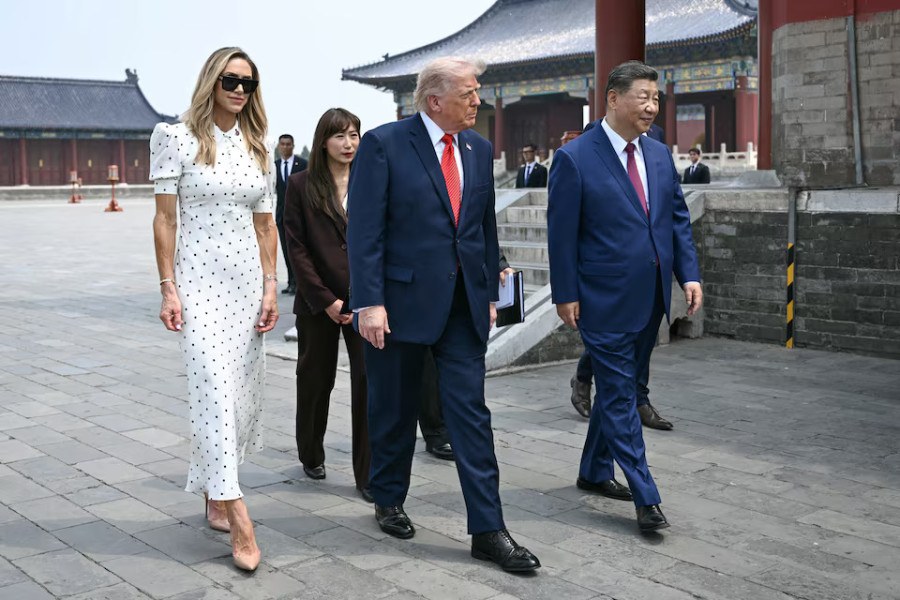
At a time when profound changes and growing uncertainties mark the international landscape, the course of the ‘giant ship’ of China-US relations has drawn worldwide attention. At the invitation of Chinese President Xi Jinping, US President Donald Trump paid a state visit to China from May 13 to 15, 2026. This marks the first visit by a sitting US president to China in nine years. During the visit, the two heads of state of the two countries conducted thorough strategic discussions on bilateral relations and major global affairs of world peace and development, reaching a number of important common understandings and further charting the course for the bilateral ties in the new era.
As the world’s top two economies and permanent UN Security Council members, China and the United States shape the livelihoods of their citizens and steer the course of global peace, development and prosperity. History and reality have repeatedly proven that cooperation benefits both sides, while confrontation leaves both worse off. Though separated by the Pacific Ocean, the two countries share extensive common interests. In the face of global challenges such as climate change, public health, economic recovery and artificial intelligence governance, no country can remain immune, nor can any nation solve all problems alone. Only through cooperation can we overcome common challenges.
Head-of-state diplomacy has long served as the ‘anchor’ and ‘compass’ guiding China-US relations. Amid an increasingly complex international landscape and intertwined global challenges, strategic communication between the two heads of state carries ever greater significance. It embodies the shared willingness of both sides to bolster strategic trust, manage differences properly and expand cooperation through high-level engagement. During this latest interaction, China and the US agreed to build a ‘constructive relationship of strategic stability’ as the new vision for bilateral ties, providing strategic guidance for China-US relations over the next three years and beyond. This serves the fundamental interests of both peoples and responds to the international community’s shared expectation for stable China-US relations. ‘Constructive strategic stability’ means positive stability with cooperation as the mainstay, healthy stability with competition within proper limits, constant stability with manageable differences, and lasting stability with expectable peace.
China stands ready to work with the US to turn this new vision into concrete and collaborative actions and advance the steady, sound and sustainable development of China-US relations. Effectively implementing the important strategic common understandings reached by the two presidents will constitute the top priority for both sides going forward.
Properly handling the Taiwan question
China has always viewed China-US relations from a strategic and long-term perspective and remains committed to handling bilateral relations in accordance with the principles of mutual respect, peaceful coexistence and win-win cooperation.
As an ancient Chinese proverb goes, “A flourishing tree depends on strong roots; a brilliant flame depends on rich fuel.” National sovereignty and territorial integrity are precisely such roots and foundations—they are inviolable and cannot be shaken. There is but one China in the world. The Taiwan region is an inalienable part of China’s territory, and the government of the People’s Republic of China is the sole legal government representing the whole of China. This constitutes a universal consensus of the international community and a fundamental principled red line that China is resolute in upholding.
Respecting this red line is an essential prerequisite for building mutual trust between China and the United States and a necessary guarantee for safeguarding regional peace and stability. During his meeting with President Trump, President Xi Jinping stressed that the Taiwan question is the most important issue in China-US relations. If it is handled properly, the bilateral relationship will enjoy overall stability. Otherwise, the two countries will have clashes and even conflicts, putting the entire relationship in great jeopardy. ‘Taiwan independence’ and cross-Strait peace are as irreconcilable as fire and water. Safeguarding peace and stability across the Taiwan Strait is the biggest common denominator between China and the US. The US side must exercise extra caution in handling the Taiwan question.
Both China and the US recognise the paramount importance of sustaining cross-Strait peace and stability. As explicitly stated by President Trump in an exclusive interview with Fox News, “We’re not looking to have somebody say, let’s go independent because the United States is backing us. And, you know, we’re supposed to travel 9,500 miles to fight a war. I’m not looking for that.” This demonstrates that the US understands China’s position and has responded to China’s concerns. Stable China-US relations cannot exist without mutual respect for each other’s core interests. Only by faithfully adhering to the one-China principle and handling the Taiwan question prudently and properly can the two sides truly keep the giant ship of China-US relations on a steady and right course, avert setbacks and pitfalls, and forge ahead steadily toward a community of shared future.
Nepal faces historic opportunities
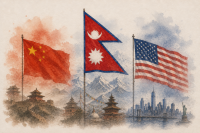
China remains firmly committed to the path of peaceful development and standing firm as a builder of world peace, a contributor to global development and a defender of the international order. It never seeks hegemony, engages in geopolitical rivalry or pursues exclusive spheres of influence. Instead, China advocates building a Community with a Shared Future for Humanity and striving to foster an open, inclusive, clean and beautiful world that enjoys lasting peace, universal security and shared prosperity. For a time-honoured friendly neighbour like Nepal, stable China-US relations are of equally profound significance.
“Though high and long as mountains and rivers may stretch, friendship prevails through all times.” Spanning millennia of trans-Himalayas exchanges to the fruitful achievements under high-quality Belt and Road cooperation, China-Nepal relations have withstood the test of time and grown even more robust. China appreciates Nepal’s consistent pursuit of an independent foreign policy and commends its firm commitment to upholding strategic autonomy as well as safeguarding national sovereignty, independence and territorial integrity. Stable China-US relations will help cultivate a more peaceful and stable international environment, and create more favourable development opportunities for developing countries, including Nepal. As a Nepali proverb aptly puts it, “Though the mountain peak stands lofty, the road to the summit can be built together”. A more stable world serves the common interests of all nations.
The world today has arrived at a new historical crossroads. Against the backdrop of rising unilateralism, resurgent protectionism and frequent geopolitical conflicts, humanity is in greater need of reason and cooperation more than ever. Guided by the strategic common understandings between the two leaders, China stands ready to work with the US to enhance dialogue, deepen mutual trust and expand cooperation, to steer China-US relations steadily forward on the right track, as stated by both leaders during the talks that we will “make 2026 a historic, landmark year that opens up a new chapter in China-US relations” and “make (US-China) bilateral relations better than ever before and embrace a fantastic future. ”
China also stands ready to work hand in hand with Nepal to fully implement the important outcomes of President Xi Jinping’s historic state visit to Nepal in 2019 and the important common understandings reached by the leaders of the two countries. The two sides will accelerate the building of a trans-Himalayan multidimensional connectivity network, share development opportunities, advance all-round practical cooperation across the board, jointly promote regional peace and stability, and build an even closer China-Nepal Community with a Shared Future.
Zhang is the Ambassador Extraordinary and Plenipotentiary of the People’s Republic of China to Nepal. He assumed office in February 2026 as China’s 23rd ambassador to Nepal.




 21.05°C Kathmandu