



 23.87°C Kathmandu


Mon, Oct 26, 2026
Columns
How the melting glaciers are unlocking ancient superbugs we’ve never seen before
Researchers warn that long-dormant pathogens and ancient antibiotic-resistance genes are slipping into freshwater systems.
bookmark
Santosh Dulal & Devraj Pokhrel
Published at : September 11, 2026
Updated at : September 11, 2026 06:15
Do not mistake glaciers for mere frozen lakes. They are time capsules holding Earth’s history. Snow that fell thousands of years ago compacts into ice; in doing so, it traps whatever was suspended in the atmosphere at the time: dust, pollen, bacteria, fungal spores, parasitic eggs and viral particles.
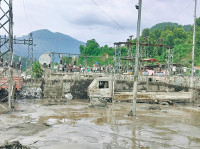
The Bhotekoshi flood of August 26 was the second major glacier flood in Nepal in the last 14 months. In early July 2025, a transboundary glacial flood triggered by a supraglacial lake outburst in China’s Gyirong County destroyed the Nepal-China Friendship Bridge, claimed several lives, crippled critical infrastructure and halted the vital trans-Himalayan trade corridor for weeks. While Nepal knows the hazards of a melting cryosphere, the receding muddy floodwater leaves behind something we are not testing for: ancient pathogenic extremophilic microbes, dormant for millennia within glaciers, now surging into watersheds. The visible wall of floodwater was only a warning. The invisible biological fallout is the factual calamity to human and ecosystem health we refuse to witness.
In 2021, researchers recovered viral genetic material nearly 15,000 years old from the Guliya ice cap on the Tibetan Plateau, with most identified genomes unlike those in existing databases. A follow-up study extended the record to 41,000 years with 1,700 viral species, revealing viral communities changed across periods. A contrasting warning comes from Siberia.
In 2016, an anthrax outbreak on Russia’s Yamal Peninsula claimed over 2,300 reindeer, infected dozens of people, one fatally. An intense heatwave thawed permafrost, exposed anthrax-infected carcasses, releasing viable bacterial spores. That outbreak was not caused by a novel, hyper-evolved super-pathogen. It was an emergence of a known mycobacterium. Yet it demonstrated how climate-driven melting can transform dormant glacial archives into tangible public-health hazards.
Researchers have found mobile genetic elements, such as plasmids and transposons, carrying antibiotic-resistance and virulence genes within permafrost and Himalayan glaciers. These traits are not static; microbes can exchange them through several routes: taking up free environmental DNA, through bacteriophages, or by direct cell-to-cell contact via horizontal gene transfer. Researchers analysing 30,000-year-old Siberian permafrost recovered a fully functional gene for vancomycin resistance, structurally identical to variants currently circulating in intensive care units globally. As vancomycin is a last-resort antibiotic, its archaic analogue’s viability reveals antibiotic resistance is not a modern invention, though it was an evolutionary trait existing for millennia.
A pivotal 2025 scientific report from Lanzhou University expanded this perspective across the planet’s cryosphere, surveying Antarctica, the Arctic and the Tibetan Plateau. They introduced the concept of a ‘glacier continuum’; glacier, river and lake as one connected system through which resistance genes of microbes are not merely transported. However, they are transformed and amplified as they move downstream to human populations. When travelling alongside these genes, turn microbes into superbug having heightened virulence and pathogenicity. Evidence from polar environments has already verified this grim trajectory; pathogenic microbes Cryptococcus fungi, Aureobasidium melanogenum, Naganishia albida and Rhodotorula mucilaginosa were isolated from polythermal glaciers in Greenland and Svalbard, confirming virulent, viable organisms emerging from the melt.
Now, let’s put these findings into regional perspective. The Hindu Kush Himalaya (HKH) holds the largest volume of ice outside the polar regions and supplies ten major river systems on which roughly 1.9 billion people depend. A 2023 ICIMOD assessment reported glacier ice loss accelerated by 65 percent in the 2010s compared with the previous decade. Nepal’s Yala Glacier in Rasuwa alone has lost 66 percent of its surface area since 1974, accelerating transformation forms the backdrop to the Rasuwa disaster and raises a question beyond the visible hazards.
For Nepal, lacking local evidence offers no comfort. Climate change and global warming are accelerating the melting of the HKH glaciers with aggressive ferocity. As Himalayan glaciers melt and icebergs collapse, long-frozen time-traveller poly-extremophile microbes, referred to as the biological time bomb, will inevitably cascade into glacier-fed river systems.
The time bomb extends beyond human infection. These invasive alien zombie microbes could disrupt local microbial signalling networks, specifically the chemical ‘quorum sensing’ that governs biofilm formation and ecological stability in the freshwater ecosystem. The cascading effects would menace wildlife, livestock, people, the nation’s fragile healthcare system and the entire ecosystem’s health.
Whether Himalayas meltwater wreaks havoc of biological time bomb or not, a mandate for pragmatic, evidence-based preparedness is a must. Nepal must decisively conduct active targeted metagenomic surveillance and eDNA metabarcoding across its sentinel Himalayan glaciers and glacier-fed river catchments. This initiative is integrated into the existing One Health framework endorsed by the nation in 2024, thereby bridging the nexus of human, animal and environmental health governance.
Operationally, urgent upscaling of in-country next-generation sequencing capabilities, enhancing bioinformatics and computational tools to flag anomalous genetic signals, and multi-sectoral collaboration among hydrologists, biologists, epidemiologists, and veterinary scientists are essential.
Routine microbial and genetic sampling, testing, metagenomic surveillance and eDNA metabarcoding guide us who are circulating in the aquatic system. Moreover, Nepal must champion transboundary cooperation under the HKH umbrella, as the waters carrying these biological risks respect no political borders.
The Himalayan glaciers holding the answers are melting at a rate unparalleled in human history, with each additional year of idleness lost as irrecoverable baseline data, from which the size and direction of a nascent outbreak could be inferred. As the inevitable human sentinel case surfaces, and no prior genome sequencing or genetic information has occurred to alert its coming, the natural milieu-the data source necessary to combat the epidemic will have vanished into the Bay of Bengal.
Santosh Dulal
Dulal is a scientist at Nexus Institute of Research & Innovation (NIRI).
Devraj Pokhrel
Pokhrel is a research assistant at Nexus Institute of Research & Innovation (NIRI).




Most Read from Columns




Editor's Picks

What to know about the US trial over Mamta Kafle’s disappearance
NPL returns with bigger ambitions and global recognition
What’s new in the Nepal Premier League’s third season?
After Nepal’s recent disaster, it wants to test whether COP31 can deliver climate justice

Why does an hour long flight to Dhangadhi cost more than a flight to New Delhi?
E-PAPER | October 26, 2026

×