



 14.4°C Kathmandu


Fri, Oct 16, 2026
Columns
Why climate change is a threat to Nepal’s hydropower sector
Climate change is not a future risk to our hydropower sector; it is a present and recurring one. The August disaster proved it at a scale no prior monsoon had.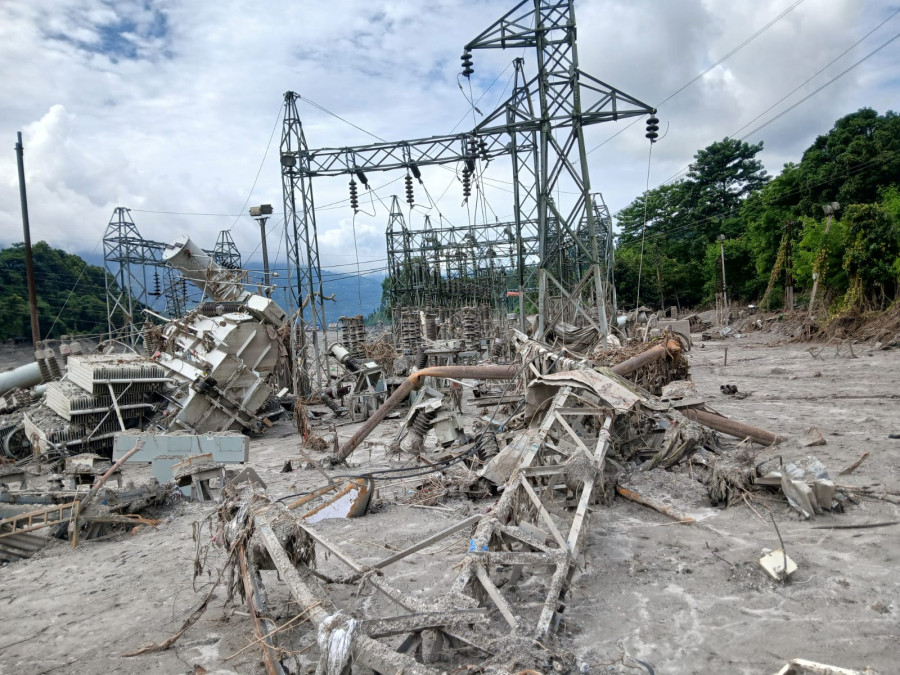
bookmark
Arun Bhakta Shrestha & Ramesh Ananda Vaidya
Published at : September 4, 2026
Updated at : September 4, 2026 19:49
On August 26, 2026, a glacier with bedrock below it collapsed above the Bhotekoshi River in the Lhende catchment on the Nepal-China border. What followed buried entire settlements in Rasuwa and Nuwakot, swept away hydropower stations under construction and in operation, and killed more than 1,250 people across Nepal and Tibet combined, a toll still rising a week later. Twelve operational projects (431.1 MW) plus 15 projects under construction (470 MW), for a combined 901.1 MW of capacity affected across all projects. Over 100 workers were unaccounted for at the 216 MW Upper Trishuli-1 project alone in the disaster’s first days.
This is not an isolated example of floods impacting hydropower. Nepal has lost hydropower infrastructure to floods and landslides in every significant monsoon since 2021: 26 projects in 2021 (Rs5 billion in losses), 30 projects amounting to 463 MW in 2023 (Rs8.5 billion), including the flash flood that killed 18 workers at Super Hewakhola in Sankhuwasabha that June, and 26 more facilities in 2024 (over Rs5 billion). Three monsoons, Rs 18.5 billion in cumulative direct losses, private developers hit hardest each time. None of it prepared the sector for what came next.
The scale of the recent Bhotekoshi and Trishuli floods is still being calculated. However, what is clear is that climate change is not a future risk to Nepal’s hydropower sector. It is a present and recurring one, and the August disaster proved it at a scale no prior monsoon had.
We have long struggled to reduce hydropower’s environmental footprint. Nepal developed a hydropower-specific EIA manual to manage what projects do to the environment, though its implementation remains uneven. The more neglected and now unmistakably urgent concern is the second relationship: What the environment does to these projects.
Climate change is intensifying both the frequency and magnitude of these hazards across the Hindu Kush Himalaya (HKH) region, making this relationship impossible to ignore. A risk analysis framework for sustainable hydropower in South Asia explicitly identifies both relationships. Mitigation measures for managing risks due to environmental challenges to hydropower are just as important as those for managing challenges from hydropower to the environment.
Climate risk assessment belongs at the beginning of hydropower planning, not the end. Where it sits determines whether it drives decisions or merely documents them. It should determine siting, sizing, design standards and long-term operational strategy. This means a comprehensive assessment of changing flow regimes, extreme flood probabilities including Glacial Lake Outburst Floods (GLOFs) and Landslide Dam Outburst Floods (LDOFs), debris flow and landslide hazard, sedimentation and glacial lake dynamics in the catchment. But assessment also needs to drive decisions on both structural and non-structural measures.
Structural measures are effective but not sufficient. Catchment-scale nature-based solutions, including watershed management, reforestation, and wetland restoration, have a complementary and underutilised role in reducing flood peaks, sediment load and erosion. While the evidence base is growing and looks promising, it remains inconclusive at the HKH scale. Measures such as early warning systems, emergency response protocols, adaptive operational rules, insurance mechanisms and regular climate risk review over the project lifetime are equally important.
A project designed in isolation from upstream glacial dynamics or land use change in its catchment is blind planning. We must take an integrated river basin (IRB) approach, treating the basin as the planning unit rather than the project site.
The recent flash flood affected 12 operational projects generating a total of 431.1 MW of power, in addition to 15 projects under construction projected to generate 470 MW. Each of those damaged projects had an approved design. The question therefore is whether these standards have kept pace with a changing climate.
The Department of Electricity Development (DoED) Guidelines for Study of Hydropower Projects, 2018, state what must be done but not how. They provide no guidance on climate models, standard GLOF quantification methodology, or a benchmark for what constitutes adequate screening. They indicate requirements without a method for meeting them. At the same time, multilateral-financed projects tend to meet a rigorous standard because lenders impose one, while domestically financed private sector projects do not. This explains the disproportionate private sector damage in 2021, 2023 and 2024.
What Nepal needs is a guideline customised for the Nepali context, tested and validated for Nepali river basins. ICIMOD and WECS, supported by Norway, are developing Nepal’s first Climate-Resilient Hydropower Guideline. Nepal has the requirements on paper but lacks the methodology in practice. The gap between the two is where billions of rupees in damage accumulate every year. Risk mitigation and management measures save far more money in avoided disaster recovery costs than it costs to build upfront.
Every rupee invested in climate-resilient planning saves multiples in flood damage, lost generation, emergency imports, and bank loan impairments. As much as Rs15 billion in cumulative direct physical losses across three monsoons is the predictable cost of planning without climate risk at the centre—a cost set to increase if the status quo holds. Nepal cannot afford that bargain.
As of mid-April, commercial banks had lent more than Rs500 billion to the energy sector—about 9.5 percent of total loans—according to the Nepal Rastra Bank. Projects are financed primarily on personal and corporate guarantees rather than rigorous climate risk assessment. When floods repeatedly damage those projects, the loan book carries unpriced climate risk.
Stocks issued by hydropower companies are actively traded in the Nepal Stock Exchange. In the first eight months of the last fiscal year, the sector ranked first in terms of turnover. On any given trading day, the total market value of all the stocks issued by hydropower companies hovered around Rs700 billion, close to 20 percent of the total trade capital. Does the capital market have information on the risks hydropower projects face for investors to trade at appropriate prices? What will be the effect on the economy in case of disasters?
The insurance sector cannot absorb repeated climate shocks of this magnitude indefinitely. Furthermore, what will be the effects of the recent disaster on the reinsurance premiums in the future? Will such a risk-transfer option still be affordable in the future, if it exists at all? Will the government have to intervene and start planning for a risk-spreading option for the future of the hydropower industry in Nepal?
The government’s introduction and ongoing implementation of a comprehensive Hydrology and Meteorology Policy 2081 (2024) is highly timely. On cryosphere research (Clause 10.4.5), studies on glacier collapse and permafrost degradation should also be undertaken. While sufficient progress has been made in filling knowledge gaps on glacial lakes, a huge gap exists in understanding these cryospheric hazards.
On collaboration beyond the borders (Clause 17 A 5, and AA 4) and multi-hazard early warning systems(Clause 10.5.1), we must establish mechanisms with China for exchanging real-time information on cryospheric changes in the Himalayas and for setting up necessary multi-hazard early warning systems.
Finally, on glacier monitoring (Clause 10.2.12), the document says that on-site monitoring and satellite-based remote sensing systems will be developed—a welcome step—but it does not mention when and how this will be implemented. This issue needs immediate attention. We must begin preparations and execute the task expeditiously.
The August 26 disaster was another dot in the pattern. Nepal had three years of monsoons to recognise—2021, 2023 and 2024—each one a smaller version of what eventually happened at scale. The question now is the same that Nepal ignored after each of the previous floods: Do we continue to treat climate risk assessment as a compliance step, or do we treat it as the starting point for where and how hydropower gets built? This is a real opportunity to make that move, but a guideline on paper will not put back what was lost. In the months ahead, the choices of reconstruction will either reinforce the failures that caused this catastrophe or correct them. This will be the last warning.
Arun Bhakta Shrestha
Shrestha is a Senior Advisor for Climate and Environmental Risk at ICIMOD.
Ramesh Ananda Vaidya
Vaidya is a Former Member of the National Planning Commission.


.PNG&w=200&height=120)

Most Read from Columns

Before you take credit for Khula Manch, read its history

Shah went to the UN to speak for Nepal, then left before he could make the most of it

Bhotekoshi flood wasn’t a freak event. It’s the Himalaya doing what it does

Lesson learned after the death of Ronaldo

Why passive neutrality won’t take Nepal anywhere
Editor's Picks

Constitutional Bench caught in seniority, ‘pick and choose’ dispute

A Dom boy’s long road to becoming a doctor

From blankets to handmade dolls, two foreign women bring comfort to flood survivors

News Analysis: When institutional defence exposes institutional fault lines

It’s a bird … it’s a plane … it’s the Indian ambassador’s farewell tweets
E-PAPER | October 16, 2026

×