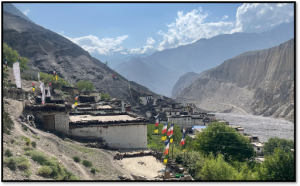
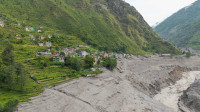
On August 16, 2024, two glacial lakes high above Thame village in the Everest region burst successively. Within just 22 minutes, massive glacial floodwaters tore through the settlement, wiping out houses, a school, a health clinic and several bridges. The disaster forced 135 Sherpa communities out of their homes and left the village reeling. It’s a stark example of how climate-driven disasters in the Himalayas aren’t just about infrastructure loss; they are increasingly becoming health hazards and emergencies.
According to an ICIMOD report, in 2025 alone, Nepal was one of the four Himalayan countries to record more than 10 supra-climate-driven disasters, a surge driven largely by intense monsoon rainfall that claimed hundreds of lives, destroyed homes and infrastructure, triggered health emergencies and inflicted colossal economic losses.
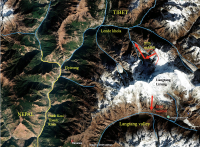
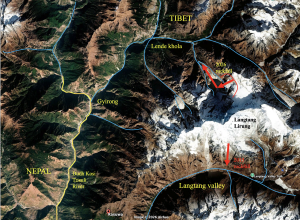
On August 26, Nepal suffered catastrophic climate-driven devastation when a towering wall of glacial flood water tore down the Bhotekoshi River valley across Rasuwa, Nuwakot and Dhading districts, swallowing roads, bridges, hydro plants, agricultural lands and entire riverbank settlements. The disaster killed 1,453 people, and around 5,200 remain missing. The breakdown in the health system was equally worse. The Plan International Situation Report published on October 2 revealed that seven health facilities were destroyed, 23 schools were severely damaged, as were 64 water systems and 10,000 latrines, impacting over 84,000 people, including over 22,000 children.
The flood hit when maternal and child health needs were high, affecting about 10,600 pregnant and breastfeeding mothers and 7,000 children under five years of age. With health facilities wiped out and roads cut off, most affected groups included the 1,854 persons with disabilities, and the vulnerable population needing urgent care had nowhere to go.
Immunisations ceased, and limited access to clean water and sanitation left communities vulnerable to diseases. The government stepped in, rolling out oral cholera vaccines in Rasuwa and Nuwakot. They set up a real-time disease tracking and digital reporting system covering health facilities, casualty management, emergency medical teams, holding centres and health service coverage, which was exactly what was needed. But these efforts highlighted that the flood didn’t just wreck properties; it tore apart the urgent health system that keeps services running.
Just five weeks later, relentless heavy rainfall on September 28-29 triggered 542 separate disasters across Nepal, killing at least 27 people and leaving 1,500 homeless. This time, the damage hit differently. Six bridges along the Kali Gandaki River disappeared, and the Maldhunga bridge—the lifeline for the Mid-Hill Highway—was wiped out, ceasing traffic between Parbat and Baglung. Roads and bridges aren’t just for travel; they allow ambulances to move, deliver lifesaving medicines, and get medical teams to those in need. Without them, even if a hospital stands, it’s left stranded.
If that wasn’t bad enough, flooding shut down the Kali Gandaki A hydropower station, knocking out electricity. Without power, health facilities lost refrigeration for vaccines and medications, and their ability to respond to emergencies at night.
Yet the real danger wasn’t just from the disasters themselves, but from how little time the health system had to recover between shocks. That’s the weak spot for Nepal’s disaster-health response—when it needs to bounce back quickly but just can’t.
In Nepal, things are already tough. Even with safe water guaranteed as a constitutional right, just 16 percent of people have access to potable water. The Nepal Multiple Indicator Cluster Survey 2024-2025 revealed that over 60 percent of household drinking water samples collected nationwide were contaminated with E. coli and faecal coliform. Floods only make this matter worse. Many remote communities are already vulnerable to faecal contamination even without disaster. When floodwater becomes a health hazard, it can exacerbate that vulnerability.
Scientific evidence shows that in the aftermath of disaster, health emergencies could spike from water-borne, vector-borne and rodent-borne diseases in combination with skin infections and mental illnesses. One disaster-related global study found that in lower-income countries, more people die from post-disaster disease outbreaks than from the immediate dangers like drowning or injuries. Another study drew a straight line between climate-driven disasters and a spike in waterborne pathogens like Cryptosporidium, Giardia lamblia and Vibrio cholerae.
Looking at global examples is vital to understanding the health emergencies that follow disasters. In 2022, floods in Pakistan caused around 660,120 illness cases in 4,210 government-run medical camps in flood-affected areas. Around 150,000 people reported serious diarrhoea cases. Authorities recorded 132,485 respiratory illness cases and 49,420 malaria cases in Sindh province alone. Dengue surged amid the torrential rains. In 2016, Hurricane Matthew in Haiti affected 1.3 million Haitians, and cholera spiked, creating outbreaks.
Globally, disaster-related economic losses were estimated at around $169 billion in 2015. Evidence shows that Nepal, China, Pakistan and Myanmar experienced a series of monsoon-induced disasters in 2025, causing massive damage to infrastructure and livelihoods and creating health hazards and emergencies.
On top of all that, a meta-analysis shows floods mean a roughly 40 percent spike in infectious diarrhoea. Not every disaster turns into an epidemic, but disasters make it much easier for infectious diseases to spread.
The next danger may occur through a glass of contaminated water, a mosquito breeding in stagnant water, or a disease that reaches a crowded shelter before the health system detects it. We should prepare to fight cholera, diarrhoea, dengue, typhoid and Hepatitis in the aftermath of disasters. The government must act immediately to secure clean water, enforce emergency sanitation, conduct surveillance to detect emerging infections, and protect its most vulnerable populations.
In the mountains and remote communities, particular emphasis should be placed on high-risk populations, ensuring continuity of basic health services, maintaining access to maternal and child health services, early warning coordination mechanisms and effective emergency responses. Without these basic interventions, communities are left behind when they need help the most.




 15.56°C Kathmandu



.PNG&w=200&height=120)