Private sector bears bulk of Bhotekoshi flood losses
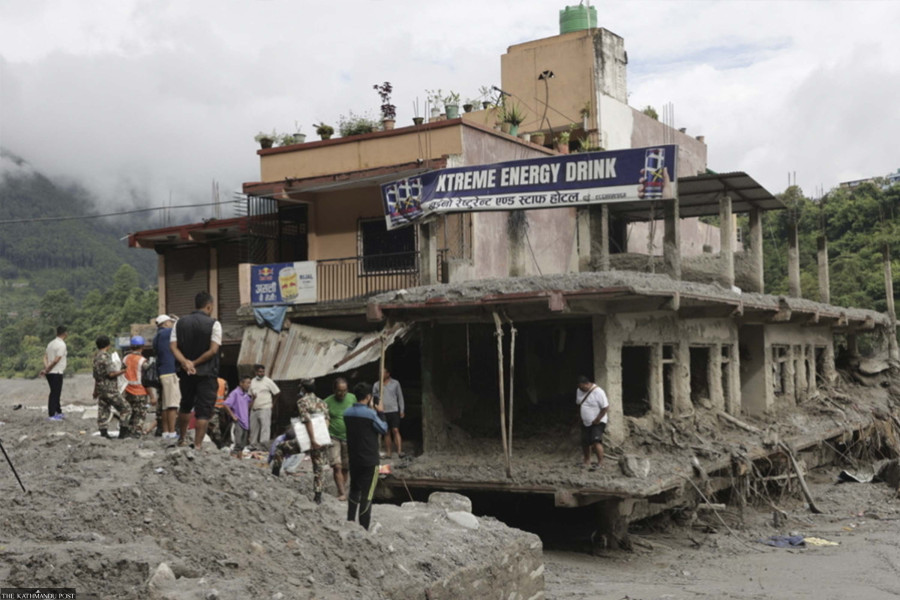
A preliminary government assessment estimates damage and economic losses at Rs408 billion. Nearly 4,800 businesses and 7,570 homes were damaged, while 13 hydropower projects and five solar plants were hit. The flood-ravaged Dhunge Bazar in Nuwakot. Post Photo
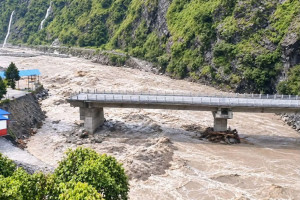
The August 26 flash floods in the Bhotekoshi river swept away roads, homes and bridges, and damaged hydropower projects, causing one of the costliest climate disasters. Beyond the visible devastation, however, the floods have exposed a stark economic reality: more than two-thirds of the estimated losses fell on the private sector.
A preliminary Rapid Damage and Needs Assessment (RDNA) prepared by the government estimates that the floods caused Rs408 billion in total damage and economic losses across five districts. Of that, nearly Rs300 billion—more than two-thirds—is believed to have fallen on private businesses, households and privately owned infrastructure.
The findings underline how increasingly destructive climate disasters are threatening Nepal’s economic backbone, from hotels and hydropower plants to schools, farms and transport companies.
“Most of the physical damage has occurred in private enterprises, private housing, hydropower projects, schools, vehicles and communication infrastructure,” said Arjun Bhandari, joint secretary at the National Planning Commission and coordinator of the RDNA. “Historically, the private sector bears the largest share of losses in such disasters, and this flood is no exception.”
While the RDNA provides an overall estimate, the commission has now begun a more detailed Post-Disaster Needs Assessment that will separately quantify public and private losses and determine financing requirements for reconstruction.
Businesses hit hardest
The commercial sector accounts for one of the largest components of the disaster.
Nearly 4,800 businesses suffered partial or complete damage, resulting in an estimated Rs146.19 billion in combined physical damage and economic losses. The figure includes destroyed buildings, damaged equipment and the income businesses are expected to lose while operations remain disrupted.
Hotels and restaurants were the worst affected, with 1,259 establishments damaged. Wholesale and retail businesses followed with 1,212, while 866 educational institutions, 345 entities dealing with cooking gas, electricity and water, 263 manufacturing firms and 190 financial and insurance institutions also reported losses.
The report estimates that rebuilding commercial establishments alone will require Rs45.45 billion.
For many businesses, the floods destroyed not only property but also supply chains. Mountain tourism, hospitality and local commerce—industries that depend heavily on uninterrupted transport links—have been particularly vulnerable after roads and bridges connecting northern districts were washed away.
National Planning Commission Vice-Chair Gunakar Bhatta acknowledged that the private sector appears to have borne the majority of the disaster’s economic burden, even though final figures are still being verified.
Hydropower faces a costly setback
The floods have dealt a severe blow to Nepal’s energy ambitions.
According to the assessment, 13 hydropower projects and five solar plants, with a combined installed or under-construction capacity of 759 megawatts, sustained damage. Eight of the affected hydropower projects are privately owned.
The estimated damage and losses to hydropower facilities and transmission infrastructure amount to Rs151 billion, making it the single most expensive sectoral loss recorded in the assessment. Reconstructing damaged power plants and transmission lines is expected to cost Rs390.62 billion.
Several projects under construction also suffered heavy losses after floodwaters buried equipment, destroyed access roads and damaged civil structures. Industry officials warn that prolonged delays could affect electricity generation targets and discourage future private investment in renewable energy.
Beyond industry, the floods have displaced thousands of families.
A total of 7,570 private houses were partially or completely damaged across Rasuwa, Nuwakot, Dhading, Gorkha and Chitwan districts. Nuwakot recorded the highest number of damaged homes at 3,977, followed by Rasuwa with 1,779 and Dhading with 1,451.
The damaged housing stock includes 2,319 mud-and-stone houses, 3,215 brick and cement structures and 2,036 reinforced concrete homes.
The housing sector alone suffered an estimated Rs63.88 billion in damage and losses, while reconstruction is expected to require nearly Rs95.82 billion.
For communities along the Bhotekoshi corridor, rebuilding homes represents more than replacing buildings. Entire settlements face the challenge of relocating to safer ground as riverbanks have shifted and previously inhabited areas remain vulnerable to future flooding.
Banking, farming and telecommunications disrupted
Although the financial sector escaped relatively lightly compared to other sectors, the floods still damaged 17 branches of 12 various banks and financial institutions.
Branches of Nepal Investment Mega Bank, NIC Asia, Prabhu Bank, Agricultural Development Bank, Global IME, Himalayan, Laxmi Sunrise, Machhapuchchhre, Nabil, NMB, Citizens and Sanima banks were among those affected.
Agriculture also sustained widespread damage. Around 1,806 hectares of cultivable land were affected, with estimated losses of Rs1.09 billion in crop production and Rs1.44 billion in livestock. More than 1,000 animals were reportedly killed.
In telecommunications, three Nepal Telecom towers and one Ncell tower were damaged, disrupting connectivity in several northern communities. The sector’s damage and economic losses have been estimated at Rs628.7 million, with reconstruction expected to cost significantly more.
In the education sector, eleven schools lost 38 buildings and 156 classrooms completely, while another seven schools sustained partial damage to 18 buildings and 152 classrooms. The affected schools are concentrated in Gosainkunda and Uttargaya rural municipalities in Rasuwa; Bidur Municipality in Nuwakot; and Galchhi, Benighat Rorang and Siddhalek in Dhading.
More than half a dozen of the damaged institutions are privately operated schools, adding to the broader private-sector losses identified in the assessment.
The destruction has forced hundreds of students into temporary learning spaces, raising concerns about prolonged disruption to education in remote mountain districts.
Climate disasters reshape economic risk
The August 26 floods are among the most expensive disasters Nepal has experienced in recent years, highlighting the growing financial consequences of extreme weather in a country highly exposed to climate change.
Unlike earthquakes, where public infrastructure often dominates reconstruction costs, floods increasingly inflict disproportionate losses on privately owned assets—from family homes and small businesses to energy projects financed by domestic investors.
The RDNA estimates that total reconstruction will require Rs723.31 billion, far exceeding the value of the initial damage itself. That figure includes rebuilding infrastructure, restoring livelihoods and improving resilience against future disasters.
Economists say the scale of private losses raises important questions about disaster insurance, business continuity planning and the resilience of critical infrastructure located along river corridors.
In response, the Cabinet last week approved the first phase of a special recovery package for flood-affected businesses and industries.
The measures include customs duty exemptions for replacing commercial vehicles and freight carriers that were destroyed or swept away by the floods. Businesses will also receive tax relief, concessional facilities and other financial support intended to revive economic activity in the affected districts.
The government has described the package as an initial intervention, with additional recovery measures expected once the detailed post-disaster assessment is completed.
For thousands of entrepreneurs and households, however, the challenge extends beyond reconstruction grants. As rescue activities nearly come to an end, the country faces the far larger task of rebuilding an economy in which the private sector has emerged as the biggest casualty of one of the country’s costliest climate disasters.




 15.77°C Kathmandu