Flood survivors face water shortages, disease risk in crowded holding centres
More than 3,600 people are staying in 37 holding centres across Rasuwa, Nuwakot and Dhading districts. No major outbreak has been reported, but cases of colds, coughs and viral fever are common. A preliminary assessment by the National Child Rights Council found 1,233 children in holding centres, including 632 girls and 601 boys. Angad Dhakal/TKP
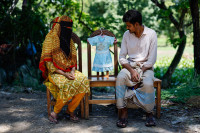
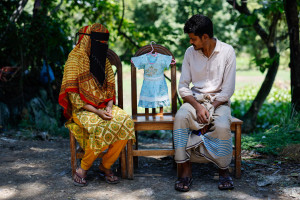
At the holding centre in Pipalatar of Bidur Municipality, five-year-old Yobisa Shrestha was playing on the afternoon of September 8 when she suddenly developed a fever and began vomiting. Her mother Yogita Tamang rushed her to the health camp set up at the centre. But she said the treatment had not helped much.
“When we ask what is wrong, they simply give her paracetamol and send us back. My child has still not recovered,” said Tamang. When Yobisa’s condition did not improve, her mother took her to a private clinic at Battar on September 12 to have her blood tested.
Yogita’s family was among those rendered homeless by the catastrophic Bhotekoshi floods on August 26. The building of Chandrajyoti Secondary School in Pipalatar, Nuwakot, has become a temporary shelter for them and other displaced families.
More than 3,600 flood survivors are staying in 37 holding centres across Rasuwa, Nuwakot, and Dhading districts where water shortages and poor sanitation are raising the risk of disease.
“The bridge to the hospital has not been rebuilt yet,” said Yogita. “We are thinking of keeping her at the clinic in Battar and giving her some medicines. My other daughter, who is 20 months old and staying at the centre, has also been suffering from continuous fever and vomiting.”
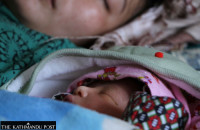
Yogita’s two daughters were not the only ones who fell ill. The six-month-old baby of Kabita Shrestha, aged 20 who is also staying at the same holding centre, has developed a fever. “My sister-in-law’s six-month-old son also developed a fever and was taken to Kathmandu,” said Yogita. “He is still suffering from fever.”
Such illnesses are being reported at several holding centres, although health officials say there is no evidence of a major outbreak.
“There are only patients with colds and coughs, viral fever and mild diarrhoea in some holding centres,” said Anju Karki, chief of the Public Health Office in Nuwakot.
The people’s representatives have reported that the displaced people, mainly the children and elderly, are suffering from various illnesses. Chameli Gurung, vice-chair of Uttargaya Rural Municipality in Rasuwa, said that children at Shivalaya holding centre had also developed viral fever, colds and coughs. “There have been some cases of common cold, cough and fever,” she said.
Dr Niradhwaj Gharti Magar, chief of the Public Health Office in Rasuwa, said health workers were monitoring the situation closely. “We have seen some cases of common cold and cough as well as viral fever,” he said. “Health workers have been deployed and we have asked that patients with cold and cough be kept in isolation. One or two people are currently staying separately.”
According to the National Disaster Risk Reduction and Management Authority (NDRRMA), the holding centres are housing people who lost homes, whose houses became unsafe or who moved to safer locations after the disaster.
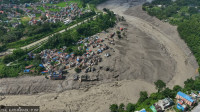
The August 26 flood swept through the Bhotekoshi and Trishuli corridors and devastated settlements and infrastructure downstream. Roads and bridges were washed away, cutting communities off from hospitals and other essential services. The 42-kilometre road between Betrawati and the Rasuwagadhi border crossing was damaged at multiple points, while several bridges were destroyed.
“Patients are still unable to reach the hospital,” said Dr Rajendra Lama, director of Trishuli Hospital. “There is no road. Since the flood washed away the bridge, even patients living five minutes away cannot reach us.”
Water and sanitation are emerging as the most immediate concerns in crowded shelters.
According to the Department of Water Supply and Sewerage Management, 55 drinking water projects in Rasuwa, Nuwakot, Dhading and Gorkha were affected by the floods, with preliminary damage estimated at around Rs640 million.
Nuwakot suffered damage to 22 projects alone. In Bidur, a main pipeline serving around 25,000 to 30,000 people and carrying about 80 litres of water a second was washed away.
“The main project at Phalaku Khola, which supplied drinking water to around 5,000 households in Bidur, was swept away by the flood,” said Kameshwar Das, information officer at the Water Supply and Sanitation Division Office in Nuwakot.
In Rasuwa, however, water sources in the higher areas have suffered relatively little damage, according to Purna Prasad Upadhyaya, chief of the district water supply office.
“There has not been much impact in the higher parts of Rasuwa,” said Upadhyaya. “But most drinking water projects near rivers have been damaged. We have provided pipes to local governments, including Uttargaya, so that temporary supplies can be arranged from local sources.”
Aid agencies have supplied water filters, chlorine, and bottled water to people in holding centres. Water from local sources is being used for cooking, washing clothes and bathing, with local user committees helping manage supplies, said Upadhyaya.
Bidur Municipality has also been using water tankers to supply displaced people.
“First of all, we simply don’t have enough drinking water,” said Sarala Shrestha, information officer at Bidur Municipality. “We are distributing water to the displaced camps through tankers.”
The quality of the water is another concern. Five of 15 water samples collected from different sources in Bidur were found to contain E. coli, a bacterium commonly associated with faecal contamination.
“We collected samples again last week from all the water sources where E. coli had been detected,” said Krishna Prasad Rijal, a senior laboratory technician at the municipality. “The sources were chlorinated as soon as the problem was identified, so there is no problem now.”
The finding prompted authorities to prepare for possible outbreaks of cholera and other waterborne diseases. Officials say subsequent testing indicates that water quality has improved, but they acknowledge that safe sources alone do not guarantee adequate access for displaced people.
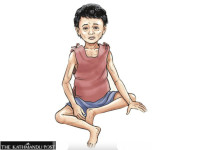
The concern is heightened by the number of children living in the centres. A preliminary assessment by the National Child Rights Council found 1,233 children in holding centres, including 632 girls and 601 boys. Of them, 102 were without parents or relatives, while 439 had been separated from their parents and were being cared for by relatives.
UNICEF has separately estimated that 17,000 children were directly affected by the floods in Rasuwa, Nuwakot and Dhading. Hundreds of students in Rasuwa and Nuwakot remain unaccounted for, while schools have been damaged or converted into holding centres.
Children are particularly vulnerable in crowded shelters, where limited water, sanitation and privacy can increase the spread of infection. But health officials say the situation remains under control.
Historically, major natural disasters worldwide have triggered devastating epidemics. In Haiti, ten months after the massive 2010 earthquake, a massive cholera outbreak infected over 800,000 people and claimed nearly 10,000 lives.
Similarly, devastating floods in Pakistan in 2010 triggered outbreaks of waterborne diseases. Data from the World Health Organisation showed that between July and September 2010, over 5.6 million flood-affected patients were treated in Pakistan, with skin infections (18.3 percent), acute respiratory infections (15.1 percent), and acute diarrhoea (13.3 percent) dominating reported consultations.
However, health authorities in Nepal say no infectious disease or epidemic situation has been seen. “We have only seen patients with viral fever and mild diarrhoea in Nuwakot,” said Karki. “To prevent infections, mosquito nets and sanitation materials have been distributed, and filtration has been facilitated in places where drinking water is contaminated.”
According to Karki, one health worker has been deployed to each of the 25 operating holding centres in Nuwakot. Federal and provincial emergency medical teams also ran ‘rapid health camps’ for seven to 10 days to examine affected people.
Gharti Magar said Rasuwa was likewise under close surveillance. “It is not that a disease has already spread,” he said. “We are monitoring the situation closely. At present, there is no indication of an epidemic.”
The danger, however, extends beyond acute infections. People with chronic illnesses can suffer when roads have been washed away, and medicines and medical records are lost.
Ram Raja Bhandari, health coordinator of Bidur Municipality, said patients with diabetes, high blood pressure, heart and kidney diseases may have missed regular medicines or check-ups.
“Many surviving chronic patients have lost their medicines and prescriptions along with their homes,” said Bhandari. “Those who have lost everything may not have been able to buy their medicines on time.”
Meanwhile, mental health problems can persist long after the disaster, experts warn. People who lost relatives, homes, property and livelihoods are unsure when they can return, whether their homes can be rebuilt, where their children will study and how they will earn a living.
Dr Pomawati Thapa, chief of the Non-communicable Disease and Mental Health Section at the Epidemiology and Disease Control Division, said that children may become fearful, withdrawn, sleep poorly, wake repeatedly in fright or cling to their parents after a disaster.
“Many displaced people have lost relatives, and many have lost everything,” she said. “Losing a loved one in front of your eyes causes enormous pain. They have suffered mental trauma that they may never forget. They need counselling and support for a long time.”
Arjun Poudel is a health reporter for The Kathmandu Post. Before joining the Post, he worked for Sagarmatha Television, Naya Patrika, Republica and The Himalayan Times.




 25.92°C Kathmandu