



 22.96°C Kathmandu

Thu, Oct 15, 2026
Columns
When a glacier collapses across a border, what does international law say?
Under international law, a state does not automatically become responsible just because something goes wrong within its national jurisdiction.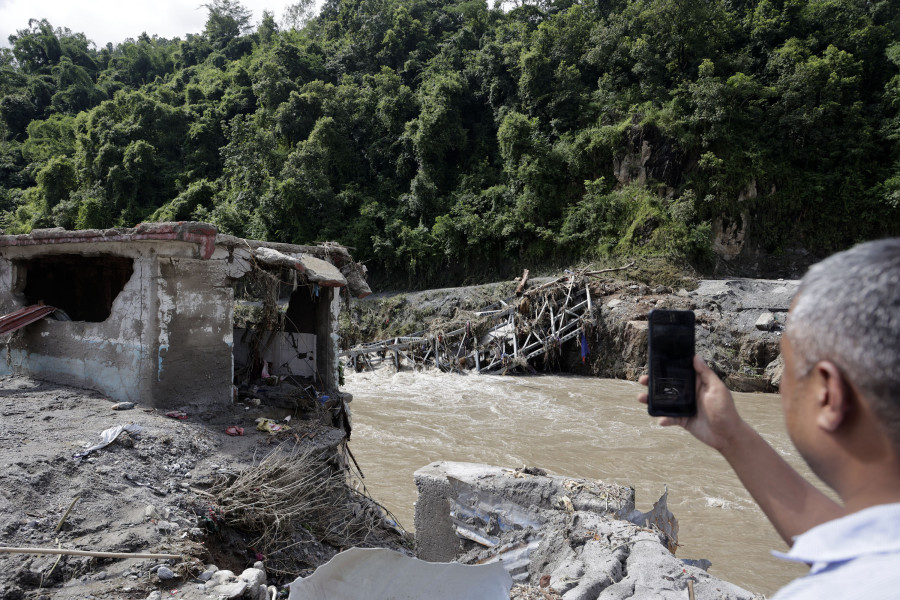
bookmark
Pravesh Shiwakoti
Published at : August 31, 2026
Updated at : September 1, 2026 00:00
The aftermath of the recent devastating flash flood across the Nepal-China border that caused massive loss of life and damage to infrastructure has once again reminded us that nature does not recognise political boundaries. It showed that landslides, glacier collapse, or glacial lake outburst in one country can quickly become a humanitarian and economic catastrophe in another. As the government’s rescue operations continue and many scientists and experts are looking to determine the cause of the disaster, it begs an important question: What happens under international law when a disaster crosses a border?
International law offers a simple answer: Natural disasters are not acts of states but of nature. A natural disaster does not automatically invoke international state responsibility for another country. However, recent developments in international law have moved beyond this understanding. States can have legal obligations to prevent, cooperate and respond under international law.
Transboundary disaster
One of the most well-established foundational principles of international environmental law is the principle of transboundary environmental harm. According to this principle, states must ensure that any activities within their jurisdiction do not cause ‘serious injury’ to other states. This principle was set out in the Trail Smelter Arbitration between the United States and Canada, where the tribunal found that a state may not use or permit the use of its territory in a way that results in ‘serious injury’ to another state.
This was later formalised in Principle 21 of the Stockholm Declaration (1972) and Principle 2 of the Rio Declaration on Environment and Development (1992). Both principles state that states are sovereign in using their own natural resources, but this is coupled with a responsibility to ensure that activities within their control or jurisdiction do not damage the environment of other states. These principles have become central through which international law approaches transboundary international harm.
A natural event occurring within a state’s territory does not ipso facto constitute an internationally wrongful act, as glacier collapse is not an industrial activity. But it is imperative to draw the distinction between causing harm and failing to manage a foreseeable risk. Under the principle of due diligence, international law obliges a state to exercise reasonable care during the time of foreseeable risk of significant harm. In the Pulp Mills on the River Uruguay (2010) case, between Argentina and Uruguay, the International Court of Justice recognised the importance of environmental impact assessment when there is a risk of significant transboundary harm and procedural cooperation where activities may affect other states. In Certain Activities Carried Out by Nicaragua in the Border Area (2015), the International Court of Justice again emphasised the obligation of a state to exercise due diligence to prevent significant transboundary environmental harm.
The principle of due diligence is not based on strict liability. Under international law, a state does not become automatically responsible just because something goes wrong within its national jurisdiction. The emphasis must be on whether the concerned state took all reasonable measures given the circumstances and available scientific evidence to mitigate or prevent such a risk. Such reasonable measures in the Himalayan region may include early-warning systems, monitoring of glaciers and glacial lakes and conducting scientific risk assessments, among others, in the 21st century.
The principle of cooperation, which is especially significant for the Himalayas, is another fundamental principle. The principles of cooperation have been outlined in the United Nations Convention on the Law of the Non-Navigational Uses of International Watercourses (1997). Furthermore, several provisions of the Draft Articles on Prevention of Transboundary Harm from Hazardous Activities (2001) of the International Law Commission emphasise the need for states to take necessary steps to prevent significant harm and to cooperate in risks beyond their national jurisdiction.
Not every natural disaster invokes international state responsibility automatically. Circumstances like the scale of risk, evidence of the scientific information, the foreseeability of harm, and the state’s capacity also should be taken into account. Therefore, the legal question following a transboundary disaster should not be who caused it, but what the States knew, when they knew, what could reasonably have been done, and if information was given to those at risk.
These questions are legally important in the context of disaster management as well. As per the Draft Articles on the Protection of Persons in the Event of Disasters (2016) by the International Law Commission and the Sendai Framework for Disaster Risk Reduction, cooperation and protection of the affected population are central to disaster response. For countries like Nepal, these international environmental law principles should further create stronger mechanisms for scientific collaboration, emergency communication and coordinated disaster response in the days to come.
Climate change and international law
Nepal contributes less than 0.1 percent of total global greenhouse gas emissions and 0.05 percent of global CO₂ emissions. Yet it is among the first to face the consequences of climate change. It is the harsh reality of the current world order that those who contribute least to the problem are hit hardest by its effects. Environmental degradation and climate change threaten basic fundamental rights, including, but not limited to, the right to life, health, food, water and housing. International law is beginning to address this injustice.
In its landmark judgment in KlimaSeniorinnen Schweiz v Switzerland (2024), the European Court of Human Rights ruled for the first time that inadequate climate action constitutes a human rights violation. In the recent Advisory Opinion given by the International Court of Justice on the obligations of states in respect of climate change (2025), the Court established that the right to a healthy environment is a precondition for the enjoyment of many human rights, such as the right to life, the right to health and the right to an adequate standard of living, including access to water, food and housing. The Court created an interdependence between human rights and the protection of the environment.
For mountain communities, the implications are profound, as failure to maintain adequate monitoring systems, provide timely warning, or take reasonable adaptation measures can raise questions about a state’s responsibility to protect fundamental rights of its citizens. Another important lesson from this devastating disaster is institutional rather than legal. The Himalayas are often called the ‘Water Tower of Asia’ and ‘The Third Pole’ as this region contains the largest volume of ice and snow after the Arctic and Antarctic. Despite their natural significance, the region lacks a comprehensive and binding framework concerning glacier monitoring, transboundary climate risks, or disaster response. We lack a comparable legal architecture as other regions have river commissions, basin organisations and regional environmental institutions.
The Himalayas may divide the states geographically, but they unite them through a common vulnerability. As this region faces more transboundary natural disasters, the question is no longer whether international law applies; it is whether states can build the institutions needed to make those legal principles meaningful before the next disaster. The next disaster will not wait for an international treaty. And the next glacier disaster will pay no attention to the map.
Pravesh Shiwakoti
Shiwakoti is a lawyer based in Nepal.


.PNG&w=200&height=120)

Most Read from Columns

Before you take credit for Khula Manch, read its history

Shah went to the UN to speak for Nepal, then left before he could make the most of it

Bhotekoshi flood wasn’t a freak event. It’s the Himalaya doing what it does

Lesson learned after the death of Ronaldo
What Lubra can teach Nepal about climate-induced migration and resettlement
Editor's Picks

Constitutional Bench caught in seniority, ‘pick and choose’ dispute

A Dom boy’s long road to becoming a doctor

From blankets to handmade dolls, two foreign women bring comfort to flood survivors

News Analysis: When institutional defence exposes institutional fault lines

It’s a bird … it’s a plane … it’s the Indian ambassador’s farewell tweets
E-PAPER | October 15, 2026

×