



 15.68°C Kathmandu
Thu, Oct 22, 2026
Columns
What Lubra can teach Nepal about climate-induced migration and resettlement
For Lubra, adaptation is both about surviving hazards and sustaining the community’s relationship with place over time.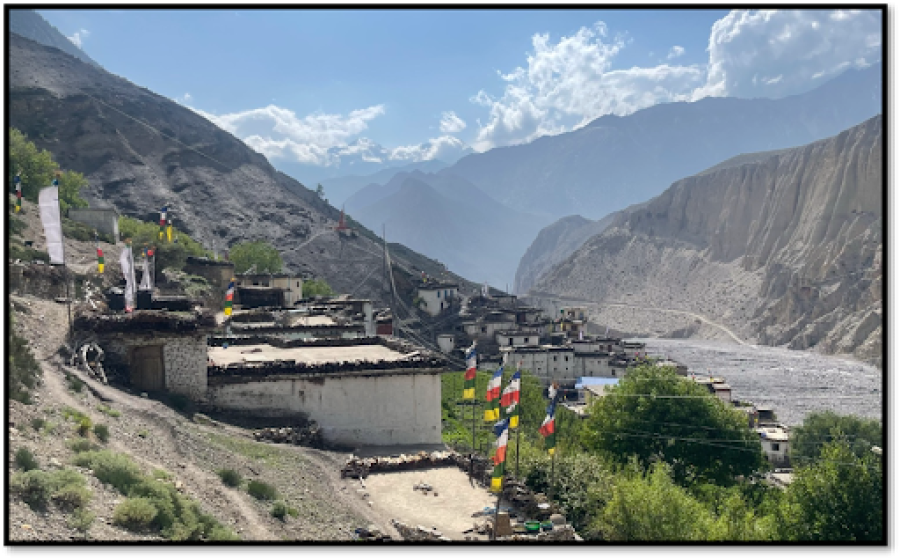
bookmark![]()
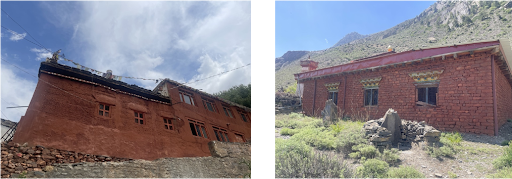
(Left) The new monastery sustaining Bon religious life in the village. (Right) The oldest Bon monastery, central to community identity/Prakriti Joshi ![]()
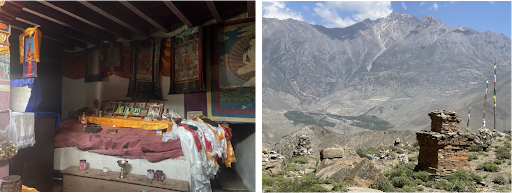
(Left) Interior of the monastery, where Bon rituals and daily prayers sustain spiritual continuity. (Right) Exterior of the monastery/Prakriti Joshi ![]()
The Panda Khola River, a vital water source and growing hazard in Lubra./Prakriti Joshi ![]()
Lower Lubra settlement beside the Panda Khola, where flooding and sediment buildup threaten homes and farmland./Prakriti Joshi ![]()
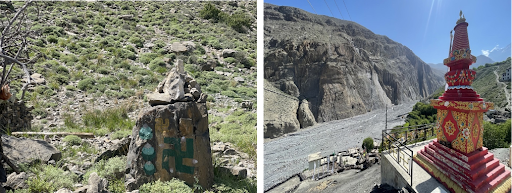
(Left) Traditional Bon religious symbol representing the Bon faith. (Right) The newly reconstructed chorten, rebuilt on higher ground after the original was swept away by the 2019 flood./Prakriti Joshi
Prakriti Joshi
Published at : September 30, 2026
Updated at : September 30, 2026 20:12
In May 2026, I travelled to Lubra, a village at 2,950 metres in Mustang, for my master’s dissertation fieldwork. I explored how its Indigenous Bon community understands its settlement future. What I found challenged the assumption that climate risk automatically leads to migration.
Lubra is an approximately 800-year-old settlement and home to one of Nepal’s remaining Bon communities. Around 40 people remain across nine households, as environmental hazards, outmigration and population decline shape the village’s uncertain future.
But Lubra is more than a collection of houses on a map. Livelihoods, spirituality, memory and identity are rooted in its landscape. Its monastery, chortens, sacred artefacts, traditional homes and farmland are part of the community’s history and its enduring ties to place.
That relationship is becoming increasingly difficult to sustain as the climate changes. Residents described warmer winters, less snowfall and shifting rainfall, changes they are experiencing in their fields, water sources and daily lives.
Nowhere is this more visible than in the Panda Khola.
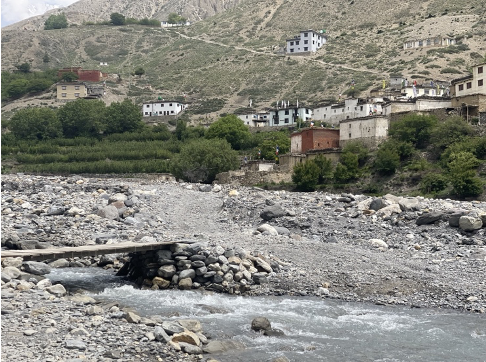
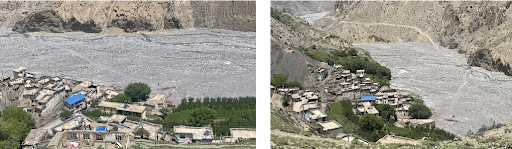
During the monsoon, the narrow Lubra River can swell dramatically, spreading across the valley and carrying sediment, cobbles and large boulders. Residents told me that floods they once experienced every three to five years have, over the past decade, occurred almost every year. Each flood leaves sediment behind. Over time, the riverbed has risen, encroaching on the village and burying agricultural land. Research estimates that it has risen by around 12 metres over the last decade, increasing exposure to homes and community infrastructure.
The 2021 monsoon brought the consequences into sharp focus. Flooding damaged homes and infrastructure and swept away farmland, apple trees and culturally significant objects. Three families sheltered elsewhere for three months before rebuilding uphill.
Yet the response was not simply to leave. Some residents adapted in place, while others moved uphill. Some could imagine relocating eventually but wanted to remain connected to Lubra. Those who moved remained tied to the village through livelihoods, farming and community relationships.
For residents, moving is therefore not simply about finding a safer place to build another house. It raises a deeper question: What happens when a community becomes separated from the landscape that has shaped its history, culture and way of life?
Climate risk does not create a simple choice between staying and leaving. Communities may adapt in place, move locally, diversify their livelihoods, migrate temporarily or relocate. These choices are shaped not only by physical risks, but also by livelihoods, resources, social ties and what people value about home.
What is lost when people move?
Resettlement can seem straightforward: identify a hazard, find safer land, rebuild houses and restore infrastructure. But a community is more than houses.
For Lubra’s Bon community, moving could mean leaving a monastery, agricultural land, memory-filled landscapes and a cultural setting that sustains identity. A new house can be built, but can a new place reproduce what made the old one home?
This does not mean communities should remain where risks are unacceptable or reject necessary resettlement. But safety cannot be the only measure of successful relocation. The question is whether people can rebuild meaningful lives in a new place, considering cultural continuity, spiritual spaces, land rights, livelihoods, social networks and intergenerational ties alongside infrastructure.
In Lubra, the question was not simply where people could go, but what they would leave behind.
Land and belonging
In Lubra, some households have moved uphill as flood risks increase. But safer ground does not always mean secure ownership. Some families have lost or seen farmland buried by floods while it remains registered in their names, leaving them liable for land taxes. Meanwhile, some new house plots lack Lalpurja, the official land-ownership certificate.
Families may escape physical danger yet remain uncertain about secure settlement.
Land is also governed through Gola Pratha in Lubra, a locally recognised allocation system lacking formal legal recognition. Resettlement is therefore about more than safer plots: ownership, land-use rights, customary systems and livelihoods shape lasting security.
The knowledge already exists
My conversations in Lubra challenged the assumption that climate knowledge must come from outside. Residents described changes in snowfall, rainfall, river behaviour and the landscape, knowledge built through generations of living with their environment.
Climate adaptation relies on hazard maps, technical assessments and infrastructure plans. These help measure physical risk but cannot capture everything. A hazard map can show flood exposure, but not what a monastery means to its community. A relocation plan can estimate rebuilding costs, but not the cultural cost of leaving a landscape.
Indigenous and local knowledge therefore cannot be an afterthought. Communities are not merely policy recipients; they are knowledge holders and participants in decisions about their futures.
Rethinking climate-induced mobility
The story of Lubra matters beyond Lubra. Nepal contributes only around 0.1 percent of global greenhouse gas emissions, yet faces growing risks from floods, landslides, glacial lake outburst floods, droughts and heatwaves. As these risks intensify, migration, relocation and resettlement will become increasingly important to climate adaptation.
Moving people away from hazards can create new vulnerabilities. Mobility is rarely a simple move from unsafe to safe places. People may stay, adapt, move locally, migrate temporarily, diversify livelihoods or relocate. Choices reflect environmental risk alongside livelihoods, land rights, social networks and cultural ties.
Where resettlement is necessary, rebuilding should consider land rights, livelihoods, cultural and spiritual spaces, social networks, customary institutions and community participation.
Lubra taught me that these answers cannot come only from maps or plans. They must begin with listening: where people feel safe, want to remain, and what they cannot afford to lose.
Climate change is changing not only where people can live, but also the choices they face about home. Nepal must ensure that when people move, they are not forced to leave identity behind. For Lubra, adaptation is both about surviving hazards and sustaining the community’s relationship with place over time.
Prakriti Joshi
Prakriti Joshi is a development practitioner from Nepal and a 2025/26 Chevening Scholar who completed an MSc in Impact Evaluation for Global Development at the University of East Anglia.



Most Read from Columns

Editor's Picks





E-PAPER | October 22, 2026

×